

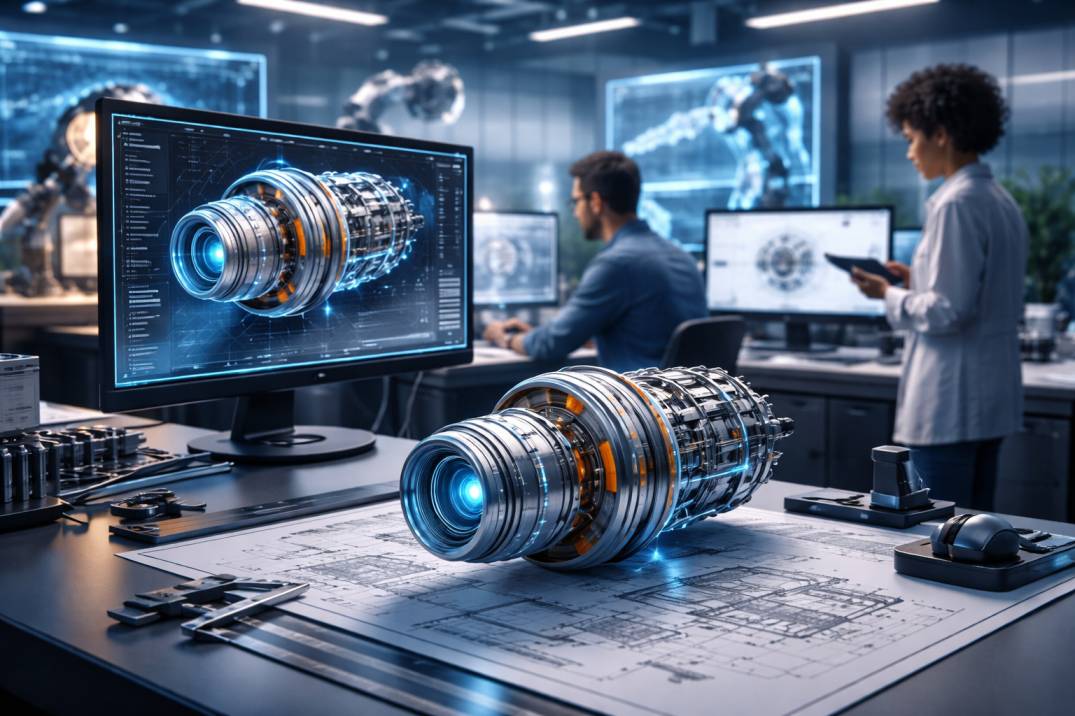
In a fast-paced product environment, speed on its own is no longer enough. Companies are expected to deliver products that are accurate, manufacturable and ready for users, while keeping costs and timelines firmly under control. This is where 3D Modeling Design Services have become a vital driver of modern product development.
From early-stage concept validation to production-ready outputs, 3D modeling is transforming how ideas move from sketches to real-world products. Startups rely on it to test and refine concepts before making major investments, while established manufacturers use it to cut errors, improve collaboration and shorten development cycles. Across the UK, the USA and global markets, 3D modeling has shifted from a “nice-to-have” tool to a strategic necessity.
This article examines how 3D Modeling Design Services speed up product development, the pressures shaping adoption, common implementation challenges and the opportunities ahead.
Why product development teams face growing pressure
Product development has become more demanding than ever. Customer expectations continue to rise, competition is global and time-to-market is often the key differentiator.
Common pressures include:
- Shorter product lifecycles
- Increasing design complexity
- Greater demand for customisation
- Rising prototyping and manufacturing costs
- Distributed, cross-functional teams
Traditional workflows often struggle to keep pace. Iterations take longer, miscommunication increases and costly errors are discovered too late. 3D modeling addresses these challenges by creating a shared digital foundation that supports every development stage.
What 3D Modeling Design Services deliver
3D Modeling Design Services focus on creating precise digital representations of products using advanced CAD software. These models capture geometry, dimensions, materials, tolerances and assembly relationships.
In product development, 3D models are commonly used for:
- Concept visualisation
- Engineering validation
- Rapid design iteration
- Virtual testing and simulation
- Prototyping and manufacturing planning
Unlike static 2D drawings, 3D models are dynamic and data-rich. They evolve with the product, reducing uncertainty and enabling better decisions earlier in the process.
How 3D modeling shortens development cycles
One of the most significant advantages of 3D modeling is its ability to compress timelines without compromising quality.
Faster concept validation
Designs can be visualised in realistic detail within days rather than weeks. Stakeholders can review concepts from all angles, identify issues early and provide feedback before resources are committed, reducing downstream rework.
Rapid iteration without physical prototypes
Instead of producing multiple physical prototypes, teams can digitally adjust dimensions, test alternative materials and evaluate several design options in parallel. This flexibility accelerates iteration while keeping costs under control.
Improving design accuracy and reducing risk
Accuracy underpins successful product development. Even minor design errors can lead to production delays, wasted materials or performance issues.
3D Modeling Design Services improve accuracy by:
- Maintaining precise dimensions and tolerances
- Identifying clashes between components
- Ensuring correct fit and assembly relationships
- Reducing misinterpretation associated with 2D drawings
Industry studies consistently show that organisations using 3D CAD experience far fewer late-stage design changes than those relying primarily on traditional methods.
Strengthening collaboration across teams
Modern product development is inherently collaborative. Designers, engineers, manufacturers, suppliers and clients all need to work from the same information.
3D models act as a single source of truth, enabling:
- Clear communication across disciplines
- Seamless collaboration between local and remote teams
- Better alignment between design intent and manufacturing requirements
- Faster stakeholder approvals
Rather than interpreting written specifications, teams can interact directly with the model, improving clarity and speeding up decisions.
The role of 3D modeling in prototyping
Prototyping is often one of the most expensive and time-intensive phases of development. Poor preparation leads to wasted materials and extended timelines.
Accurate 3D models allow businesses to:
- Produce precise prototypes using CNC machining or 3D printing
- Validate form, fit and function before mass production
- Reduce the number of physical prototypes required
As a result, many organisations now adopt a digital-first prototyping approach, carrying out most testing virtually before building physical models.
Integrating simulation and testing
A major strength of modern 3D workflows is integration with simulation tools. Engineers can assess performance before manufacturing begins.
Typical simulations include:
- Stress and load analysis
- Thermal performance evaluation
- Motion and kinematic studies
- Material behaviour under varying conditions
These insights highlight weaknesses early, reducing the risk of failure and costly redesigns. In complex projects, digital simulation can significantly lower overall prototyping costs.
Industries gaining the most value from 3D modeling
While 3D modeling is now widespread, some sectors rely on it particularly heavily:
- Manufacturing and industrial products: improving manufacturability and assembly efficiency
- Consumer products: balancing aesthetics, ergonomics and production constraints
- Automotive and aerospace: managing complex assemblies and strict compliance requirements
- Architecture and engineering: coordinating products within built environments
Across the UK and USA, many organisations now view 3D Modeling Services as a core capability rather than a specialist add-on.
Common challenges when adopting 3D modeling
Despite its benefits, adoption can present obstacles, including:
- Learning curves for advanced CAD tools
- Integration with existing processes
- Data management and version control
- Aligning design intent with manufacturing realities
These challenges are usually short-term. With the right expertise and workflows, organisations quickly realise long-term gains in efficiency and product quality.
The evolving role of a 3D modeling company
Today, a 3D Modeling Company offers far more than geometry creation. Modern providers increasingly act as strategic partners, supporting:
- Design-for-manufacturing (DFM)
- Design-for-assembly (DFA)
- Custom and configurable product designs
- Scalable modeling for product families
As products grow more complex, external expertise helps businesses maintain speed and precision without overburdening internal teams.
Trends shaping the future of 3D Modeling Design Services
The CAD and drafting landscape is evolving rapidly, particularly in advanced markets such as the UK and USA. Key trends include:
- Cloud-based collaboration and model sharing
- Integration with digital twins and smart manufacturing
- AI-assisted design optimisation
- Greater use of parametric and configurable models
These developments are making 3D modeling more accessible, scalable and impactful across industries.
Why startups rely on 3D modeling
For startups, errors are expensive. 3D Modeling Design Services enable young businesses to validate ideas early, present concepts clearly to investors and prepare for manufacturing from the outset. By reducing uncertainty, 3D modeling helps smaller teams compete with larger players on innovation and speed.
Supporting sustainable product development
Sustainability has become a core requirement. 3D modeling contributes by reducing trial-and-error prototyping, supporting lightweight design strategies and minimising material waste during manufacturing. Better decisions at the design stage lead to more sustainable outcomes throughout the product lifecycle.
Final thoughts
Modern product development depends as much on clarity and collaboration as it does on creativity. 3D Modeling Design Services provide the digital backbone needed to accelerate timelines, reduce risk and deliver better products.
By improving accuracy, enabling collaboration and supporting informed decision-making, 3D modeling has become a cornerstone of product development across industries. As digital transformation continues, many businesses choose experienced partners, such as established UK-based CAD drafting and design companies, to support scalable, high-quality workflows without slowing innovation.