

The numbers paint a sobering picture of modern agriculture. Between 2000 and 2022, the proportion of the global workforce engaged in farming plummeted from 40 per cent to just 26 per cent, according to the Food and Agriculture Organization. Meanwhile, demand for food continues its relentless climb, creating a widening gap that threatens food security worldwide.
It’s against this backdrop that Yanmar Holdings, a Japanese industrial equipment manufacturer with roots stretching back to 1912, is rolling out a suite of technologies designed to reconcile productivity demands with environmental sustainability. The company’s approach combines autonomous farming machinery with renewable energy systems, targeting both the labour shortage and climate pressures simultaneously.
The scale of the challenge becomes clearer when examining global farming patterns. Five out of every six farms worldwide operate on less than two hectares, yet these smallholdings collectively produce more than a third of the world’s food supply. These operations face mounting pressures from climate volatility, resource constraints, and the physical demands of manual labour on difficult terrain.
Yanmar’s response includes the YV01, an autonomous vineyard robot engineered to navigate steep and uneven landscapes where traditional machinery struggles. The machine handles precise operations whilst reducing the physical toll on workers—a critical consideration as the agricultural workforce ages and shrinks in many developed nations.
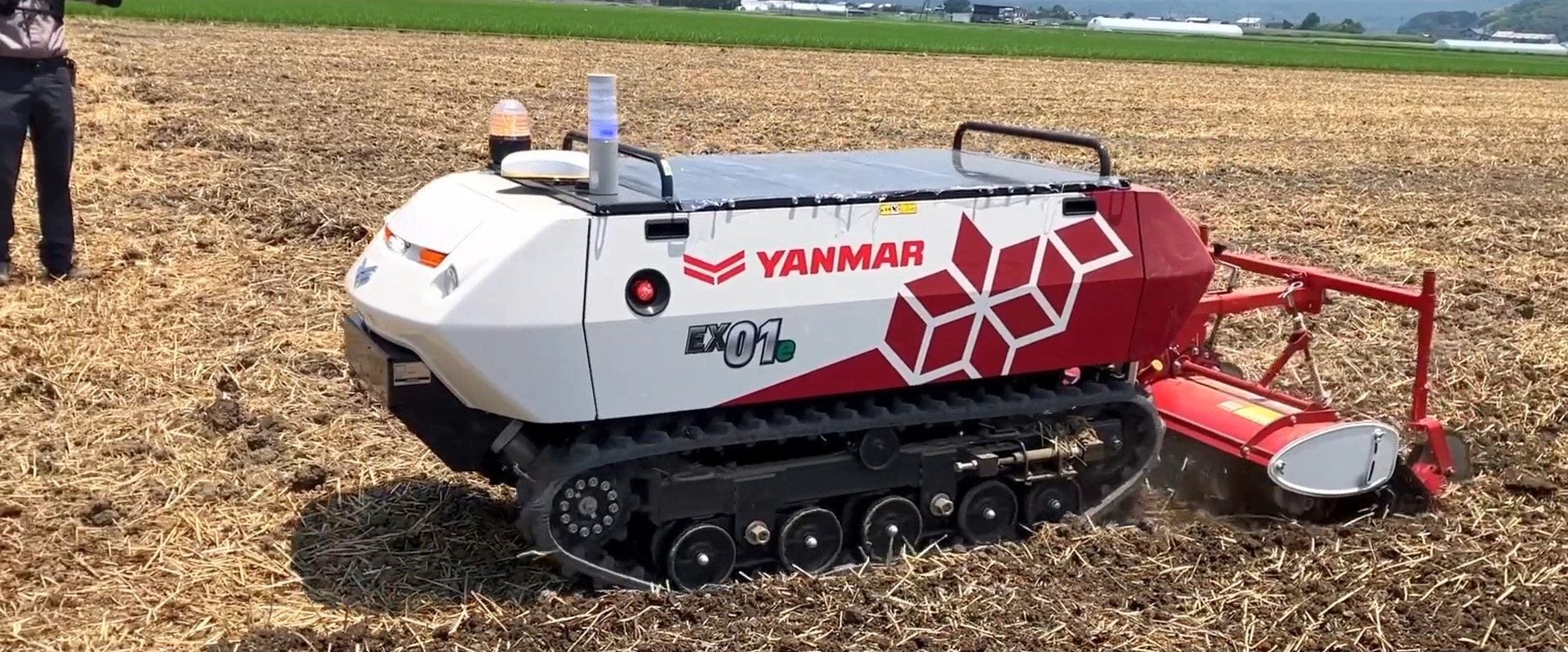
Further along the development pipeline sits the e-X1, a fully electric autonomous agricultural machine currently advancing through testing phases ahead of market monitoring scheduled for 2025. The equipment represents the company’s push toward electrification in farming, promising lower emissions alongside operational efficiency gains.
Shigemi Hidaka, who heads agribusiness research and development at Yanmar, frames the technological mission in terms that extend beyond mere output. “Yanmar’s mechanization technology will increase productivity and yields, but this will be pointless unless we also realize sustainable agriculture. We need to think from both sides and realize both increased production and a sustainable environment.”
Kemal Shoshi, president of the company’s agribusiness division, echoes this dual focus. “The problem with agriculture now is not only production volume, but climate change, drought-we are facing a lot of challenges that we need to support through our mechanization technology.”
These sentiments align with the company’s YANMAR GREEN CHALLENGE 2050, an environmental commitment targeting zero greenhouse gas emissions across all business activities, supplier networks, and customer operations by mid-century. The initiative drives development across clean energy systems, electrified equipment, circular resource approaches, and what the company terms “regenerative environmental initiatives.”
One such initiative, Save the Farms by Yanmar, applies agrivoltaic principles to revitalise underutilised agricultural land. The model installs solar panel arrays above working farmland, allowing simultaneous crop cultivation and renewable energy generation. Revenue from electricity production flows back to farmers, creating an additional income stream that could make farming more economically attractive to younger generations.
Kenichi Tanaka, who leads the project, articulates its broader ambition. “Save the Farms by Yanmar connects agriculture to the future. We are planning to install solar power generation equipment and return the profits to farmers. Our hope is that farming will become a career the next generation will aspire to.”
The agrivoltaic approach has gained traction in Europe and the United States, where it’s increasingly viewed as a climate adaptation measure rather than simply an energy project. Proponents argue the dual-use systems enhance land resilience whilst supporting energy transition goals and providing economic stability for rural communities.
By integrating capabilities across agriculture, energy infrastructure, and engineering, Yanmar positions itself as offering complete systems rather than isolated products. This convergence aims to strengthen regional food security whilst enabling more efficient energy utilisation and supporting local economies.
The company’s sustainability focus connects to its founding philosophy. “A Sustainable Future – New Value Through Technology,’ a statement which reflects the philosophy of Yanmar’s founder Magokichi Yamaoka, guides employees’ actions. We deliver this every day so every part of society can benefit from our technology and environmentally friendly solutions,” Shoshi explains.
Yanmar’s industrial heritage provides context for its current direction. Established in Osaka in 1912, the company achieved a breakthrough in 1933 when it became the first manufacturer to successfully produce a compact diesel engine of practical dimensions. That pioneering work in engine technology laid foundations for what has evolved into a diversified industrial group.
Today the company operates across seven business domains spanning small and large engines, agricultural machinery, construction equipment, energy systems, marine applications, machine tools, and component manufacturing. Operations extend globally, with solutions deployed on land, at sea, and in urban environments.
The convergence of robotic automation, electrification, and renewable energy integration represents Yanmar’s interpretation of how technology can address interconnected challenges in food production, climate mitigation, and rural economic vitality. Whether these systems can scale sufficiently to address the labour crisis whilst delivering on environmental commitments remains to be demonstrated through market adoption.
What appears clear is that the company views sustainability not as a constraint on productivity but as inseparable from it—a perspective shaped both by market realities and the environmental targets it has committed to meet within the next quarter-century.