

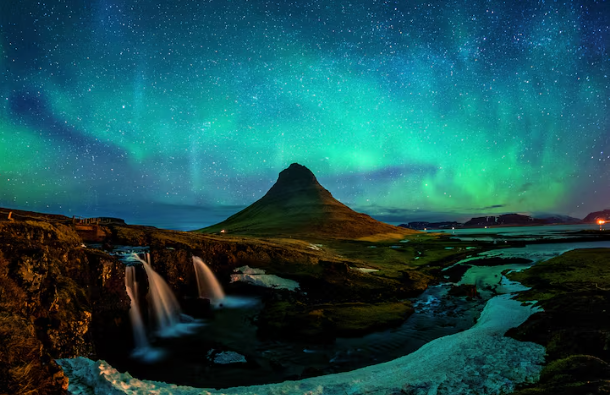
People frequently venture outside and stare north just after nightfall, not because they anticipate seeing anything but rather because they have heard they might. The northern lights aurora borealis forecast becomes more of an expectation than a guarantee on evenings like today.
Discussions have changed slightly around New England. Apps for the weather are used increasingly frequently. For something that seems less predictable, such as cloud cover or geomagnetic indices, rather than rain or snow. A moderate geomagnetic storm, or G2 event, is predicted to be strong enough to drive the aurora farther south than usual, at least in theory. However, “on paper” doesn’t necessarily transfer into actuality.
Northern Lights Aurora Borealis Forecast: Waiting for the Sky to Change
| Element | Information |
|---|---|
| Event | Geomagnetic Storm (G2 Level) |
| Cause | Coronal Mass Ejection (Solar Activity) |
| Best Viewing Areas | Northern U.S., New England, Canada |
| Peak Timing | Wednesday night into Thursday |
| Key Conditions | Clear skies, low light pollution |
| Common Colors | Green, pink, purple |
| Reference Website | https://www.swpc.noaa.gov |
At least in theory, the science underlying it is simple. A solar energy outburst known as a coronal mass ejection has been moving in Earth’s direction, bringing with it charged particles that interact with the planet’s magnetic field. Light is created when such particles clash with nitrogen and oxygen in the upper atmosphere. When the conditions are ideal, that light turns into the aurora borealis.
It’s difficult to ignore the subtle emotional shift from something so scientific. People gazing at the same expanse of sky while standing in parking lots, backyards, and deserted roads. waiting.
Because of the high concentration of oxygen in the atmosphere, green is the most prevalent hue. Although they are frequently more difficult to observe, reds and purples emerge at different elevations. Modern cellphones in particular sometimes have cameras that capture more information than the human eye can. On a screen, what appears to be a light gray haze in real time can become vibrant color streaks. This is surrounded by a little but expanding ritual. The phones remained stable. Night mode has been turned on. A sort of subdued patience taking hold.
The odds are higher in New England’s northern regions. The area where these lights emerge, known as the auroral oval, is more likely to become visible the further north you travel. However, nothing is certain even there. Whether the energy from this specific solar flare will precisely match viewing circumstances is still up in the air. As usual, clouds make things more difficult.
Parts of the western and northern areas are expected to see an increase in cloud cover. Just enough to raise questions, but not enough to rule out the idea. In this situation, skepticism too becomes a part of the experience.
That uneasiness has a familiar quality. It is similar to how people interact with nature in general today—armed with information, forecasts, and alerts, but nevertheless reliant on chance. You can use technology to determine when to look. It cannot guarantee what you will see.
Experts in space weather and meteorology are keeping a careful eye on the situation. The initial enthusiasm was caused by the G2 storm watch issued by the Space Weather Prediction Center. This level indicates that visible auroras may occur farther south than normal, though this is not a given.
Similar predictions have produced inconsistent outcomes in the past. On certain nights, the sky is filled with vibrant fireworks. Others just provide subtle glows that are hardly detectable unless you know what you’re searching for. And occasionally, nothing shows up at all even though all the signs are in line.
As you watch this happen, you get the impression that it’s more than just the lights. It’s about the potential. The notion that, above familiar locations, something extraordinary could occur in silence.
People are looking for darker areas of the sky in suburban areas where lamps typically dominate the night. Parks, wide-open spaces, the town limits. Anywhere you can see the north more clearly.
These nights are frequently defined by a single moment. waiting while remaining motionless and staring up. The sky doesn’t instantly alter. If it does change, it does so gradually. A slight change in color. A faint motion that could initially be imagined. Then, occasionally, it comes to pass.
One of those times might be delivered by this specific prognosis. At least some of the prerequisites are present. The time, the geomagnetic reaction, and solar activity. However, there’s also a feeling that something might go slightly off course.
The outcome is still unknown even as alerts are distributed via apps, social media, and word-of-mouth. People will go outside, gaze north, and bide their time. It will be seen by some. Some won’t.
The way that this combines science with something that is practically older than science is difficult to ignore. Long before satellites and prediction algorithms, people have been observing the aurora for centuries. It was mysterious back then. It can now be measured. However, the experience hasn’t really altered.
There could be something strange in the sky over some sections of New England by late Wednesday night or early Thursday. Or it might not. The clouds could get thicker. The solar energy may get weaker. Perhaps the time is off. However, the potential exists at least for a few hours.
And occasionally that’s enough to get people outdoors, where they stand silently beneath a pitch-black sky, observing, and waiting for a trace of color that might or might not appear.