

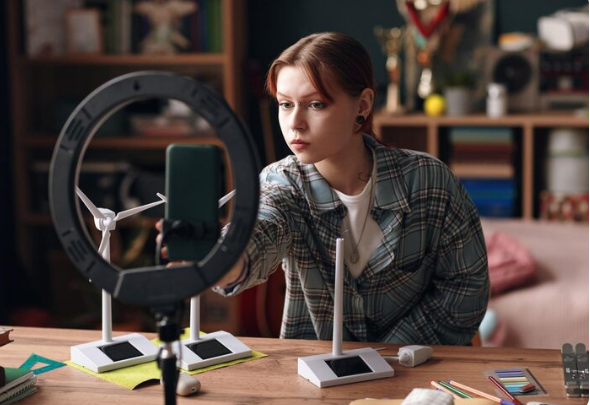
Imagine a young woman filming a sixty-second video explaining Roth IRA contribution limits or the distinction between a growth ETF and a dividend fund while seated in her apartment, most likely in an area with some natural light and perhaps a bookshelf placed purposefully in the background. Not in a studio. No teleprompter.
The script is not reviewed by the compliance department prior to distribution. All she has is a phone, an algorithm that determines whether her content reaches 10 or ten million people, and a ring light if she invested in the setup. In 2026, a sizable percentage of Americans under thirty will receive financial education in this way, and the women spearheading it have amassed audiences that, if they paused to compare the numbers honestly, would legitimately unnerve the creators of traditional financial television shows.
Key Reference & Industry Information
| Category | Details |
|---|---|
| Topic | Gen Z Women’s Influence on Finance TikTok (FinTok) and the Financial Industry |
| Platform | TikTok — short-form video (15–60 seconds) |
| Key Hashtags | #FinTok (42.6M+ views), #StockTok (97.4M–254M+ views), #Investing (1B+ views) |
| Legacy Comparison Figure | Jim Cramer — Mad Money, CNBC (~200,000 daily viewers) |
| New Media Equivalent | Roaring Kitty, BitBoy — YouTube/social finance creators |
| Audience Size Context | YouTube: 2 billion users, 40 million channels |
| Key Demographic Driver | “Zillennials” and Gen Z — raised on social media, motivated by financial anxiety |
| Regulatory Concern | FCA and U.S. regulators flagging unregulated financial advice on TikTok |
| Cultural Context | Pandemic-era investing boom; student debt pressure; algorithmic content delivery |
| Industry Shift | Direct creator-to-audience model replacing traditional media intermediaries |
| Reference Website |
FinTok, a loose constellation of financial content with hashtags like #fintok, #stocktok, and #investing, has been quietly growing for a number of years. During the pandemic, millions of young people were given the resources and the incentive to start paying attention to how money actually works due to a combination of stimulus money, time spent at home, and an abruptly volatile market.
On TikTok, the hashtag #investment alone has received more than one billion views. Over 254 million people have visited #StockTok. These figures are not specialized. They have a much larger viewership than Jim Cramer’s Mad Money on CNBC, which attracts about 200,000 viewers every day, or about the same as a mid-tier YouTube channel. The contrast is supposed to serve as a warning that the distribution landscape has changed in ways that legacy financial media has been reluctant to completely embrace, rather than to disparage Cramer, who created something genuine and long-lasting.
In a field that has historically been dominated by a very specific archetype—loud, self-assured, typically male, performing certainty about markets with the kind of theatrical authority that the Jim Cramers and BitBoys of the world perfected—the Gen Z women angle is particularly intriguing because of the combination of scale, credibility, and cultural positioning they have developed.
Women that use FinTok to grow audiences typically do it in diverse ways. Instead than emphasizing hot selections and short-term trading excitement, the tone is more conversational, more honest about uncertainty, and more focused on core literacy—explaining index funds, budgeting systems, and the compounding reasoning behind early investing. That strategy is more responsible and, it turns out, more appealing to a group of young women who have traditionally regarded financial media to be either irrelevant or alienating to their real situation.
Here, TikTok’s algorithmic structure matters in ways that are simple to overlook. TikTok’s algorithm displays material based on engagement signals, unlike YouTube, which promotes search optimization and channel loyalty. This means that a creator with no following can reach hundreds of thousands of people on a single video if the content resonates with its initial viewers.
In the banking industry, this mechanism has been truly democratizing; no resume needs to impress anyone, no media firm gatekeeping access, and no credentials are needed. During and after the pandemic investment boom, some of the most popular finance makers on the platform grew their followers nearly entirely in the last two years, starting from nothing and reaching follower counts that would be indicative of respectable careers in traditional media.
The regulatory community has been observing all of this with a mix of confusion and worry. The proliferation of financial tips on social media has been identified by the FCA in the UK and several U.S. financial regulators as an issue that needs to be addressed, raising concerns about the distinction between unlicensed investment advice and financial literacy information.
In a sixty-second film that discusses why someone would think about maxing out their 401(k) before opening a brokerage account, the distinction is important legally, but it does not accurately reflect what actually occurs. The majority of FinTok founders firmly operate on the education side of the spectrum, which contributes to the regulatory hand-wringing’s inability to identify a clear target. People who were never taught the fundamentals of compound interest in school cannot be successfully regulated.
Observing the growth of this field gives me the impression that the Gen Z women creating finance audiences on TikTok are doing something that has genuine value beyond view counts; they are reaching people who would never visit a bank branch or make an appointment with a financial advisor, people for whom the conventional infrastructure of money management was always either unwelcoming or inaccessible.
It’s still uncertain if their viewers will ultimately benefit financially from that reach. However, the alternative—no financial literacy materials, no clear explanations of fundamental ideas, and no peer-to-peer discussion about money—was also not working well. The issue was not caused by the women at FinTok. They simply arrived with a phone and began discussing it.