

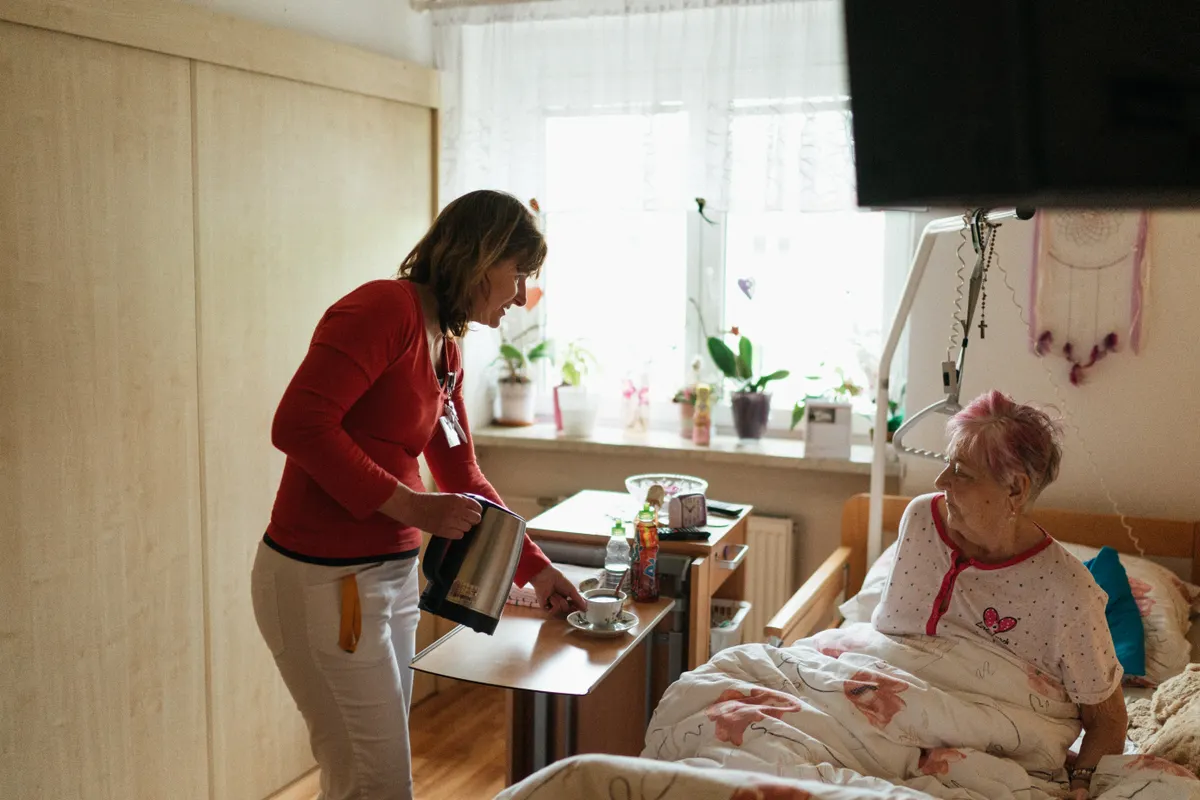
Home health aide work in college offered Careb Bien-Aime something most student jobs do not: genuinely flexible hours, a certification that took one week to earn, and a wage of $19.15 an hour at one of the agencies he worked with. Now 23 and studying information systems management at New York University, Bien-Aime has since moved on, but his account of the role cuts through the romanticised and the grim in equal measure.
Getting into home health aide work in college
Bien-Aime came to the job through his mother, a certified nursing assistant, and through the Haitian community he grew up in, where home care work is common. When he was at community college and needed income that would bend around his timetable, she pointed him towards a personal care aide (PCA) certificate.
In New York State, a PCA training programme approved by the state Department of Health requires a minimum of 40 hours of basic training, according to CDPAP-NY. Bien-Aime completed his in one week, attending in-person classes for eight hours a day, and began taking cases shortly after. A full home health aide certification, by contrast, carries a higher bar: at least 75 hours of instruction and 16 hours of direct skills observation under New York rules, as outlined by the 1199SEIU Home Care Industry Education Fund.
Once qualified, he shaped the work entirely around his schedule, sometimes taking three shifts a week, occasionally picking up 12-hour days when money was tight, and accepting live-in cases lasting one or two full days when it suited him.
The pay, the physical strain, and the emotional weight
At $19.15 an hour, Bien-Aime was earning above the national median. The U.S. Bureau of Labor Statistics (BLS) Occupational Outlook Handbook puts the 2024 median annual wage for home health and personal care aides at $34,900, equivalent to $16.78 an hour. The lowest 10 per cent earned below $25,600; the highest 10 per cent earned above $44,190. His rate sat comfortably in the upper half of that range for a student doing shift work.
His duties covered hygiene, meal preparation, and mobility assistance, including transfers using a Hoyer Lift, a hoist device he described as operating like a parachute that raises a patient from a bed. Not every case was physically demanding: some clients were mobile and simply needed company or a meal cooked. But on harder cases, the cumulative toll was real. ‘One agency paid me $19.15 an hour. I think the pay was decent, but it could be more because people don’t realize caregiving is a lot of work,’ he said. ‘Emotionally, physically, you’re caring for a human being, and it does take a lot out of you to take care of someone, especially if the person needs more help.’
His first long-term client, with whom he worked for roughly a year, died. That kind of loss is woven into permanent cases, where a carer sees the same person every week and a relationship builds naturally.
He left one of his agencies in April 2025, began earning income through social media sponsorships around the same time, studied abroad in August, and did not return to home care work afterwards. His career goals lie in technology, not healthcare.
A sector growing faster than almost any other
Bien-Aime’s observation that demand for home health aides is driven by families unable to care for ageing parents on their own is backed by the employment data. The BLS projects home health and personal care aide employment to grow 17 per cent between 2024 and 2034, far above the average across all occupations, adding roughly 739,800 jobs and generating about 765,800 openings a year over the decade.
As of May 2024, home health and personal care aides had become the single largest occupation in the United States, with 4 million workers, surpassing retail salespeople and fast food counter workers, each at 3.8 million, according to McKnight’s Home Care citing BLS data.
New York is at the heart of that concentration. As of May 2023, 60 out of every 1,000 jobs in the state were in the home health and personal care aide occupation, more than double the national average of 24 per 1,000, making New York the state with the highest density of these workers in the country, according to BLS data published by the BLS Economics Daily.
For students weighing the option, Bien-Aime’s advice is direct: the job suits those who are patient and compassionate, works well around a flexible timetable, and is particularly useful for anyone heading into nursing or healthcare. It is not, he says, a role where you can walk away from a difficult day mid-shift. The client still needs care regardless of how the carer feels.
With nearly 766,000 openings projected annually across the decade, the question for students is less whether the work is available, and more whether they can handle the days when it weighs heaviest.