
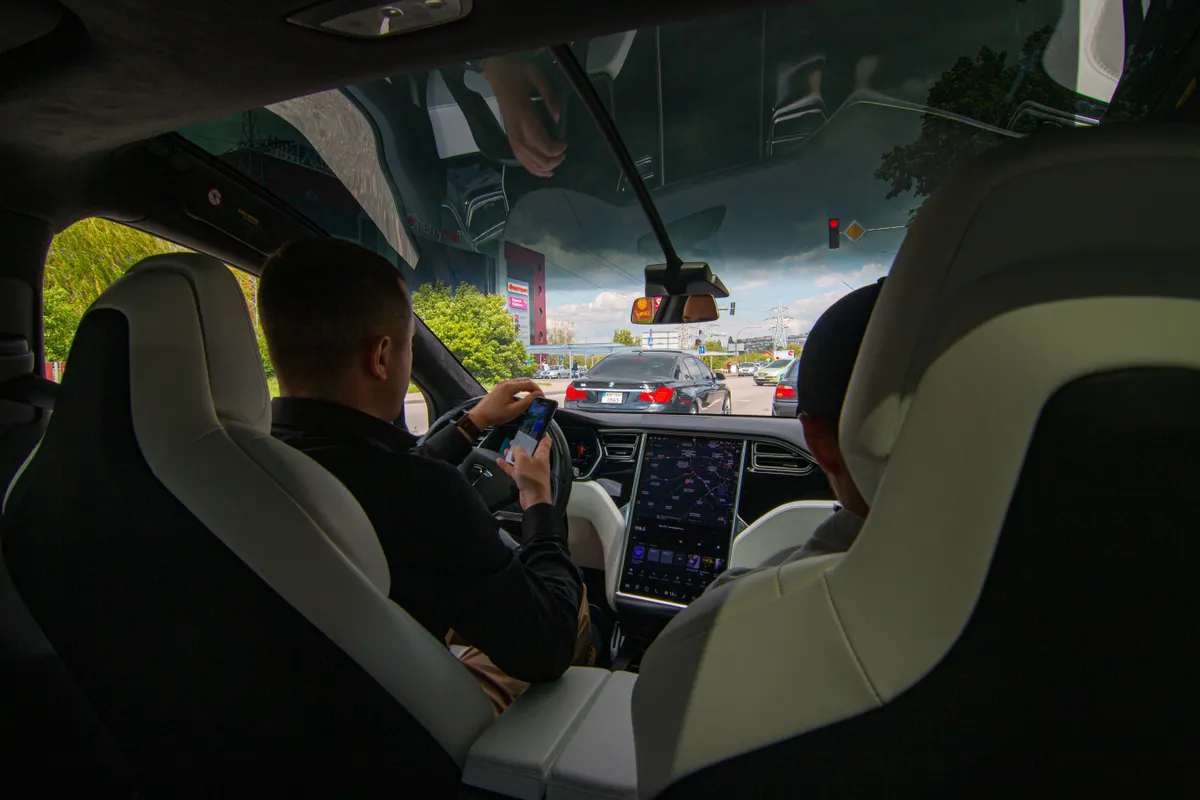
A National Highway Traffic Safety Administration (NHTSA) Tesla FSD investigation has formally demanded answers from the company over a series of social-media posts in which chief executive Elon Musk encouraged drivers to text and make espresso while the automated driving system was engaged.
In a letter sent to Tesla on 2 July, NHTSA officials asked the company to clarify whether those posts accurately represented the technology’s capabilities and whether Tesla had taken any steps to prevent misuse. The letter, formally designated Engineering Analysis EA26002, Information Request ID EA26002-01, was addressed to Eddie Gates at Tesla’s Fremont, California headquarters and invokes the agency’s investigative authority under 49 U.S.C. § 30166.
Among the posts cited is one from December 2025 in which Musk said FSD users could text and drive ‘depending on [the] context of surrounding traffic.’ Another, in which Musk responded to a video of a Tesla owner reclining his seat and operating an espresso machine while the system was active, read: ‘Make your espresso on the road while your Tesla drives itself.’ NHTSA also flagged posts stating that FSD can ‘operate in all conditions’ and that an update will ‘substantially reduce’ the need for driver attention.
Tesla Assist Chatbot Also Drawn Into Tesla FSD Investigation
The scrutiny extends beyond Musk’s personal posts. A separate NHTSA information request asked Tesla to clarify whether its in-car chat feature, Tesla Assist, accurately represents the system’s limits. When queried about Full Self-Driving, the chatbot reportedly tells users the feature ‘is designed to be able to conduct short and long distance trips with no action required by the person in the driver’s seat,’ a characterisation regulators are questioning.
Tesla’s own documentation tells a different story. The company’s website and owner manuals state that Full Self-Driving (Supervised) requires drivers to pay attention to the road and be ready to take over at all times. The Tesla Model X Owner’s Manual details an enforcement mechanism in which a driver who receives five inattentiveness warnings, each triggering a suspension of the system for that trip, is locked out of Full Self-Driving (Supervised) for a week. The system itself can be activated at any speed below 85 mph (140 km/h), including when stationary.
NHTSA asked Tesla to explain the discrepancy between those public-facing messages and both the manual’s guidance and the posts from Musk and the company’s own accounts. Regulators want to know whether the examples cited were ‘accurate and consistent’ with FSD’s real-world performance.
A Pattern of Legal and Regulatory Pressure
This is not Tesla’s first encounter with regulators and courts over how it markets its driver-assistance systems. A California judge ruled that the ‘Autopilot’ and ‘Full Self-Driving’ branding was misleading, and Tesla struck a deal to avoid a ban in that state in February. Separately, Tesla was ordered to pay $242 million in damages in a wrongful-death lawsuit that alleged its advertising exaggerated the capabilities of Autopilot, FSD’s predecessor.
The engineering analysis now under way was first opened in October 2024 and upgraded in March. It centres on FSD’s ability to alert drivers in low-visibility conditions, following reports of collisions in areas where visibility was reduced by sun glare, fog, or airborne dust.
Tesla markets Full Self-Driving as a system trained on what amounts to more than 100 years of anonymous real-world driving scenarios drawn from a fleet of over six million vehicles, according to the Tesla FSD product page. The feature is currently available in the United States, Canada, China, Mexico, Puerto Rico, Australia, New Zealand, and South Korea. Tesla did not respond to a request for comment.
The response deadline in NHTSA’s information request will determine the next stage of the probe: if Tesla’s answers satisfy regulators, the analysis could close; if not, the agency retains authority to escalate toward a recall investigation.