

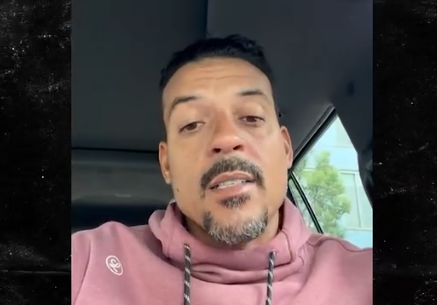
Although Matt Barnes has never shied away from controversy, this time the drama wasn’t brought on by heated arguments or altercations on the court. Instead, he became the focus of a widely shared allegation that he was the most recent artificial intelligence victim, having been defrauded of $61,000 by an attractive AI-generated model on a dating app. Because the narrative was so strange, it spread like wildfire thanks to podcast rumors and online rumors.
Barnes had had enough by December 8, 2025. He used Instagram to adamantly refute the reports, speaking straight into his phone’s camera with the same straightforward manner that fans recall from his playing days. “Trash,” he murmured. “Lies on the internet” He rejected the idea that he had fallen for an AI scammer—and most definitely wasn’t suing one—in a tone that was both worn out and defiant.
(Matt Barnes – Background)
| Name | Matt Barnes |
|---|---|
| Profession | Former NBA Player, Sports Analyst |
| Age | 45 (as of 2026) |
| Known For | 14-season NBA career, ESPN analyst |
| Recent News | Denied rumor of AI dating scam |
| Public Link |
His brief video, which lasted just under three minutes, was really powerful. He confronted what he described as a year of fabrications head-on, flipping the script on digital speculation with forceful language and a splash of frustrated comedy. He claimed, “I’ve watched the internet lie about me the whole year,” citing anything from outrageous rumors about abortion and reality TV drama to untrue statements about his sexual orientation.
Nor was this a coincidental spark for a gossip mill. Gilbert Arenas, a longtime friend and former NBA player, had exacerbated it by repeating the untrue claim in a podcast episode. Barnes disclosed that he had personally contacted Arenas to express his displeasure that such a strange assertion could be made public without even a text message to confirm it. Arenas expressed regret, but the harm had already been done. Even though there was no reality to the AI lawsuit narrative, it had legs.
Barnes was irritated by the lazy churn of content as much as by the embarrassment to himself. He harshly criticized “bottom of the barrel” sites for their propensity to post unconfirmed rumors in order to garner attention. His words were unvarnished, often vulgar, but intensely impassioned. It was the candor of someone weary of tidying up digital messes made by others, not the polish of a PR statement.
To put it in perspective, the $61,000 amount wasn’t unexpected. In 2023, Barnes admitted to being the victim of a true extortion case in which a human woman threatened to broadcast his private affairs unless he paid. In a previous statement, he indicated he was taking legal action and acknowledged paying her the money. However, artificial intelligence or artificial identities had nothing to do with this prior episode. With just enough ridiculousness to go viral and just enough truth to sound credible, the confluence of events created the ideal environment for a contemporary rumor.
The growing legitimacy of such schemes was what convinced some people that the AI aspect was plausible. Deepfake technology has developed amazingly quickly, and AI-generated models now dangerously accurately blur the distinction between real and manufactured. These tools are already being used by scammers for impersonation and extortion. Therefore, it didn’t seem completely out of the question when the internet stated that even an astute former athlete like Barnes had been duped.
That line, “You guys believe I got played by an A.I. model?” made me stop because it so aptly encapsulated the tension between incredulity and frustration. He wasn’t merely refuting a rumor; rather, he was reflecting our general credulity.
Barnes wasn’t only protecting his reputation, though. He was also negotiating something more profound and intimate: the gradual, public reconstruction of his personal life. He and his fiancée, Anansa Sims, called it quits on their engagement earlier in 2025 due to allegations of infidelity. Barnes officially admitted that he was to blame for the separation and accepted full responsibility. Since then, he hasn’t shared much, preferring to concentrate on his family and healing—a unique decision for someone whose life is in the public eye.
The story of the AI lawsuit showed how easily, in the era of algorithmic attention, fiction can trump reality. Barnes, who used to pursue opponents on the court with the same ferocity he now saves for parenthood, now finds himself searching online for the truth. Some parts of the internet probably continue to believe the false version even after the facts have been revealed and a direct denial has been made.
The narrative also highlights a more general fear of technology and trust. The likelihood of misidentification—both unintentional and intentional—will only increase as AI-generated personas become more realistic and approachable. Public personalities may be particularly at risk, but so will regular people, whose digital footprints are far more easily manipulated.
Barnes did more than just cleanse his name when he publicly dispelled the allegation. He warned viewers that not everything ostentatious is true, especially younger followers who are immersed in digital culture. Perhaps even more powerful than a polished legal statement or manager-led press release was his decision to speak simply, unscripted, and uncensored.
Barnes has a communication style that is highly adaptable. He combines an undercurrent of personal development with unvarnished realism. Even while he struggles with its public misconceptions, his delivery shows that he has come to terms with his background.