

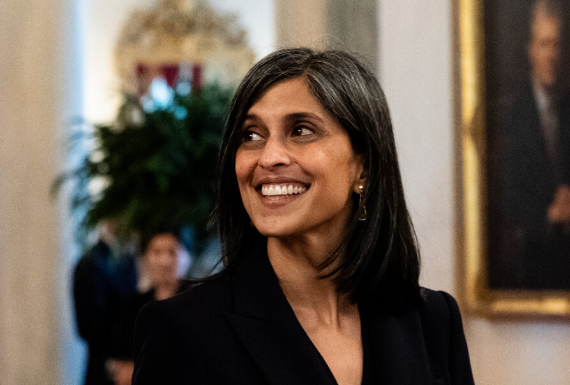
In late July, Usha Vance will give birth to her fourth child, a boy. Only a social media post from her and Vice President JD Vance made the announcement. Its ramifications, however, are both historical and personal.
It is especially uncommon for a second lady to be pregnant during her husband’s term in American politics. The first in contemporary memory will be Usha. Already juggling the demands of public life, their family will soon welcome a new member into an already extremely complicated schedule.
| Name | Usha Vance |
|---|---|
| Age | 40 |
| Profession | Lawyer, former Supreme Court clerk |
| Spouse | Vice President JD Vance |
| Children | Three (two sons, one daughter), fourth due July 2026 |
| Historical Note | First modern Second Lady to give birth while spouse is in office |
| Verified Source |
The timing of this pregnancy coincides with a renewed emphasis on family values in politics. Only a few months after JD Vance openly demanded “more babies in the United States,” the Vances made their announcement. The couple’s expanding family presents that message in a different light—less theatrical, more lived—than the verbal populism that some have rejected.
The distinction between private and public life has never been easy for a vice-presidential household. However, few families must prepare for the life of a newborn while parenting in front of national cameras. Even at eight years old, their eldest child is already aware of the compromises. Vance claims that he prefers quiet times and stays away from cameras. Their five-year-old middle child is very different; he thrives on attention and practically acts in public.
Any parent can relate to this kind of disparity inside the family, but it is accentuated by Washington’s attention. The Vances’ capacity to keep their own rhythm in the face of protocol’s architecture reveals a more profound form of resilience that is influenced by temperament as well as title.
Yale-trained lawyer and former Supreme Court clerk Usha Vance has always exuded a calm composure. For someone whose family currently resides in one of the most scrutinized homes in the nation, she keeps an exceptionally low profile and rarely gives interviews. Her desire for seclusion is a personal decision that is becoming less common, not a political tactic.
It was easy to concentrate on the content because of how straightforward their announcement was. They acknowledged the military personnel that support their life behind the scenes and thanked military doctors for their care. Although they weren’t particularly eye-catching, these words were incredibly clear. They recognized the sometimes disregarded infrastructure that even enables political service while raising a small family.
It’s also important to note that very few contemporary administrations have had official members experience delivery. Two children were born during the presidency of Grover Cleveland. During his time in office, JFK lost a kid too soon. However, these instances have all but disappeared from political life in the decades that have passed. This one is noteworthy in part because it is a marker of changing norms rather than merely being trivial.
In a recent interview, Vance said that despite the growing obligations of public service, his marriage is “as strong as it’s ever been.” He talked openly about attempting to strike a balance between his responsibilities and the needs of his three young children, who will shortly be four. He described it as the tired comedy of someone modifying bedtime habits in between policy briefings rather than self-praise.
His description of his five-year-old’s enjoyment of attention from others drew my attention. “Everywhere he goes, people give him candy or cookies,” Vance remarked, sounding both amused and cautiously proud. Even though it was a brief period, I thought it was surprisingly human.
Despite its historical context, this pregnancy is also a tale of a family attempting to stay grounded. They are surrounded by aides, advisors, security, and the media during these months, so they are not sailing alone. However, this is fundamentally still about getting ready to give birth. purchasing onesies. Setting up a place to sleep. scheduling medical appointments.
Because of this subtle contrast between historical significance and daily life, the announcement feels very impactful. It seems so commonplace, but there’s something quite powerful about it.
In terms of politics, this time also coincides with more general demographic issues. The fertility rate in the United States has decreased for over ten years. Some analysts attribute this to changes in American culture regarding parenthood, while others attribute it to economic uncertainty. In any case, the urgency of the discourse has increased.
The Vance family’s expansion is a gesture rather than a solution in that broader discussion. Additionally, gestures convey messages, especially when they come from public persons. They serve as a reminder that having children is not only feasible but also beneficial, even for those in high positions.
The announcement was strategic, according to critics. Maybe. However, tactics typically don’t involve stories about candy-filled pockets or appreciative bows to military medics. Those particulars seem overly detailed and recalled.
Prenatal treatment under security escort will be part of Usha Vance’s upcoming months. Maybe an other name to choose. Before everything changes once more, there can be a baby shower or just peaceful dinners. Her calendar is probably already changing, and July is quickly approaching.
It’s hard not to feel some admiration for this family as they get ready for a new chapter in their lives. They are already under pressure, and they are choosing expansion. Instead of delaying joy, they are leaning into it. And they’re doing it in a way that feels remarkably classic as well as incredibly modern.
The pregnancy might be a fleeting headline for many Americans. However, it presents a significantly better image of what public service can entail for the Vances and those who are paying more attention. People, not simply policy or power. Parents. Kids. One more is on the way presently.