

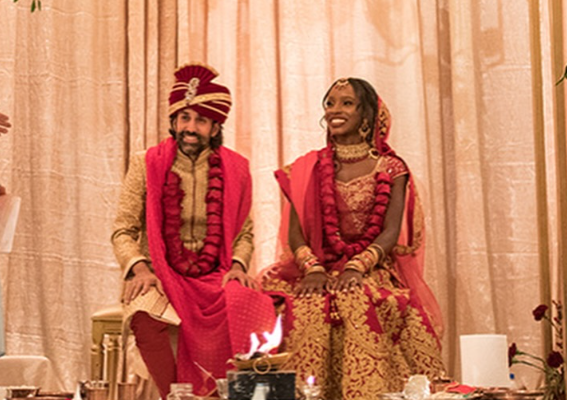
A couple that somehow honored centuries of culture in a single day, three rituals, and a brilliant weekend. That is the tale of Yinka Animashaun and Nitin Sikka that was initially praised. She was well-known—quietly and meaningfully—for planning one of the most tastefully multicultural weddings Texas has recently witnessed, long before viral threads made her name a popular hashtag.
November 23, 2019 was the date. Over the course of twelve hours, the location, the Westin Stonebriar Hotel in Dallas, changed into three separate yet related areas. With vibrant Ankara designs, gele headdresses, and Yoruba customs that have been passed down through the years, the Nigerian ritual got underway. Subsequently, the Indian portion arrived, adorned with marigold garlands and gold embroidery. Nitin arrived in traditional baraat garb, welcomed by dancing family members and a dhol drummer whose beat reverberated through the marble hallways. Under gentle lighting and violin accompaniment, the Western ceremony concluded the evening with English-language vows gently uttered in front of loved ones.
| Name | Yinka Animashaun |
|---|---|
| Profession | Designer (pet fashion and accessories) |
| Known For | Viral multicultural wedding with three ceremonies |
| Spouse | Nitin Sikka (Investor) |
| Wedding Date | November 23, 2019 |
| Location | Westin Stonebriar Hotel, Dallas, TX |
| Wedding Style | Nigerian, Indian, and Western fusion |
| Recent Spotlight | Email controversy involving Cole Walliser |
| Source | Public reports, social media coverage (Pulse Nigeria, X, Instagram) |
The way each phase allowed attendees to experience emotional shifts as the day progressed, rather than just the artistic layering of cultural aspects, was what made the celebration really innovative. The encounter was not dominated by any one identity. Rather, one sari, one gele, one kiss at a time, the pair crafted a cultural dialogue.
Even the meal was well planned. Mango lassi was distributed with Chapman cocktails, and Jollof rice was seated pleasantly next to paneer masala. These served as markers of family unity rather than merely menu options. Many of the guests, who had never been to a cross-cultural wedding before, said the event was incredibly successful in fostering connections without ever being overpowering.
An unexpected aspect of Yinka’s background appeared in early 2026 due to a TikTok controversy involving Cole Walliser, the director of Hollywood’s Glambot red carpet pictures. It wasn’t a video. It wasn’t a picture. It was a thread in an email.
The thread, purportedly dated 2019, detailed Yinka’s effort to use Walliser’s Glambot contraption for her nuptials. Her question appeared to be typical: she was praising the technology and wondering whether it might be modified for a private gathering. But his answer seemed remarkably incisive. According to reports, he clarified that the setup was “not cheap,” implying that a conversation might start if her budget was between $10,000 and $1,000,000. He never gave a quote, but he added, almost performatively, that he didn’t think she could afford it.
Social media responded remarkably quickly. His tone struck many as needlessly contemptuous. His wording, which assumed financial class without context, was criticized by some for being subtly elitist. The tale swiftly spread beyond the red carpet and into more general comments about respect, access, and industry gatekeeping as people began to associate the name with the now-iconic Dallas wedding.
The line when she merely responds, “Yeah, I just assumed it was very pricy since it’s featured at the Oscars,” caused me to pause while reading the screenshots. Her tone is one of tactful curiosity rather than pushiness or snark. That brief statement, which seemed so inconspicuous at first, stuck with me.
The exchange’s purported roughness isn’t the only noteworthy aspect. Many people still recall the juxtaposition between the warmth of the wedding and the jagged edge of the Glambot email. One internet user pointed out that her full name, Olayinka Animashaun, has a lyrical symmetry that roughly translates to “one who has and shares” and “wealth surrounds me.” Strangely enough, that linguistic comment summed up what many people were already thinking: she wasn’t attempting to win anyone over. She was just attempting to add something unique to a day that already exuded abundance—not materially, but in terms of purpose.
Yinka never offered her own thread in response. She failed to seize the opportunity. She refrained from stoking the fires. Rather, her quiet overshadowed any quotation. People filled in the blanks by recalling who she was from that wedding.
Her supporters completely changed the narrative by drawing on the sentimental recollection of her initial jubilation. This wasn’t just one email. It has to do with dignity. About how women are frequently expected to demonstrate their worth before they are even assigned a price tag, especially women of color.
However, the email scandal served as a catalyst for more extensive discussions about industry elitism and who is allowed to request access without facing consequences. Even though the scandal was unintended, it diverted focus from celebrity drama to cultural sensitivity and raised important issues on how service providers see their clients based on factors like names, histories, or apparent income.
Yinka’s wedding, meanwhile, endures. The images, which are now even more valued in retrospect, are still in circulation. Her pet fashion business is still doing strong. All outward indications suggest that her marriage is still quietly solid. That kind of constancy has advantages, particularly in times of unexpected digital storms.