

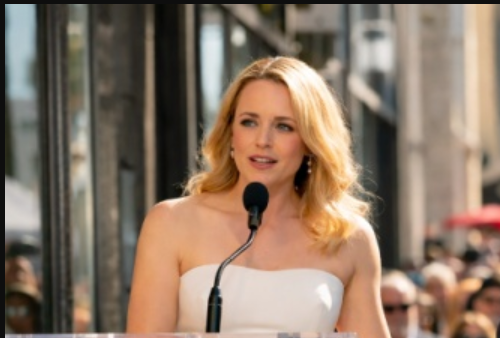
The sun was unseasonably gentle for Los Angeles that day, as if it too had paused to admire the woman whose name would now be permanently etched into Hollywood’s most storied sidewalk. Rachel McAdams, known for roles that veer from the achingly romantic to the sharp and comedic, stood at the center of a moment she rarely seems to chase—unfiltered public adoration.
It wasn’t just that McAdams had earned her place with roles in The Notebook, Mean Girls, Spotlight, and About Time. It was that she had done so without leaning into celebrity culture. She never weaponized fame. She seemed to walk around it instead—quietly, purposefully.
Rachel McAdams Walk of Fame Ceremony
| Event | Hollywood Walk of Fame Star Ceremony |
|---|---|
| Honoree | Rachel McAdams |
| Date | January 20, 2026 |
| Location | Hollywood Boulevard, Los Angeles |
| Guests of Note | Domhnall Gleeson, Dylan O’Brien, Sam Raimi, Jamie Linden |
| Memorable Moment | Gleeson’s humorous roast and emotional hug |
| Upcoming Project | Send Help (Directed by Sam Raimi) |
| Reference | Hollywood Chamber of Commerce |
Domhnall Gleeson, her co-star from About Time, delivered a speech that started like a roast but bloomed into something more tender. With a mischievous smile, he told the crowd: “Rachel, I don’t think you deserve this.” That got a laugh. But it was the kind of laughter that made everyone lean in. He went on to list her so-called “offenses”: being both a beloved colleague and a gifted actor, managing motherhood and stardom without complaint, crossing genres with ease, and refusing to be boxed in.
He ended with, “That’s not how we do things. So yeah, I just don’t think you deserve it.” The line, delivered with theatrical mock outrage, melted quickly into a warm embrace. The moment lingered just long enough to land as genuine. It reminded me how some performances don’t end when the credits roll—they echo in small, unscripted gestures like that hug.
Also present was Dylan O’Brien, her co-star in the upcoming Send Help, a plane-crash survival dramedy directed by Sam Raimi. Raimi himself stood close by, clearly proud to align himself again with an actress he once directed in Doctor Strange. Her longtime partner, Jamie Linden, typically invisible in public spaces, was spotted off to the side, eyes mostly on her. They share two children—another role she rarely speaks of, but seems to wear like armor.
This wasn’t the typical Walk of Fame photo-op with stylists and scandal. There was no performative vulnerability. It felt more like a gathering of collaborators who had seen each other exhausted, inspired, or temporarily defeated on long film sets. That’s a rarer kind of tribute—one grounded in shared days, not just press junkets.
The star, set in terrazzo and brass like all the others, is now part of a tradition that tourists pose over. But few of those stars come with such conflicted tributes—teasing, affectionate, utterly sincere. Gleeson’s tone shifted effortlessly from sardonic to sweet, and you could see in McAdams’ face that she wasn’t brushing it off. She listened.
That, too, felt like a pattern with her.
She listens—to scenes, to partners, to the shape a character needs to take in her voice and body. It’s what makes her work not only effective but oddly intimate. Even in larger-than-life roles, she rarely feels like she’s performing at us. Instead, there’s a measured closeness, as though she’s inviting us to overhear.
Her career, spanning more than two decades now, has never relied on a single franchise or formula. She’s dipped into mainstream spectacle (Sherlock Holmes, Doctor Strange) and stayed loyal to smaller character pieces (The Family Stone, Disobedience). She moves deliberately, and that deliberateness is what some people mistake for absence. But it’s actually choice.
There was a quiet defiance in the ceremony—not angry or activist, just intentional. That her partner was there, but not the focus. That she chose roles like Send Help that let her play women surviving both nature and men. That she let Gleeson play the fool so she wouldn’t have to.
Even her wardrobe was restrained: not a glittered red carpet gown but a tailored, structured outfit that seemed to say, “I’m here for work.” Because if McAdams has been consistent about anything, it’s her aversion to distraction. The focus, always, remains on the work.
And that may be the reason why she matters—not just to fans, but to other actors. She reminds the industry that it’s still possible to do good work quietly, to be immensely watchable without being omnipresent, and to earn reverence without ever demanding it.
After the speeches ended and the photographers began directing people toward the plaque for official shots, McAdams crouched down to examine the star. Not posing—just looking. For a beat, she ran her hand along the brass lettering. It didn’t feel like vanity. It felt like surprise.
Even now, it seems, she finds this whole thing a little unreal.