

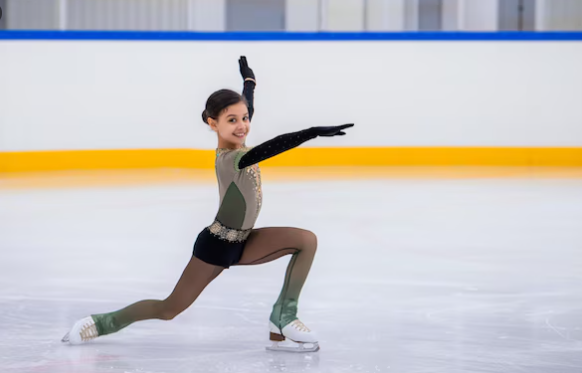
Mone Chiba does not loom over the ice at 1.56 meters, or slightly more than five feet one inch. She moves over it, little and accurate, the type of skater whose presence seems to grow as soon as the music starts.
In figure skating, height is a curiously enduring topic. Fans look it up on Google. It is mentioned by commentators. It is listed in athlete graphics by broadcasters as if it clarifies a crucial point. Chiba’s 156-centimeter frame is more than simply a fact; it plays a role in the mechanics of her jumps, rotation speed, and stability under duress.
| Athlete Profile | |
|---|---|
| Name | Mone Chiba |
| Height | 1.56 m (156 cm / 5 ft 1 in) |
| Date of Birth | May 1, 2005 |
| Birthplace | Sendai, Japan |
| Notable Titles | 2025 World Bronze Medalist; 2024 Four Continents Champion |
| Olympic Result | 4th Place, 2026 Winter Olympics |
| Affiliation | Kinoshita Group |
| Reference |
You see the sudden spin in the air as you watch her practice triple-triple combinations while standing rinkside at a Grand Prix event. Smaller skaters tend to conserve angular momentum by rotating more effectively. It is not mythology, but physics. However, without discipline, height alone cannot explain anything.
Chiba, who was born in Sendai, Japan, on May 1, 2005, has risen through the ranks gradually. Before moving on to senior competition, she won junior medals, Four Continents medals, and a bronze at the World Championship in 2025. That podium finish was a hint that she was coming, not just making promises.
Her stature seems to go well with the way she skates. Cleaner rotations are made possible by compact athletes’ ability to hold tighter air positions. However, they also have to make up for power during takeoff. The strain is evident as Chiba drives into a triple Lutz with his arms coordinated and his knees deeply bowed.
Whether height advantages are contextual or significant in figure skating is still up for debate. Champions of all sizes have been crowned in the sport. Timing, edge control, and resilience are more important. And her recent seasons have been characterized by resilience.
Chiba finished fourth overall at the 2026 Winter Olympics, narrowly missing bronze by 1.28 points. That margin persists. Three were deemed “on the quarter” when she successfully executed each leap in her free skate, eliminating important fractions. The distinction between fourth and podium seems nearly inhuman.
Her subsequent response was remarkable. She characterized the frustration as deep and multi-layered, unlike anything she had ever experienced. Despite acknowledging her disappointment, she applauded the medalists. It’s difficult to ignore how mature that response is. No one is immune to the pressures of the Olympics because they are 1.56 meters tall.
She talked about both intensity and appreciating the moment during the little program in Beijing, when she skated last in her maiden Olympics. That blend of excitement and nervous energy seems to be representative of her career thus far. She acknowledges her position and presses forward. In certain cases, height becomes symbolic.
Taller players have visual superiority in several sports. Reach is favored in basketball. Vertical extension is rewarded in volleyball. In contrast, figure skating frequently praises compact efficiency. Faster spins and tighter rotations can be produced by smaller skaters, but timing is crucial.
That rhythm appears to fit Chiba’s build. She feels intentional and in control of the centrifugal force as she speeds into a spin. In person, the keen echoes of the ice scratches beneath her blades serve as a reminder that power is not about size but about accuracy.
Fans may be drawn to height because it provides something concrete in a sport where scoring is subjective. Centimeters are a unit of measurement. Artistry and nerve are more difficult to measure.
Her membership in the Kinoshita Group has given her access to international exposure, coaching consistency, and structural support. However, individual performance is still crucial. One can detect her quiet calculating as she gets ready in the kiss-and-cry area, shoulders slightly forward, gaze fixed forward.
It seems as though her Olympic fourth-place finish will influence her future. Near-misses are frequently referred to by athletes as fuel. In contrast to winning, the difference between 1.28 points and a medal can help concentration.
The concern isn’t whether her height restricts her as she gets closer to upcoming World Championships. It’s if her experience now makes her more composed.
Margin is narrow in skating. On a jump, a quarter turn. The landing was a little under-rotated. A step outside.