

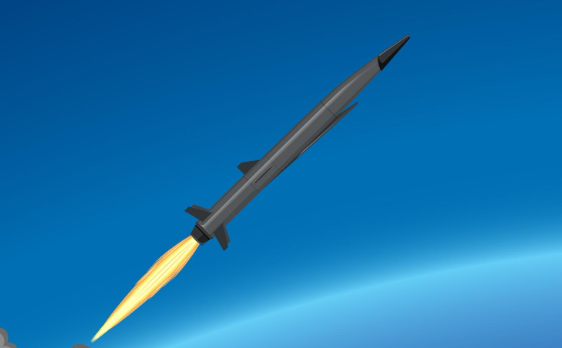
A Tomahawk cruise missile is nearly straightforward at first appearance. It had a small jet engine hidden in the back, a long cylindrical body, and short wings folded along its sides. However, the simplicity rapidly fades when you’re standing close to one inside a military testing facility. The surface panels conceal thousands of precise elements, such as motor components, guidance systems, and sensors, all of which are intended to direct the missile hundreds of miles in the direction of a far-off target. The question that people frequently ask is surprisingly simple: who manufactures Tomahawk missiles?
The response now identifies a single business. The main producer of contemporary Tomahawk cruise missiles employed by the US Navy and a number of its allies is Raytheon, which is currently a part of RTX Corporation. The weapon is produced by the corporation as part of a multi-decade effort that dates back to the Cold War.
Key Information About the Tomahawk Missile
| Category | Details |
|---|---|
| Weapon Name | BGM-109 Tomahawk Cruise Missile |
| Type | Long-range cruise missile |
| Primary Manufacturer | Raytheon (RTX Corporation) |
| First Developed | 1970s |
| Initial Developer | Johns Hopkins Applied Physics Laboratory |
| First Manufacturer | General Dynamics |
| Current Operator | U.S. Navy and allied navies |
| Typical Range | ~1,000 miles (varies by variant) |
| Annual Production | ~90–100 missiles historically |
| Future Production Goal | Potentially over 1,000 per year |
| Reference Website | https://www.rtx.com |
The beginnings of the missile now seem nearly antiquated. In the 1970s, scientists at the Johns Hopkins Applied Physics Laboratory started working on a new kind of long-range cruise missile that could navigate toward far-off targets while flying low across the ground. The U.S. military at the time was looking for a weapon that could hit deep into enemy territory without exposing pilots to opposing defenses.
General Dynamics, a significant defense contractor, created the first working models and manufactured early versions. The program passed through a number of corporate hands over time. Later iterations were managed by McDonnell Douglas in the early 1990s, then Hughes Aircraft after acquiring a portion of General Dynamics’ missile branch. The year 1997 then saw a sea change.
Raytheon became the only producer of the Tomahawk after acquiring Hughes Aircraft’s missile division. Since then, the business has kept improving the missile by releasing several upgraded models that are intended to increase accuracy, targeting versatility, and dependability.
It’s oddly captivating to see a test footage of a Tomahawk launch. The rocket booster on a naval ship fires for a few seconds before the missile drops away after exploding from a vertical tube. Shortly after, the missile’s wings spread, its tiny jet engine fires, and it levels off slightly over the ocean’s surface, flying like a robotic plane toward its objective.
One of the things that makes the weapon so amazing is the navigation system. Tomahawks use a combination of terrain-matching sensors, GPS navigation, and inertial guidance to compare the terrain below with maps that have been stored. This enables the missile to navigate intricate paths, dodging obstructions and modifying its trajectory in mid-flight. However, there are manufacturing issues with that technology.
Tomahawk production has generally been somewhat slow, despite its reputation as a mature missile system. Historically, the United States has manufactured between 90 and 100 missiles annually, which has kept the production line running but at a low pace. That might be changing lately.
Defense planners have been forced to reconsider stockpile levels due to escalating international tensions and renewed military planning in areas such as the Pacific. To bolster their naval capabilities, nations like Japan have started placing orders for hundreds of Tomahawks, which has increased demand for the aircraft.
According to reports, Raytheon has been looking into ways to significantly boost production, possibly surpassing 1,000 missiles per year in the long run. Scaling production, however, is a difficult task.
The intricate supply chain for the missile is one factor. Many of the thousands of specialized parts that make up a Tomahawk are supplied from tiny subcontractors that specialize in very specific technology. Some components, such propulsion systems and sophisticated guiding sensors, might only come from one supplier.
The entire manufacturing process may come to a standstill if one of those suppliers slows down operations. The solid rocket motors that are employed during the missile’s launch phase present another challenge. These propulsion systems are only made by a small number of American companies, and those companies already have facilities that support other military programs. It takes time to build more production capability.
The pace of defense manufacturing is also slower than that of most other businesses. Every component must undergo extensive testing by engineers in order to meet stringent safety and reliability requirements. A single Tomahawk missile may take up to two years to produce when component production, assembly, and testing are taken into consideration, according to some estimates. Both the intricacy of the missile and the caution involved in its manufacture are reflected in that timeline.
It is evident that these weapons are more like complex machines constructed piece by piece than typical manufactured commodities when one is standing close to a missile assembly site, where technicians wearing safety gear cautiously walk between workstations. Nevertheless, the Tomahawk’s design has remained incredibly flexible.
Engineers have created several variations over the years that can carry out various tasks. While some versions target ships at sea, others concentrate on land-attack strikes. After getting new targeting data, more recent versions can even change their trajectory in midair.
The missile’s influence extends well beyond US military operations as it has also been employed by friendly fleets, including as those of the Netherlands, Australia, and the United Kingdom.
It’s hard to ignore how some technologies subtly endure for generations as the defense sector as a whole develops. While fighter jets and satellites frequently make news, weapons like the Tomahawk are still in the shadows, being updated, modified, and sometimes used. Raytheon continues to play a crucial part in that effort.
With the help of a network of subcontractors who provide everything from propulsion hardware to navigation systems, the business is currently assembling the missile in specialized facilities throughout the United States. As a result, the weapon system has been in use for over 40 years.
Furthermore, that kind of longevity shows something uncommon in a world where military technology is changing quickly: a design that has been able to adapt to the battles and tactics it was first intended to support.