

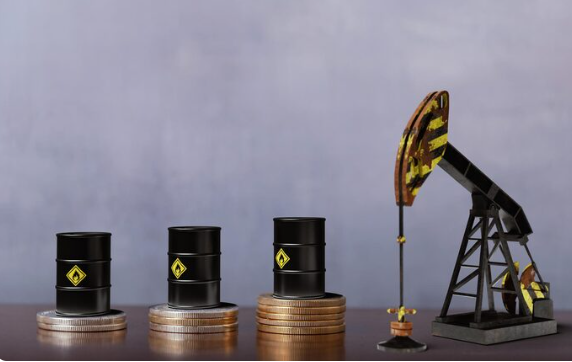
Tanker trucks travel steadily through the industrial corridors close to Occidental Petroleum’s offices on a hot Houston morning. The faraway hum of refineries fills the air as workers in luminous jackets move past security gates. It’s not the kind of location that Silicon Valley venture capitalists or technology investors often find exciting. However, Oxy stock, or Occidental Petroleum shares as traders refer to them informally, has recently emerged as one of the energy market’s most widely watched tales. An odd source contributes to some of that attention.
The renowned investor has spent years building up Occidental Petroleum shares through Berkshire Hathaway. Berkshire is now one of the company’s biggest shareholders thanks to his consistent purchases. Buffett’s engagement serves as a kind of silent signal for many investors. There must be something noteworthy if he continues to make purchases.
| Category | Information |
|---|---|
| Company | Occidental Petroleum Corporation |
| Stock Ticker | OXY (NYSE) |
| Headquarters | Houston, Texas, United States |
| Industry | Oil, Gas, and Chemical Manufacturing |
| Market Cap | ~$60–65 Billion (approx., 2026) |
| Key Investor | Berkshire Hathaway (Warren Buffett) |
| Core Businesses | Oil & Gas Production, OxyChem, Carbon Management |
| Stock Trend (2026) | Trading near 52-week highs |
| Dividend Yield | ~1% (approx.) |
| Reference Source | https://www.oxy.com |
Naturally, that reasoning does not ensure success. However, Occidental’s stock has been rising gradually. Shares were trading close to their 52-week highs by March 2026, indicating a resurgence of confidence in the energy industry. Over the past few years, oil businesses have had an odd renaissance.
Many observers thought that traditional fossil fuel companies were about to undergo a gradual collapse not so long ago. Investments in renewable energy increased dramatically. Electric cars made news. North America and Europe toughened their climate regulations. The future of the oil sector appeared to be dwindling at times. Yet the real world rarely goes in straight lines.
The demand for natural gas and oil has remained steadfastly strong around the world. Emerging economies are still growing. Airlines are operating once more. Massive amounts of energy are needed for industrial manufacturing. Additionally, businesses that own substantial oil reserves typically profit when energy demand increases. Occidental is right in the middle of that dynamic.
In the Permian Basin, one of the world’s most productive energy regions, the corporation manages significant oil and gas assets around the United States. The magnitude is evident when you drive across parts of West Texas. Drilling rigs emerge like transient metal towers on the horizon, pipelines cover miles of open space, and pumpjacks rise from the dusty countryside.
On its own, any well may produce slightly. When combined, they produce massive amounts of oil. These activities are the foundation of Occidental’s financial success. Strong cash flow from high oil prices enables the business to reduce debt and make investments in upcoming initiatives. Over the past few years, Occidental’s strategy has made financial discipline a key component.
Reducing debt is more important than it may seem. When the business acquired Anadarko Petroleum a few years ago, it borrowed a significant amount of money, which at first alarmed many investors. Since then, Occidental has made a significant effort to reduce that debt, progressively strengthening its balance sheet. According to reports, total debt had decreased to about $17 billion by the end of 2025, a significant improvement over previous levels.
That kind of advancement is typically rewarded by markets. However, Occidental’s operations go beyond well drilling. Additionally, the corporation runs OxyChem, a sizable chemical manufacturing sector that produces goods for industrial processes, plastics, and building materials. Even because it generates consistent income despite fluctuations in the energy markets, that sector frequently gets less attention than oil extraction.
The use of carbon capture and carbon management systems, which store carbon dioxide underground to lower emissions, has become more common among executives. Occidental has made investments in a number of significant initiatives to advance this capabilities. Supporters think such initiatives have the potential to grow into substantial businesses in the future. Skeptics continue to exercise caution.
Government incentives and energy policies have a major role in the economics of carbon capture technologies, which are still in the early stages of development. Some experts question if these initiatives will turn a profit fast enough for investors to care. Meanwhile, the stock market continues focusing on simpler variables.
The price of oil is still comparatively steady. Major basins continue to produce more. Additionally, Buffett’s status as a significant shareholder provides a level of investor confidence that is challenging to measure but difficult to overlook. That momentum is seen in recent trade activity.
OXY’s shares have been rising steadily, with a recent increase of almost 3 percent in a single day as optimism permeated energy markets. The stock’s near-term indications are robust, according to technical experts, indicating that investors are still interested in the company’s future. However, there is always uncertainty about the future of oil corporations.
Energy markets react swiftly to world events. Demand may decline as economic growth slows. Supply could be disrupted by geopolitical conflicts. The shift away from fossil fuels could be expedited by government laws.
As the sun sets on a pipeline corridor in West Texas, those possibilities seem far away but not unattainable. The energy sector has always been characterized by cycles: exuberance followed by caution, booms followed by corrections.
However, Occidental Petroleum seems to be at one of the more advantageous stages of that cycle right now. Additionally, a lot of investors are eager to follow along as long as Warren Buffett keeps discreetly purchasing shares.