

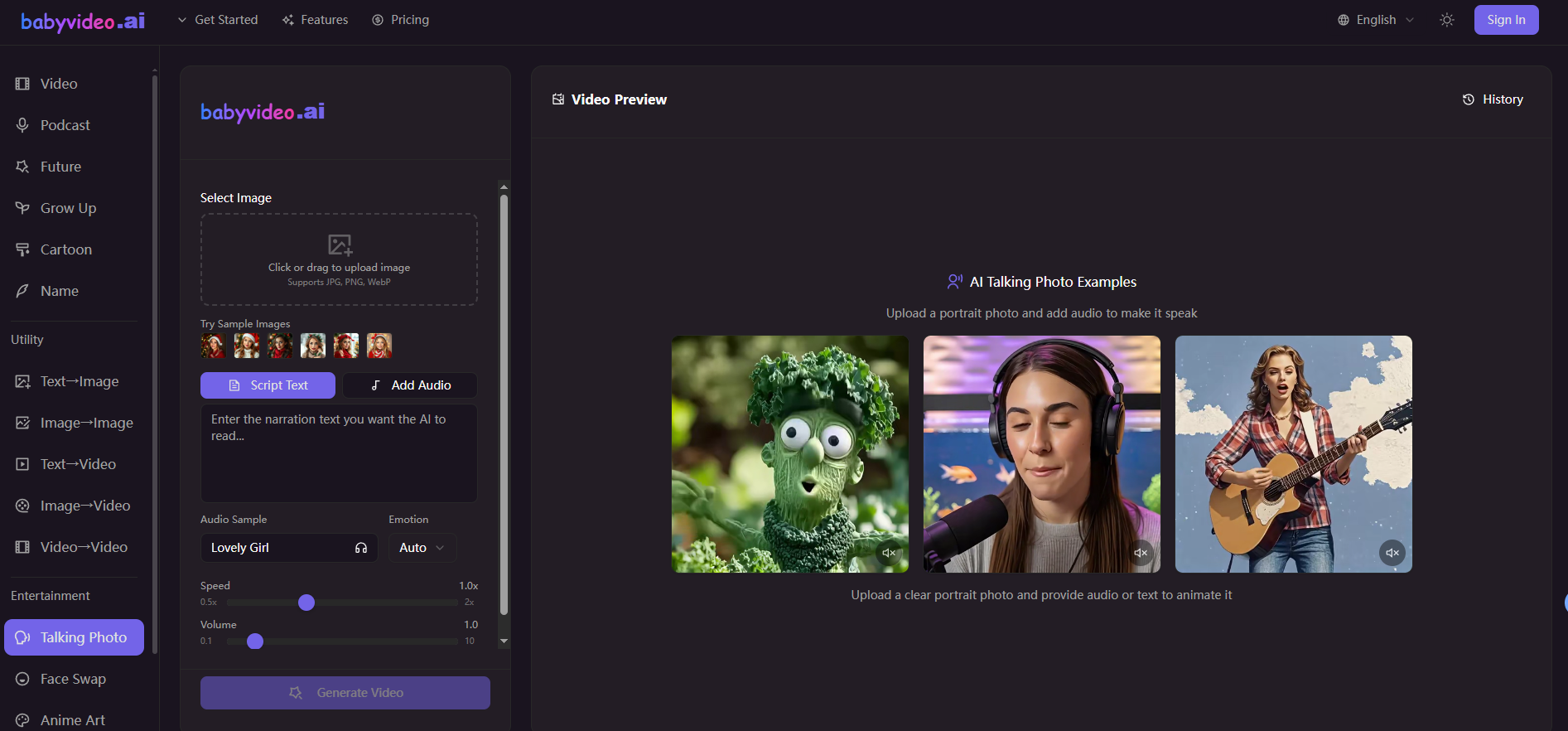
The idea behind BabyVideo.ai began with a simple observation: “parent-child/baby” content has an exceptional ability to spread across social platforms. Whether it is cute, humorous, heartwarming or centred on questions like “what will the future baby look like?”, this type of content naturally attracts clicks, comments and shares. Yet for most people, producing baby content that looks polished, attractive and ready to share is far from easy. It typically requires editing skills, colour correction, source material preparation and, above all, time.
The ambition was therefore to create a tool that “requires no editing skills”. Users would simply upload a photo or enter a description, select a template and instantly generate a finished video or image. The product vision also focused on supporting the most popular and shareable formats:
- Future Baby Prediction: Couples upload their photos to generate a predicted image of their “future baby”, creating highly entertaining results.
- Growth and age progression: A single image generates comparisons across multiple ages, offering strong commemorative value.
- Cartoon baby styles: One-click transformation of baby photos into different cartoon avatars, suitable for multiple sharing scenarios.
- Baby-themed video templates: Shifting content creation from manual editing to simply selecting templates and generating videos.
BabyVideo.ai was created with this purpose: to make “baby content creation” a product that anyone can use and share immediately.
From Zero to Launch: Key Lessons from Development
A product is more than “connecting a model”
A common misconception is that AI products are simply about connecting to a model API. In practice, the most complex work lies in making the system stable, controllable and scalable. Even when using the same video template, user-uploaded images can vary dramatically in lighting, angles, clarity and composition, all of which affect output quality.
To address this, a range of product-level safeguards were built in:
- When no description is provided, default prompts ensure consistent output.
- When users add descriptions, limits on length, sensitive language and unrealistic requests help prevent failures.
- Failures must be retryable, with clear problem resolution paths and a points-based refund or compensation system to avoid user churn.
Cost and billing: the real headache is accounting
AI generation costs are inherently variable. A single seven-second video can suddenly become expensive due to long inference times, queuing, concurrency limits or retries. To avoid uncontrolled losses, focus was placed on two core areas:
- Cost monitoring: Tracking actual costs per feature, per generation and per second of output.
- A points system: Translating dollar-based costs into user-friendly points while protecting long-term margins.
Without this discipline, an independent developer risks building a product where increased usage directly increases losses.
Engineering foundations users never see
Once live, many user issues appear mundane, but solving them requires robust engineering:
- Login systems covering email, third-party authentication, CAPTCHA and anti-abuse measures.
- Object storage for generated videos and images, organised with scalable directory structures.
- Queuing, rate limiting and task tracking to prevent uncontrolled execution.
- Clear task states such as generating, failed, successful, expired and retry.
- Defensive handling for timeouts, third-party instability and invalid user inputs.
Behind a single button sits an entire stability framework.
Multilingual reach and SEO are not just translation
Building multilingual pages quickly revealed that translation alone is insufficient. Search behaviour varies by language, page structures influence indexing, and content duplication risks must be managed through canonicalisation and careful internal linking. For AI tools in particular, SEO is a long-term, iterative process rather than a one-off task.
From Building to Growing: Finding Real Users
Prioritising shareability over advanced features
In the earliest phase, the focus was not on feature depth but on whether users wanted to share what they created. For BabyVideo.ai, organic sharing on social platforms offered more sustainable growth than paid advertising. As a result, priority was given to:
- Eye-catching outputs that invite sharing at first glance.
- Clear visuals with consistent styles.
- Minimal parameter input to reduce friction and abandonment.
Testing channels and discovering what works
Experiments ranged from AI tool directories and community forums to platforms such as Pinterest and Quora. Over time, a pattern emerged: directories may not directly boost SEO, but they can generate real clicks, brand searches and organic mentions. The most effective approach combined content, demos and before-and-after comparisons.
Reproducible demo materials proved particularly powerful:
- Couple photos transformed into future baby predictions.
- Single images expanded into multi-age growth comparisons.
- Original photos converted into collections of cartoon avatars.
These outputs functioned as marketing assets in their own right.
Using failure as a driver for improvement
The most valuable operational feedback was not aesthetic praise, but practical questions such as why a generation failed, why queues felt slow or why points usage seemed unclear. Each issue fed directly into product iteration, from clearer prompts and defaults to more transparent billing and compensation rules.
For an independent developer, operations are less about promotion and more about allowing real users to shape a stronger product.
The Ongoing Challenge
Moving from zero to one is only the beginning. The real work lies in maintaining controllable costs, delivering a stable user experience, continuously improving output quality, testing channels, building SEO over time and iterating based on feedback.
BabyVideo.ai continues to evolve with the aim of becoming a tool where “anyone can easily generate baby-themed content”: no editing, no design skills and no learning curve — just open a webpage and receive a shareable result.