

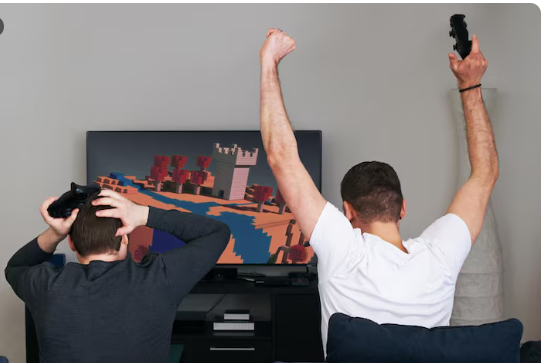
The corridors of Netflix’s Los Gatos headquarters are more serene than one might anticipate for a business that is attempting to reinvent itself. Inside glass-walled conference rooms with views of well-kept lawns, executives discuss controllers, cloud latency, and multiplayer lobbies in addition to scripts and streaming stats. Known for creating Netflix’s original content machine, Ted Sarandos is currently attempting to convert watchers into gamers.
It’s a daring goal. Over 325 million people are Netflix customers globally. It should be clear from the calculations that even a small amount of gaming might have enormous effects. However, the company’s gaming endeavors have yielded inconsistent outcomes over the past four years. According to reports, management gave the trial a B-minus.
| Category | Details |
|---|---|
| Company | Netflix, Inc. |
| Co-CEO | Ted Sarandos |
| Subscribers | 325M+ global members |
| Gaming Strategy (2026) | Cloud-based TV games, party titles, IP-driven games |
| Engagement Challenge | <1% daily game usage historically |
| Notable Titles | Squid Game: Unleashed, LEGO Party!, Boggle, Pictionary |
| Reference |
In the past, less than 1% of users played games on Netflix every day. An unpleasant extra step for viewers used to pressing “Play” on a TV remote, the early strategy mostly relied on mobile downloads. It’s possible that Netflix misjudged how well-established gaming ecosystems were already.
Sony is used by console players. Steam is available to PC gamers. Users of mobile devices browse the many possibilities available in app stores. People were being asked to break their routines by Netflix. In 2026, the approach is changing.
Games in the cloud that can be played directly on TVs are the company’s top priority. No individual downloads. Only a controller or smartphone acting as a remote control is needed. It’s like starting a series—just click and play. The concept is straightforward: eliminate friction.
Families were exploring a party-style game in a lounge environment at a recent Netflix demo event. Not intensity, but laughter. Call of Duty isn’t being outgun by this. It’s an attempt to transform informal viewing periods into interactive social activities.
According to reports, party games like LEGO Party!, Pictionary, and Boggle have higher player engagement than conventional single-player games. It seems like Netflix has identified its target market, which is wide-ranging, international, and not just die-hard gamers. Greg Peters, Sarandos’ co-CEO, seems to be embracing that.
Additionally, Netflix is exploitation of its own intellectual property. Squid Game: Unleashed is closely related to one of its most well-known worldwide properties. Games that draw inspiration from Emily in Paris and Selling Sunset make it difficult to distinguish between fandom and gameplay. Yes, there is synergy, but there is also survival.
Across the board, the growth of streaming is slowing. Churn is costly. Gaming may improve subscriber loyalty if it even slightly raises daily engagement. Investors appear cautiously hopeful. They contend that gaming could expand the Netflix network. But doubt persists.
The business has scaled back its first acquisition binge, which included purchasing studios and assembling internal teams. Entertainment Boss Fight was shut off. Instead of concentrating on blockbuster console rivals, the current strategy is “less is more,” emphasizing smaller, more cohesive experiences.
An ambitious attempt was even made to purchase Warner Bros. Discovery, a move that would have allowed Netflix to acquire significant gaming assets. Netflix pulled out when a competing bid surfaced. It seemed like a revelation. Whether Netflix wants to become a gaming behemoth or just a superior entertainment center is still up in the air.
The change makes cultural sense. Interaction is becoming more and more expected from younger viewers. TikTok encourages participation. Around the world, video games are the most popular pastime. Even though passive viewing is still effective, active interaction is more effective.
As this plays out, it seems like Netflix is battling not just rivals but also time. It launched a streaming revolution that is now growing. There must be a source of growth. Cloud gaming might be the decisive factor.
Netflix reduces psychological barriers by integrating games into the same interface as movies and TV shows. Imagine participating in a show-themed multiplayer trivia competition just after finishing a season finale. smooth. Easy to use. However, convenience by itself does not ensure a shift in behavior.
Gamers are devoted. Platforms are sticky. And it takes both technical mastery and artistic risk to create engaging games, even casual ones. Shallow gameplay, clumsy interfaces, or latency problems might swiftly sap excitement.
An early test could be provided by Netflix’s forthcoming soccer simulation, which is planned for the 2026 World Cup. Time is of the essence. The title may indicate feasibility if it gains international traction. Or it might blend inconspicuously with the algorithm.
The attempt is admirable in some way. Sarandos assisted in transforming Netflix from a DVD-by-mail service to a dominant force in streaming. The company’s DNA is rooted in reinvention. However, not all pivots are successful.
One gets the impression that a corporation is growing beyond its initial scope when they are in the cafeteria of the Los Gatos site and hear engineers talking about frame rates and server capacity while writers are proposing new plays. Netflix aspires to be more than just a television. It aims to serve as a forum for communication.
It’s unclear if subscribers will accept that change. However, the ambition itself implies that Netflix is aware of a basic reality: watching could not be sufficient in the attention economy. So the experiment goes on, silently and relentlessly, attempting to convert millions of viewers into players.