

Jonathan Alexander Abt is a registered specialist in orthodontics who has worked at various prestigious institutions, including Luton and Dunstable Hospital in the UK, Columbia University in New York, USA, and Beer Sheva Medical School in Israel. This article will take a closer look at orthodontics, a complex medical field, and provide an overview of the main orthodontic appliance types.
Orthodontics is about more than just straight teeth, providing patients with a healthy smile to last a lifetime. Orthodontic treatment improves the harmony of mouths and jaws and enhances the patient’s bite, allowing them to eat more comfortably and care for their teeth and gums more easily and effectively.
A branch of dentistry centring around growth of the teeth, jaws and face, orthodontics is in high demand today. In England and Wales, more than 200,000 children and teenagers undergo orthodontic treatment annually, with growing numbers of young people and adults seeking treatment on a private basis. Age is no barrier to orthodontic treatment. Patients frequently report a life-changing impact, boosting their self-esteem as well as enhancing their oral health.
Orthodontic treatment improves the harmony of the mouth and jaws, enabling patients to bite correctly and benefiting their smile immensely. Primary benefits of orthodontic treatment include:
- Aligning upper and lower dental arches
- Closing spaces or eliminating crowding
- Enhancing facial aesthetics
- Correcting the bite of the teeth
- Accommodating displaced, unerupted or impacted teeth
- Preparing for advanced dental treatment such as implants, crowns or bridges
- Reversing drifting of teeth in older patients
- Reducing the risk of damage to prominent teeth
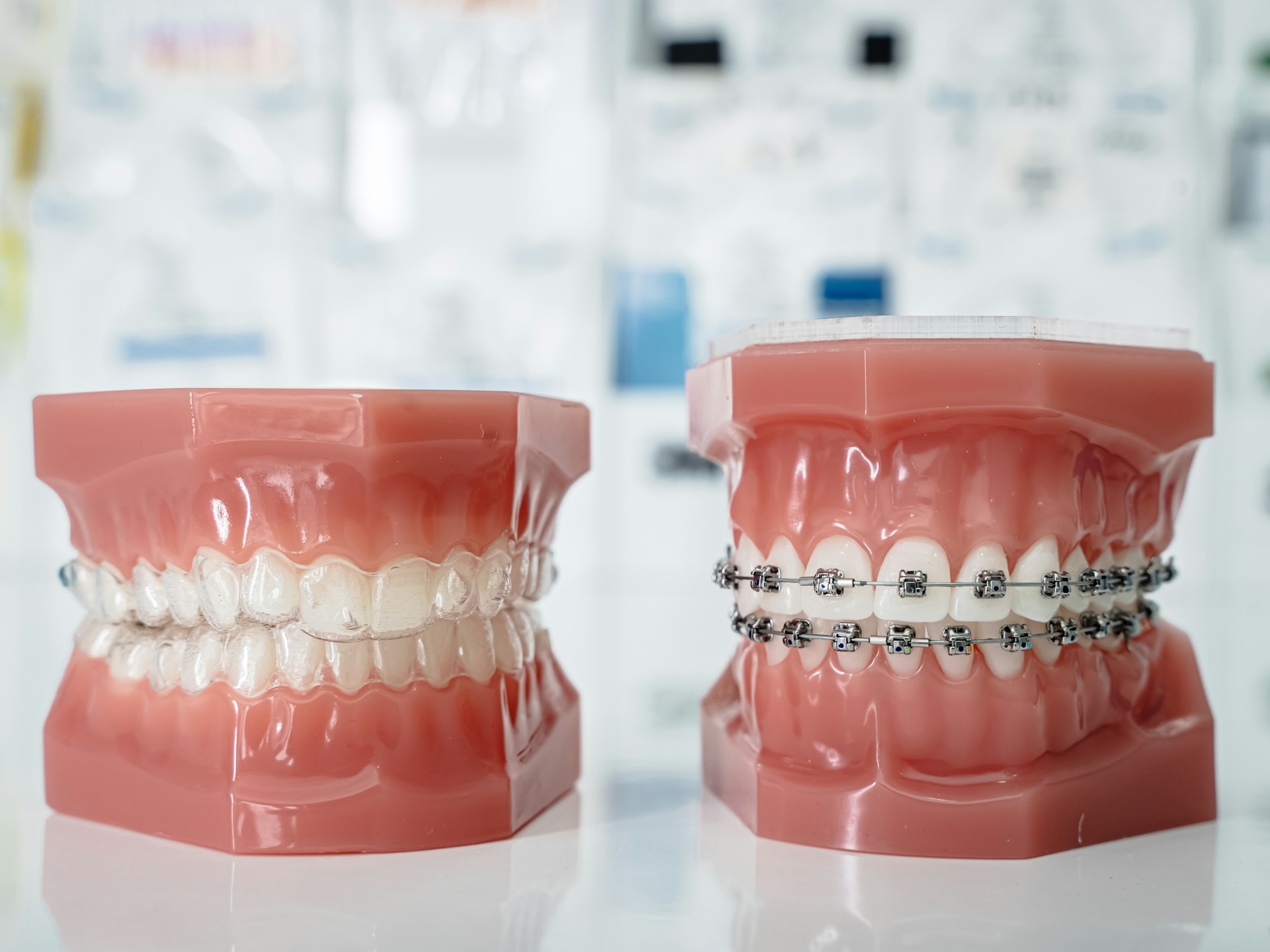
Braces are orthodontic appliances that apply force to teeth to encourage tooth movement to achieve alignment and/or correct the bite. Traditional orthodontic appliances come in two main types: fixed braces and removable aligners.
Fixed appliances are the most popular type of orthodontic brace in the UK today. They are available in a range of compositions, including tooth-coloured ceramic, metal and lingual braces that are fitted behind the teeth. Fixed appliances are able to produce very precise tooth movements to achieve optimal results.
Removable braces are generally used for 6 to 12 months, although the precise duration will vary according to the severity of the case. The patient may need to progress to a fixed brace for several months to complete their treatment. Missing appointments or losing or breaking braces will increase the duration of treatment.
Temporary anchorage devices and mini-implants are recent orthodontic advancements. Introduced at the start of the 21st century as a means for precisely controlling tooth movements, mini-implants are used by orthodontists all over the world to correct bite issues that would otherwise require surgery. Mini-implant techniques form part of orthodontic specialist training, with many UK orthodontists undergoing specific postgraduate training in the field.
Scientific research suggests that mini-implants do not damage teeth or other tissues within the mouth, with the vast majority remaining stable during brace treatment and causing few issues. Patients need to do a little more work to take care of a mini-implant than they would for a fixed brace, and orthodontics advise against using electric toothbrushes, instead recommending a small toothbrush soaked in antiseptic mouthwash to gently clean around the mini-implant’s base.
Orthodontics can be used to successfully treat a wide range of dental problems, from protruding upper front teeth to asymmetry. Across the UK, orthodontics remains in high demand, with ever-increasing numbers of adults seeking treatment on a private basis. Centring around improving the harmony of the mouth and jaws, orthodontics not only enables patients to eat more comfortably and care for their teeth more easily but also helps them to create a healthy, beautiful smile that will last a lifetime.