

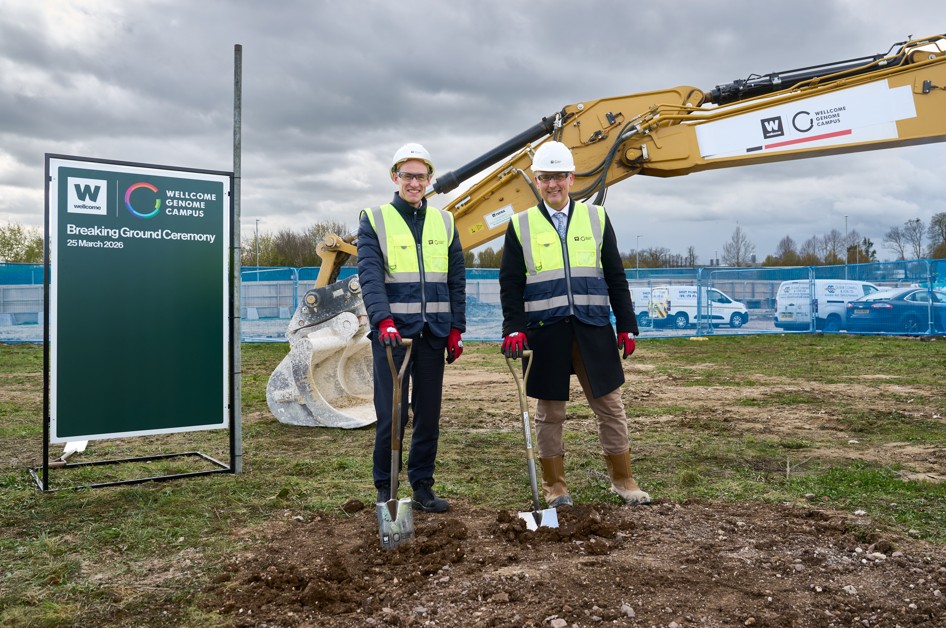
A 125-acre science campus in Hinxton began construction on Wednesday on an expansion that will more than triple its size to 440 acres, potentially housing 9,000 researchers by the end of the decade.
The Wellcome Genome Campus, already home to the Wellcome Sanger Institute and the European Bioinformatics Institute, marked the start of its first construction phase with a ceremony attended by employees, partners and local residents on 25th March.
The scale is significant. The campus currently employs more than 3,000 people working in genomics, biodata and health data science. Once complete, the expansion will create one of Europe’s largest concentrations of genomics expertise on a single site.
SDC, the construction firm first on site, will deliver 160,000 square feet of lab-enabled workspace. That’s just the opening salvo. Later this year, crews will begin work on two bridges connecting the existing campus to the expansion site, a health and fitness club, and 83 homes specifically for campus workers.
The first phase carries a completion target of early 2028. It includes what the campus describes as an “innovative microgrid power and ambient loop heating network”—infrastructure designed to support energy-intensive genomics research and data processing facilities.
Beyond laboratories, the plans incorporate padel courts, playgrounds, food venues and green spaces. These facilities will be open to the local community, not just campus staff—a detail that may ease concerns about such a large development in the Cambridgeshire countryside.
Robert Evans, chief executive of the Wellcome Genome Campus, acknowledged the lengthy planning process. “Breaking ground today marks an important milestone for the Campus, and it was fantastic to celebrate it alongside colleagues, partners and members of the local community,” he said. “These plans have been years in the making, so it’s exciting to see ground works start.”
He framed the expansion as more than infrastructure. “This expansion is about so much more than new buildings – it’s about creating a destination for people in and around the area, with new homes, green spaces, and community facilities that are open to all,” Evans said. “We want to build a Campus that is open, collaborative, and connected to the local area, while continuing to play a global role in shaping the future of bioscience and technology.”
The campus sits within the Cambridge-Milton Keynes-Oxford growth corridor, a region the government has identified as critical for life sciences investment. Backed by the Wellcome Trust, the project represents what organisers describe as one of the largest current investments in UK life sciences and technology infrastructure—though no specific figure was disclosed.
The campus already hosts organisations at the forefront of genomics research. The Wellcome Sanger Institute has contributed to major international genomics projects, while EMBL-EBI manages some of the world’s most comprehensive biological databases. The UK’s new Health Data Research Service will arrive soon, adding another layer to the campus’s data science capabilities.
Those organisations increasingly rely on machine learning and artificial intelligence to process genomic data—work that requires both cutting-edge laboratory facilities and substantial computing infrastructure. The expansion is designed to accommodate both.
For South Cambridgeshire, the implications extend beyond research prestige. The campus expansion will create construction jobs in the near term, then research, technical and support positions once facilities open. The 83 on-site homes address a practical challenge: attracting international talent to a rural location where housing costs have climbed steadily.
The transformation from 125 to 440 acres will integrate historic buildings, parklands and wetlands with contemporary research and commercial spaces. That blend—16th-century architecture alongside genomics laboratories—reflects the tension inherent in expanding a major research facility within a protected countryside setting.
By early 2028, the first new buildings will be operational. The full build-out timeline remains unclear, as does the phasing of subsequent construction stages beyond phase one.
What’s certain is the trajectory. A campus that began as a single institute has evolved into a genomics cluster rivalling similar hubs in California and Massachusetts. The 440-acre footprint positions it to compete for the next generation of biodata and health data organisations choosing European locations.
Whether the expansion attracts sufficient commercial tenants and research organisations to reach the 9,000-person target will depend partly on the UK’s ability to maintain its position in the increasingly competitive global genomics sector. Wednesday’s groundbreaking suggests the Wellcome Trust believes the investment is justified.
For now, construction crews are clearing ground in Hinxton. The bridges, laboratories and homes will follow over the next two years—assuming the project stays on schedule.