

In the 1930s, two researchers at Cambridge University needed something reliable for their experiment. John Cockcroft and Ernest Walton were attempting what many thought impossible: splitting the atom. The material they chose came from Manchester, developed by a British engineer named Cecil Reginald Burch just years earlier.
They succeeded. The Nobel Prize in Physics followed in 1951.
That same material—Apiezon, manufactured in Manchester since 1926—is still being made in the same city a century later. NASA uses it. So does Boeing, Honeywell, and CERN, where the Large Hadron Collider probes the fundamental structure of matter. What Burch created at Metropolitan Vickers as a low-pressure solution (the name derives from Greek for precisely that) has outlasted most companies, let alone products.
The centenary arrives in 2026, marking 100 years of a product range that has threaded through aerospace engineering, cryogenics research, semiconductor production, and high-energy physics. M&I Materials, which produces Apiezon today, exports it worldwide through established distributor networks. Yet production remains rooted in Manchester, where Burch first christened his invention.
Few materials can claim a resume stretching from early atomic research to modern space exploration. Fewer still remain in continuous production at their point of origin. The Apiezon range—pronounced Ap-ee-ay-zon, a detail that speaks to its longevity—represents both.
Dr Neil McSporran, managing director of speciality products at M&I Materials, acknowledged the rarity of the milestone. “Reaching 100 years is an extraordinary achievement for any product range. We are immensely proud that Apiezon, developed in Britain in 1926, is still trusted today in some of the most advanced scientific and industrial environments in the world.”
The applications span extreme conditions. Aerospace components operating in vacuum. Cryogenic systems approaching absolute zero. Semiconductor fabrication requiring ultra-high purity. High-energy physics experiments at facilities like CERN, where particles collide at near-light speed. In each case, Apiezon products provide sealing, lubrication, or vacuum integrity that more modern alternatives have struggled to match.
“From early atomic research through to modern space exploration and high-energy physics, Apiezon has consistently supported groundbreaking work,” McSporran noted. “That legacy speaks to the quality of the product and to the dedication of our team here in Manchester, who continue to manufacture and supply it to customers across the globe.”
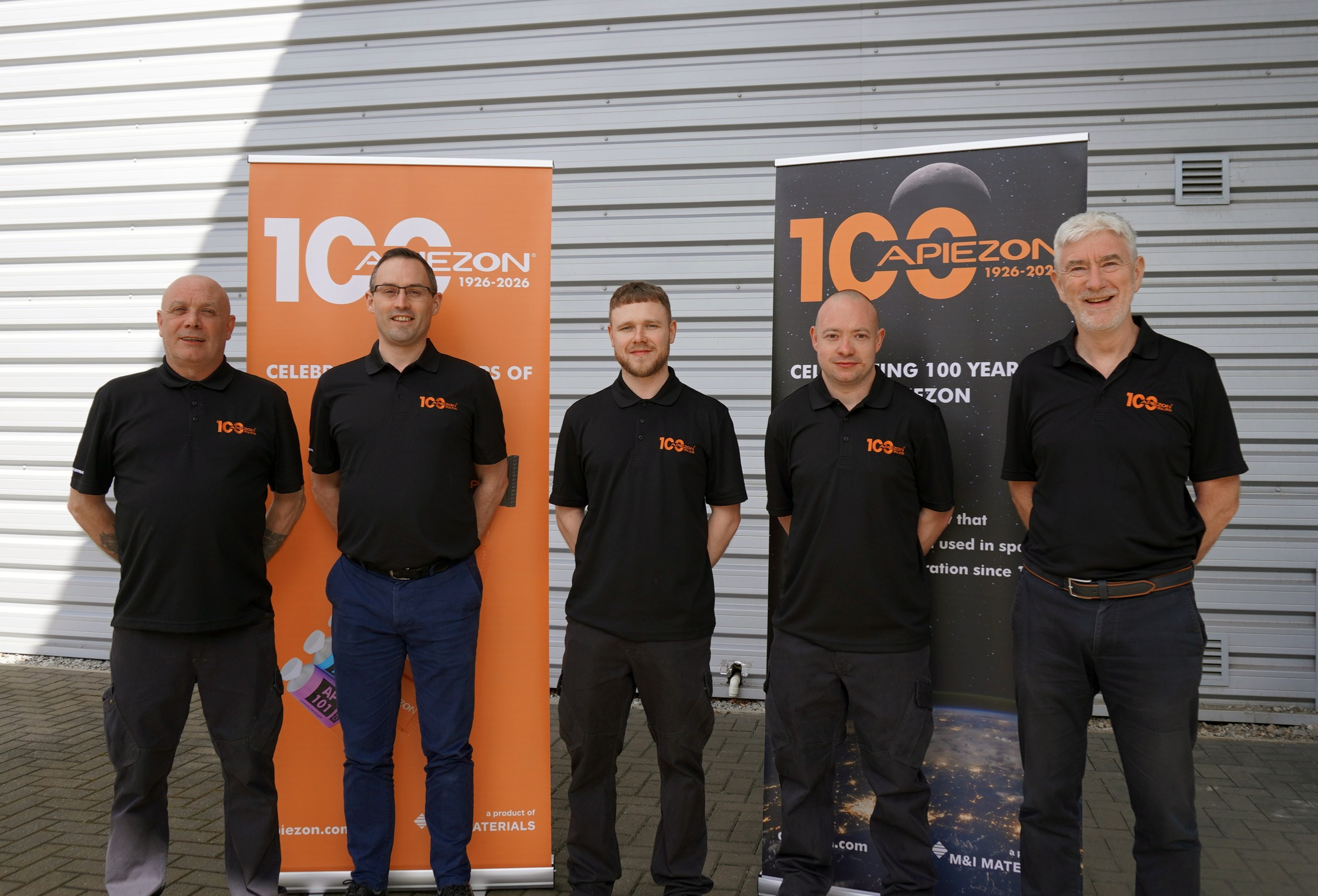
The team remains modest in size. Steve Marsh leads production as team leader. Ethan Marsh and Adam Hulse work as production operatives, maintaining manufacturing processes refined over decades. Their output reaches research institutions and industrial facilities on every continent.
Giles Salt, chief executive of M&I Materials, pointed to a broader context. “Celebrating Apiezon’s centenary is a proud moment. It also coincides with a wider milestone for M&I Materials, which has been manufacturing specialist materials for industry and science for 125 years,” he explained. “Our long heritage underpins our ability to support innovation across many industries, and Apiezon’s 100-year legacy is a perfect example of how our commitment to quality and performance has stood the test of time. We look forward to continuing this journey, helping customers achieve breakthroughs well into the future.”
That 125-year span positions M&I Materials among Britain’s enduring industrial manufacturers, though few of its product lines match Apiezon’s century-long run. The speciality materials sector has seen consolidation, offshore production shifts, and technological disruption. Apiezon’s persistence suggests either exceptional product performance or applications so specialised that substitution remains difficult.
Likely both. Vacuum technology and extreme-environment materials occupy niches where reliability outweighs cost. A failed seal in a spacecraft or a contaminated semiconductor fabrication run carries consequences that dwarf material expenses. Organisations like NASA and Boeing—where failure modes are measured in lives or billions—tend toward proven solutions.
M&I Materials is now inviting customers, researchers, and industry partners to share experiences with Apiezon products over the decades. The company hopes to gather stories of innovation and technical advancement enabled by the range, building an archive of its contribution to scientific progress.
The request may surface accounts from unexpected corners. A century offers time for a product to migrate into obscure applications, to solve problems its inventor never anticipated, to become embedded in systems where its presence goes unrecorded except by engineers who specify it by habit.
Burch, working at Metropolitan Vickers in 1926, could not have foreseen the Large Hadron Collider. He likely imagined vacuum pumps, laboratory equipment, industrial machinery of his era. Whether he envisioned his creation outlasting the company where he developed it, or supporting Nobel Prize-winning research, remains unknown.
What’s certain is that the material he named for low pressure has maintained its grip on high-stakes applications. From the Cambridge laboratory where Cockcroft and Walton split atomic nuclei to the 27-kilometre ring beneath the Franco-Swiss border where CERN smashes protons, Apiezon has been present for breakthroughs that redefined physics.
For the team in Manchester, the centenary offers a moment to reflect on continuity in an industry obsessed with disruption. They manufacture a product older than transistors, older than jet engines, older than most materials science as a formal discipline. Yet demand persists, orders arrive, and production continues in the city where it began.
The question now is whether another century awaits, or whether technologies emerging from quantum computing, advanced composites, or nanomaterials will finally render Apiezon a historical curiosity. For now, at least, the 100-year-old solution from Manchester remains relevant enough that the world’s most advanced research facilities keep buying it.