

Walk into any jury box in America, and you’ll find people who’ve watched hundreds of hours of crime television. That’s not a guess — it’s a problem prosecutors and defense attorneys deal with every day.
The “CSI Effect” has a firm grip on public imagination. It’s the gap between what crime TV teaches people to expect and what prosecutors must prove in an actual courtroom — and that gap is wider than most people realize.
Here’s the thing: the justice system doesn’t run on dramatic confessions and lab results that arrive before the commercial break.
Real criminal cases are slower. Messier. Built on ordinary evidence that rarely makes for good television.
Why TV Gets It So Wrong
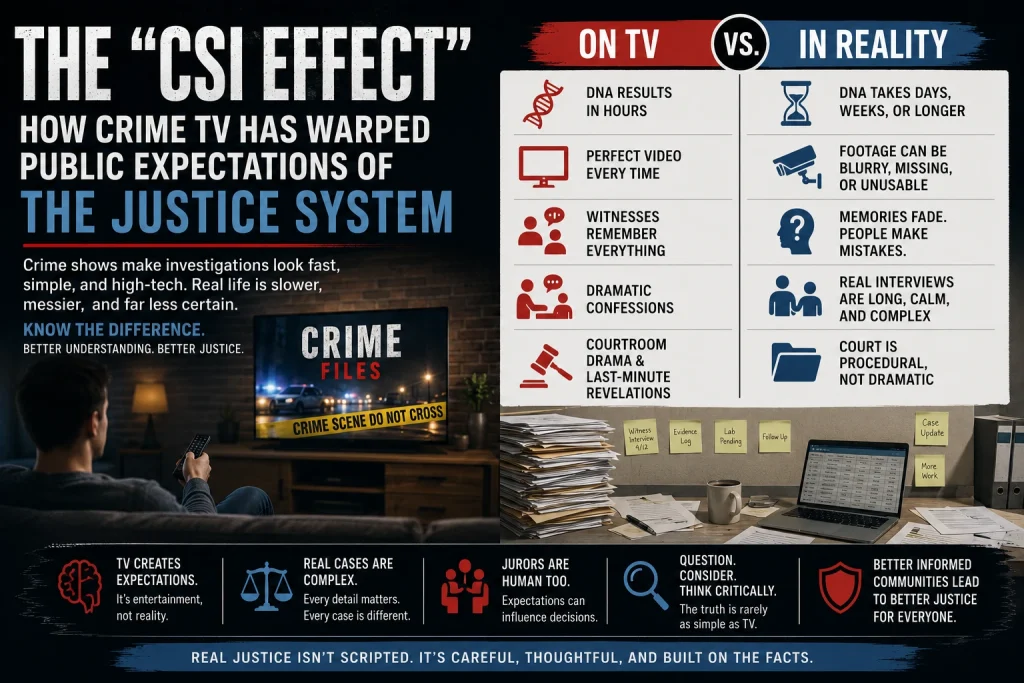
Crime shows have one job — keep you watching. So they compress months of investigation into 42 minutes, sharpen blurry surveillance footage with a few keystrokes, and wrap everything up with a tearful confession just before the credits roll.
None of that reflects how investigations actually work.
DNA processing takes days, sometimes weeks. Security cameras often capture grainy, unhelpful footage. Witnesses misremember. Suspects stay quiet. And cases built entirely on circumstantial evidence — text messages, phone records, eyewitness accounts — go to trial and result in convictions all the time, with zero forensic drama.
Television has quietly trained viewers to expect laboratory certainty. Real investigations can’t deliver that.
The “Perfect Evidence” Myth
This is where the CSI Effect causes real damage.
Many people now assume that if there’s no DNA, no fingerprints, no high-tech forensic breakthrough — the case must be weak. That assumption is wrong, and it can skew how jurors evaluate evidence.
Not every crime scene yields fingerprints. Not every case has surveillance footage. And some of the most straightforward convictions in history came from simple, human evidence: someone saw what happened, or the defendant said something they shouldn’t have.
The catch? Jurors primed by television may discount that evidence entirely — waiting for a scientist in a lab coat to confirm what common sense already established.
Interrogations Don’t Look Like That Either
You know the scene. Detective slams a folder on the metal table. Suspect cracks. Credits roll.
Real interrogations are long, repetitive, and psychologically intricate. Investigators revisit timelines. They ask the same questions differently. They build rapport over hours, not minutes.
And here’s something TV almost never shows: innocent people get nervous. They stumble over words. They forget things. They come across as evasive or emotional, not because they’re guilty, but because being interrogated is terrifying — even when you’ve done nothing wrong. Stress scrambles memory in ways no crime drama bothers to capture.
What Prosecutors Must Prove — and What TV Ignores
This is where legal reality diverges most sharply from entertainment.
Understanding what prosecutors must prove in any criminal case means understanding the burden of proof — and it’s a high one. In Florida and across the U.S., the standard is proof beyond a reasonable doubt. That doesn’t mean perfect proof. It doesn’t mean forensic proof. It means enough credible evidence that a reasonable person would have no significant doubt about guilt.
That standard exists for a reason. And yet, television has subtly shifted public expectations around it — in both directions.
Some viewers now demand scientific certainty before they’d convict anyone. Others trust forensic evidence too much, not realizing it can be contaminated, misinterpreted, or overstated. Forensic science isn’t infallible. It’s a tool, not a verdict.
The legal system still runs on human judgment, which is imperfect by design.
Courtrooms Are Not That Exciting. Seriously.
Surprise witnesses. Last-minute revelations. Emotional speeches that change everything.
Actual trials involve objections, scheduling delays, technical testimony about chain-of-custody procedures, and long stretches where nothing dramatic happens at all. Many of the most consequential legal decisions occur before trial even starts — through motions and rulings made quietly, with no jury in the room.
The courtroom drama people expect rarely materializes.
Why This Matters Outside the Courtroom
The CSI Effect doesn’t stop at the jury box. It shapes how ordinary people think about police encounters, criminal accusations, and even their own privacy.
Most people wildly underestimate how much weight digital evidence carries — texts, app data, location history — compared to the flashy forensic labs TV loves to show. They misunderstand what defenses actually look like. They assume investigations follow a predictable script.
They don’t.
The Bottom Line
Crime television can be entertaining, sure. Sometimes it even gets things right. But entertainment built around dramatic resolution is a poor teacher about a system built around legal process.
Real criminal investigations are human — full of imperfect evidence, uncertain timelines, and outcomes that don’t always feel satisfying. What prosecutors must prove is defined by law, not by what makes for compelling viewing.
The next time a fictional detective solves a murder in under an hour with flawless science and a perfectly-timed confession, enjoy it for what it is.
Just don’t bring those expectations into a jury room.