

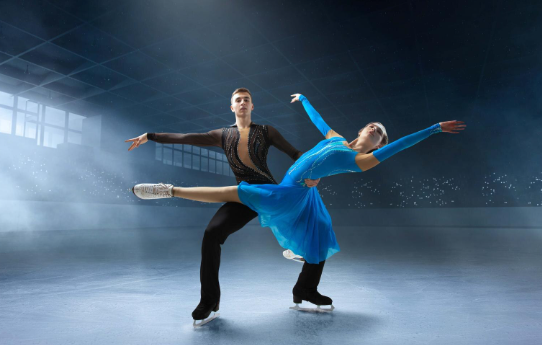
Madison Chock and Evan Bates were closing a chapter that had taken fifteen years to write when they took the ice in Milan. They weren’t just skating a program. You could practically hear the tension in their well-choreographed and emotionally compressed performance. Pairs that skated 19th out of 20 were included in the crescendo, the last act. They controlled the night for seven minutes. Their 224.39 score demonstrated both theatrical assurance and technical mastery. Not finality, though.
A few minutes later, Cizeron and Fournier Beaudry of France answered with a composed, immaculate routine. Their musicality was purposefully subdued, their edgework was flawless, and when their score of 225.82 came up, there were gasps instead of applause. Silently, the gold medal had moved. It was an old pain for Chock and Bates. Silver is frequently lovely. It can be devastating at times.
2026 Olympic Ice Dance – Key Event Summary
| Detail | Description |
|---|---|
| Location | Assago Ice Skating Arena, Milan-Cortina |
| Event Format | Rhythm Dance and Free Dance |
| Gold Medal | France – Laurence Fournier Beaudry & Guillaume Cizeron (225.82) |
| Silver Medal | USA – Madison Chock & Evan Bates (224.39) |
| Bronze Medal | Canada – Piper Gilles & Paul Poirier (217.74) |
| Top U.S. Debuts | Zingas & Kolesnik (5th), Carreira & Ponomarenko (11th) |
| Organizing Body | International Skating Union (ISU) |
| Noteworthy U.S. Pair | Chock & Bates – 4 Olympic appearances, 7x U.S. Champions |
| Reference | Olympics Official |
The Americans hardly disguised their emotional exhaustion as they passed through the mixed zone, a tangle of lights, recorders, and a hundred variations of the same question. Their responses were calm despite their glassy eyes. “That’s just how it shakes out sometimes,” Chock said, pausing momentarily in the middle of her statement. Even though that pause was brief, it said a lot.
Chock and Bates have been dominant players in international competition over the last few seasons. They have won numerous Grand Prix events, three world titles, and established themselves as a reliable standard in American ice dancing. But like the final note of a symphony suspended in midair, Olympic gold had always remained just out of reach.
Set to Ramin Djawadi’s audacious rendition of “Paint It Black,” their Milan performance was evocative—fierce, Spanish-infused, and unabashedly dramatic. With each motion, Chock’s vivid red costume, which was reminiscent of a matador, floated. Many of the audience members stood up before the last pose in response to the enthusiastic reception. It was extraordinary energy.
However, what followed appeared to sap the arena’s momentum. Despite being less enthusiastic, France’s accuracy was numerically superior. Even though the difference was only 1.43 points, it felt emotionally and statistically insignificant.
Paul Poirier and Piper Gilles of Canada, on the other hand, smiled during their medal ceremony. Their bronze had arrived as a surprise, and they clearly enjoyed holding onto it. Perhaps under pressure from recent off-ice scrutiny, the French champions, meanwhile, kept their responses low-key, possibly on purpose.
Silver has a particularly illuminating quality. It evaluates not only quality but also closeness to what might have been. Bates and Chock had previously suggested that this Olympics might be their last appearance. And while there was no official announcement, their tone indicated that a decision was quietly coming to them.
I couldn’t help but think of their promising but incomplete PyeongChang performance in 2018. The contrast was strikingly similar to listening to a demo turn into a fully orchestrated song when I watched them now, more mature and precise.
The following generation appeared just behind them. Fans and commentators were astounded by Emilea Zingas and Vadym Kolesnik’s self-assured, artistically intricate routine, which they performed while skating to Romeo and Juliet selections. They signaled a change of guard with remarkable effectiveness, finishing in fifth place.
Kolesnik appeared in disbelief. He grinned and said, “This is completely crazy,” with a hint of incredulity still in his voice. “I would have laughed if you had told me a year ago that I would place in the top five at the Olympics.” His happiness was genuine. It was honest, unhurried, and pure.
Carreira and Ponomarenko, who finished 11th with a clean, technically sound, and subtly elegant routine, also displayed impressive promise. Their international standing has significantly improved as a result of their growth, especially in the last two seasons.
Depth is now a reality for the United States, not just a pipe dream. More significantly, the bench is stylistically diverse in addition to being strong. While some skaters prefer minimalist elegance, others tend toward theatricality. For longevity in a sport that occasionally rewards sameness, that variety is especially helpful.
Ice dancing’s structure itself promotes creativity and regularity. With its emphasis on cinematic interpretation, this year’s rhythm dance theme gave skaters plenty of opportunity to express themselves clearly. Bates and Chock accepted this wholeheartedly. Even though their stories were sometimes exaggerated, they were never without substance. Each gesture had a purpose.
They created a program that felt lived in rather than practiced by incorporating delicate transitions and complex footwork. It was their signature in many respects.
Both shook their heads when asked if this silver finish would lead to a fifth Olympics. With her eyes already looking for the exit, Chock softly repeated Bates’ statement, “Not right now.” It was a deeply earned synchronization.
They have left a legacy of perseverance, ingenuity, and respect for one another through four Olympic appearances and innumerable titles. Their impact is unassailable, regardless of whether they decide to retire or change course. Zingas and Kolesnik are among the many younger teams that publicly discuss emulating their career strategy.
Milan provided a handoff rather than just medals. One generation starts its arc, another closes its loop. The way this cycle is developing, with teams prioritizing both technical range and emotional depth, is especially novel.
U.S. ice dancing has a realistic chance to stay highly competitive if it keeps helping these skaters through coaching, federation support, and international exposure. The equipment is ready. The skill is developing. Silver also shows how close the line between good and great has become, even though it can hurt.
Skating is dynamic, just like any other developing art form. It recalibrates, stretches, and bends. This was evident in these Games, which were influenced by legacy and change. And in spite of the pain, it felt like a start.