

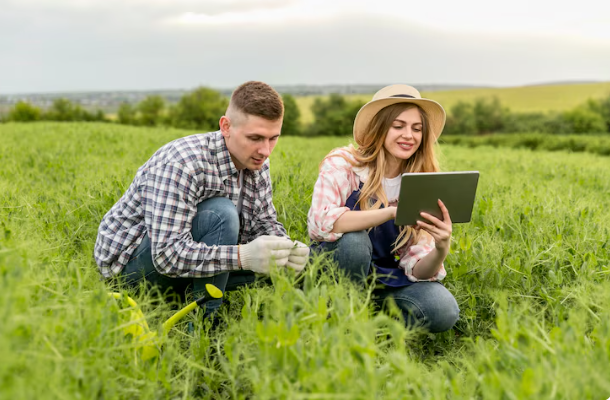
The gravel driveway opens onto a modest home surrounded by fields after curving around a faded red barn. On a bright morning in rural Ontario, a handful of people stand near a vegetable patch while a former software engineer discusses something that sounds oddly like a venture capital pitch. However, the figures pertain to carrots.
He writes numbers on a whiteboard leaning against a wooden fence and says, “Seed cost, irrigation, labor, packaging.” “The farm fails if you don’t comprehend these numbers.”
| Category | Information |
|---|---|
| Story Subject | Canadian couple transitioning from tech/corporate careers to farming |
| Location | Rural Ontario / Canadian countryside |
| Previous Careers | Technology / Corporate sector |
| Current Focus | Farming, financial literacy education, sustainable agriculture |
| Core Idea | Teaching financial management through real farm economics |
| Broader Theme | Reverse migration from cities to rural entrepreneurship |
| Inspiration Areas | Sustainable business, farm profitability, community education |
| Reference Source | https://www.fcc-fac.ca (Farm Credit Canada resources on farm financial literacy) |
It’s difficult to ignore how strange the situation seems as you watch it develop. The pair in charge of this farm used to spend their days staring at spreadsheets and coding in glass office towers just a few years ago. These days, they teach financial literacy in an environment with a subtle compost and dirt scent. Although the shift from technology to agriculture may seem idealistic, the reality is more nuanced.
The couple had well-paying jobs in the Canadian tech and corporate sectors before to relocating here, but they came with the typical rhythm of contemporary office life: long hours, video calls, product deadlines, and the silent pressure of ongoing growth targets. Something changed at some point.
It’s still unclear if it was curiosity, burnout, or just a growing awareness that the task felt abstract. A large portion of the output in the computer industry—lines of code, cloud infrastructure, and digital platforms—lives inside screens. In contrast, farming yields observable outcomes. There are tomatoes. The soil gets better. Eggs are laid by hens.
During the pandemic years, when virtual work suddenly made geographic location less relevant, the couple started considering moving away from the city. They eventually decided to purchase a small farm, which shocked friends and coworkers. The plan was straightforward at first. Live more slowly, cultivate food, and re-establish a connection with the real world.
It takes unwavering financial discipline to run a farm. equipment malfunctions. The weather might change suddenly. Weekly fluctuations occur in market pricing. Farm income rarely comes in the form of steady monthly installments, in contrast to corporate salaries. The true turning point was that learning curve.
The duo started using their tech-related analytical abilities—data tracking, cost modeling, forecasting—to comprehend farm economics. Spreadsheets monitored revenue each harvest, agricultural production per acre, and fertilizer use. Over time, the farm evolved from a lifestyle experiment to a well-run enterprise. The neighbors began to inquire.
Financial planning is a common challenge for young farmers, particularly in small farms with narrow profit margins. The pair observed that many newcomers to agriculture, especially those relocating from cities, lacked adequate training in the financial realities of farming. Thus, they started holding unofficial workshops.
Initially, the meetings were tiny, with a few farmers talking about budgeting and cash flow at a picnic table. However, news got out. At what the couple now refers to as “farm finance days,” guests began traveling from neighboring communities. Real numbers are walked through by participants.
the price of making eggs. The greenhouse tomato break-even point. The math of sustainable cattle production without financial loss. The lessons come straight from the farm’s own books rather than from abstract financial theory.
This tale is also part of a larger trend. A modest movement sometimes referred to as “reverse migration” has been garnering notice in portions of the United States and Canada. Technology, banking, and consulting professionals have started to relocate from urban areas to rural enterprises, such as vineyards, orchards, and specialized farms.
Some people want to live more slowly. Some desire more tangible labor. And some find that analytical thinking, which was formerly linked with corporate employment, is increasingly beneficial to modern agriculture. That intersection is reflected in the couple’s workshops.
Spreadsheets are taught in addition to soil health. crop rotation in addition to market strategy. It’s a hybrid strategy that combines real-world farming expertise with business education. The sessions’ appeal to younger farmers may be explained by this mix.
Today’s agriculture is under tremendous financial strain due to growing land prices, erratic weather, and shifting commodity prices. It takes more than just agricultural expertise to comprehend such factors. Financial literacy is necessary.
There’s a sense that the lesson goes beyond farming as you see a group of workshop participants figure out the actual cost of a dozen eggs while hens roam around. Everywhere, money functions in the same manner.
Income must be greater than expenses. Investments must yield profits. Additionally, when margins are narrow, minor inefficiencies can mount up. At times, the pair makes jokes about how the property has turned into an outdoor business school.
However, there’s more going on here as well. The simplicity of planting seeds and managing finances carries a quiet clarity at a time when digital platforms and algorithmic markets rule the day.
The farm becomes silent once more as people gather their notebooks and make their way to their automobiles while standing in the fields at twilight. The landscape is covered in rows of crops, and somewhere inside the barn, a calculator is sitting next to a dirty pair of boots.