

A firm recently persuaded investors to put $2.5 million into a ring in a San Francisco co-working space. Not a ring made of diamonds. Not even a very fashionable one. A large piece of circuitry and titanium that replaces the budgeting software you haven’t used in three months, keeps track of every dollar you spend, and vibrates when you’re going to go over your grocery budget. Wear it, forget about it, and let it handle your finances while you sleep is the straightforward pitch. Apparently, investors believe that’s worth wagering on.
Although the company has not yet revealed its name, prototypes of the device are already being circulated among testers in Brooklyn and Austin. The NFC contactless payment technology that allows you to tap your phone at Starbucks is included into this smart ring. However, you simply tap your palm rather than taking out a device, unlocking it, and launching an app. The ring automatically classifies the purchase, registers it, and instantly adjusts your budget. No entry by hand. Do not use spreadsheets. No guilt when you browse Mint at 11 p.m. and wonder where the money went.
| Startup Information | Details |
|---|---|
| Company Name | [U.S. Startup] |
| Funding Round | $2.5 Million (Seed) |
| Product | NFC-enabled smart ring with budgeting software |
| Launch Target | Late 2026 |
| Key Feature | Real-time spending tracking and contactless payments |
| Competitor Examples | Ultrahuman Ring Pro, Oura Ring, TAPSTER |
| Technology | NFC contactless payments + biometric tracking |
| Market Trend | Smart rings replacing smartphones for financial tasks |
| Primary Innovation | Automatic budget categorization via payment data |
| Target Audience | Millennials and Gen Z seeking frictionless finance tools |
| CES 2026 Context | Vocci AI Ring (2.8mm thick) launched for conversation recording |
| Industry Shift | Wearables moving from health tracking to financial management |
The timing seems deliberate. Smart rings are popular right now. Oura is the industry leader in health tracking, keeping an eye on heart rate variability and sleep cycles for wellness enthusiasts. In 2025, Ultrahuman submitted trademark applications for a Ring Pro that would allow you to use your finger as a digital credit card. Although their design resembles a prop from a cyberpunk film rather than something you’d wear to dinner, TAPSTER already sells rings that accept NFC payments. The Vocci AI Ring, a 2.8mm metal sliver that captures and summaries talks, was introduced by Gyges Labs at CES 2026. As each business carves out a niche, the category is rapidly fragmenting. This unidentified business is wagering that the niche that people truly need is finance.
When you follow the reasoning, you can understand why most people’s budgeting programs have failed so miserably. They need feedback all the time. Logging cash purchases, reconciling transactions, and changing categories when something is miscoded are all important tasks. It’s tiresome. Within a month, the majority of consumers stop using them. Those that persevere are typically very disciplined or very worried about money. Everyone else simply hopes for the best and periodically checks their bank account. The friction that kills typical apps is eliminated by a ring that automates the entire process—passively recording purchases, identifying spending patterns, and alerting you when you’re off course.
However, it also has a faintly dystopian quality. Every transaction is known to the ring. It is aware of where you had lunch, when you purchased coffee, and the amount you spent on rideshares at two in the morning. There must be a home for the data. Your spending history never leaves the device until you decide to sync it, according to the startup’s boasts of end-to-end encryption and local processing. It’s questionable if that pledge will stand up to investigation. Questions are already being raised by privacy advocates. Financial information is delicate. The security performance of wearable tech businesses has been inconsistent. This becomes a liability rather than a tool after just one breach.
Investors are unfazed. A combination of fintech VCs and health-tech investors contributed to the $2.5 million seed round, indicating a confidence that wearables are becoming a unified category. These days, you do more than just monitor your heart rate. You monitor your mood, productivity, sleep, and expenditures. Everything is optimized, quantified, and fed into algorithms that are intended to make better decisions than you would. It is the natural culmination of the quantified-self movement, but it is now commercialized by transaction data and membership fees.
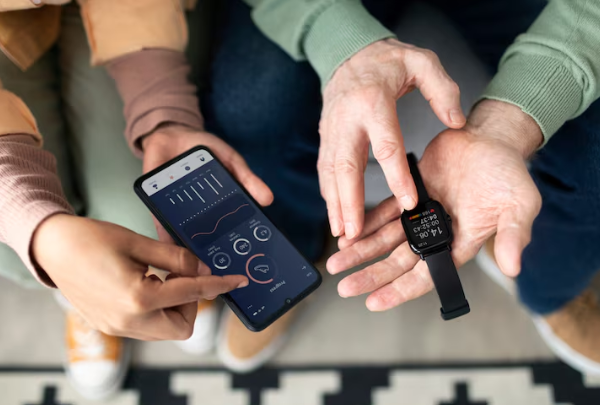
In interviews, the founder of the startup—a former product manager at a payments company—has purposefully been evasive regarding the target demographics. However, the tale is told through the design decisions. The ring is available in rose gold, brushed silver, and matte black. It is thick enough to hold a five-day battery while still being thin enough to be worn with other jewelry. Soft pastels and rounded fonts—the visual language of Calm and Headspace—are used in the accompanying software. This isn’t for Excel-obsessed accountants. It is intended for those who want their money to seem simple and nearly undetectable.
Within two years, there’s a sense that this might either become commonplace or disappear. For ten years, wearable payments have been considered “the next big thing”. There is Apple Pay. There is Google Wallet. There are contactless cards everywhere. The question is whether individuals genuinely want to wear their budget on their finger, not whether the technology works—it does. Mixed responses are reported by early testers. Some people adore passive monitoring because it allows them to finally see their spending without feeling guilty about using a budgeting software. For others, the incessant alerts are like having a helicopter parent embedded in jewelry.
Proponents claim that integration is what’s different this time. The ring serves as more than just a means of payment. It is a loop of feedback. The only thing that happens when you swipe your card is that money is taken out of your account. When you tap the ring, a gentle vibration is sent if you’re trending over. It also notes the purchase, checks your budget, and compares it to your goals. It is a personal finance application of nudge theory, which is predicated on the notion that brief, immediate interventions have a greater impact on behavior than monthly reports that you choose to ignore.
It won’t be evident until the product ships whether that is the case. Pre-orders will commence this summer, and the company plans to debut commercially in late 2026. Similar smart rings cost between $200 and $400, with extra membership fees for more advanced functions. Pricing has not yet been disclosed. For something that takes the role of a free app, that is a hefty request. However, $2.5 million can seem like a good deal if it succeeds—if individuals truly stick with it, if spending patterns actually improve, and if the passive tracking fulfills its promise. If it doesn’t, there’s always another wearable trend in the works. The former is what investors are wagering on. If they are correct, only time will tell.