

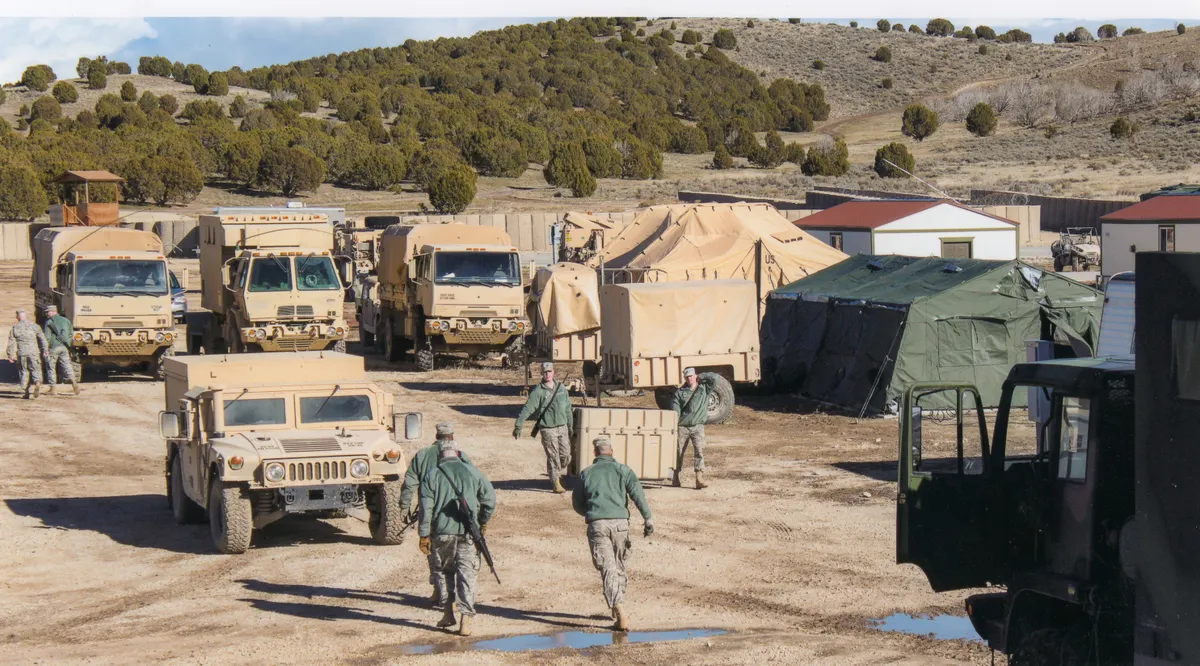
Operation Legio Viking training is pushing Ukrainian soldiers through 51-day rotations at a purpose-built camp in southeastern Poland, where Norway’s elite Telemark Battalion is combining its own warrior culture with Ukraine’s hard-won battlefield experience to sharpen the fighters heading back to the front line.
Camp Jomsborg, named after the legendary Viking fortress, was officially opened by the Norwegian and Polish Ministers of Defence on 1 October 2025, according to the Norwegian Government. Training of Ukrainian personnel had already begun earlier in the summer of 2025 in Eastern Norway, with additional phases conducted in southern Germany in cooperation with the United States, the Norwegian Armed Forces confirmed. The camp has since completed five rotations and sits roughly two hours from Ukraine’s border.
Operation Legio Viking Training Reaches Beyond the Battlefield
Norway leads the operation as the framework nation, providing the main structure and leadership for the other participating countries. The training is supported by 11 nations in total, with the Norwegian Armed Forces confirming that the operation draws all its capacities from Brigade Nord, enabling Norway to supply what Ukraine needs across infantry, mechanised units, artillery, engineering, medical services, logistics, and command functions including intelligence and communications. The operation forms part of the broader Operation Ellisiv.
Maj. John, the S3 Operations Officer responsible for synchronising the overall training, told Business Insider that the Telemark Battalion places great emphasis not only on technical skills but on cultivating a ‘warrior mentality’ that allows soldiers to fight and ‘thrive in harsh conditions.’ He asked to be identified by his first name only for security reasons.
‘We draw that warrior mentality from our Viking heritage,’ he said, ‘and the Viking culture is very important for us.’
The battalion’s emblem is a Viking ship, and its battle cry is ‘To Valhalla,’ a reference to the hall in Norse mythology reserved for warriors slain in battle. Viking-inspired signs and a large Viking ship decorate the camp’s training, eating, and sleeping areas, with streets named after figures such as Thor, the Norse god of thunder.
John was careful to define what that mentality means in practice. ‘It’s not like over-aggressive, over-eager, doing stupid stuff,’ he said. ‘We take the best parts of that Viking mentality and then apply it to the ethical and moral standards that are required of our soldiers.’
Instructors, Not Just Recruits: The Multiplier Behind the Mission
The programme is deliberately designed to train leaders rather than basic recruits. Business Insider’s reporting on Operation Legio’s training approach notes that the focus falls on specialists, instructors, and commanders, including section leaders and platoon and company commanders, many of whom already carry combat experience. A trained instructor from the programme is estimated to go on to train approximately 400 to 500 Ukrainians per year within Ukrainian training programmes, giving each rotation an outsized reach.
DVIDS reporting noted that Camp Jomsborg already had more than 200 trainers from the Norwegian Army on site alongside Ukrainian Army trainees at the time of filming.
Brigadier Atle Molde, commander of Task Force Legio, described the exchange as mutual. ‘Unit cohesion is important,’ he said, and the Telemark Battalion was seeking to take what it sees as positive in its own culture and ‘try to give that over to the Ukrainians as well. So long as it has a positive effect, it’s a good thing.’
He also noted the cultural fit. ‘For one reason or another, the whole Viking mythology, the Ukrainians like that,’ Molde said.
The name Jomsborg itself carries meaning. Molde explained that what characterised the Jomsvikings, a legendary warrior brotherhood based along the Baltic Sea, ‘was that they were very disciplined and professional warriors. So that’s where the name comes from.’
Ukraine shapes the curriculum directly. John described the camp as ‘a Ukrainian training centre,’ with Ukraine outlining what it needs, Ukrainian instructors helping to lead sessions, and the programme updated regularly based on Ukrainian feedback. That accountability, he said, ‘is what has made this an effective training mission.’
The Ukrainians arriving at Camp Jomsborg are not novices in austere conditions. Many come from years of high-intensity warfare that has included constant attacks and heavy attrition. Norwegian instructors, meanwhile, bring decades of institutional NATO experience and practices that their Ukrainian counterparts lack.
Jørgen, a Norwegian instructor at the camp, told Business Insider that training the Ukrainians was not difficult. ‘I think it’s quite incredible how eager to learn they are in general,’ he said. ‘It kind of confirms how good the guys are.’
With the programme now into its fifth rotation and the Norwegian and Polish prime ministers having visited the camp in person, the question is whether the leader-multiplier model can scale fast enough to meet Ukraine’s frontline demand before the next rotation concludes.