


Contributed content: this article was written by a third-party contributor and does not necessarily reflect the views of News Anyway. Editorial and Advertising Policy
Carrots and beets are the two vegetables that expose a weak juicer fastest. They are dense, fibrous and low in free water compared with cucumber or apple, so a machine that breezes through soft fruit can stall, overheat or spit out sopping pulp the moment you feed it a beet.
That matters if you are juicing for nutrition rather than novelty. Most people fall short of the six to eight daily servings of fruit and vegetables they are told to aim for, and a glass of carrot and beet juice is an easy way to close part of that gap. But only if the machine extracts what you paid for at the grocery store.
Here is what separates a juicer that handles roots well from one that turns them into expensive compost.
Slow grinding beats fast spinning for hard roots
There are two mechanisms worth your attention. Cold press (masticating) juicers use a slow-turning auger to crush produce against a screen. Centrifugal juicers shred the food on a spinning disc and fling the juice outward through a mesh basket.
For soft fruit, the difference is modest. For roots, it is not.
Cold press machines typically run around 55 RPM, which gives the auger time to grind through carrot and beet fiber instead of skidding off it. Reported yields land somewhere between 85 and 99 percent, with pulp that comes out dry and crumbly. Centrifugal models tend to sit in the 70 to 85 percent range, and the waste feels wet and heavy in your hand.
That gap is the clearest buying signal in this category. If you are paying for organic carrots and beets, losing 15 percent of each bag in the pulp bin adds up faster than most people expect.
Cold press juice also behaves differently once it is in the glass. It is smoother, foams less and holds up longer in the fridge, because slow extraction stirs in less air. Centrifugal juice is ready in seconds but separates within hours and often arrives with a layer of foam some people find off-putting.
The pulp tells you what the spec sheet won’t
After a run, pick up a handful of the pulp. Dry and flaky means the machine did its job. Damp and clumping means juice is still in there.
This is the single most useful test once a juicer is on your counter, and it is also the fairest way to compare machines in a showroom or a review. Yield claims vary; pulp does not lie.
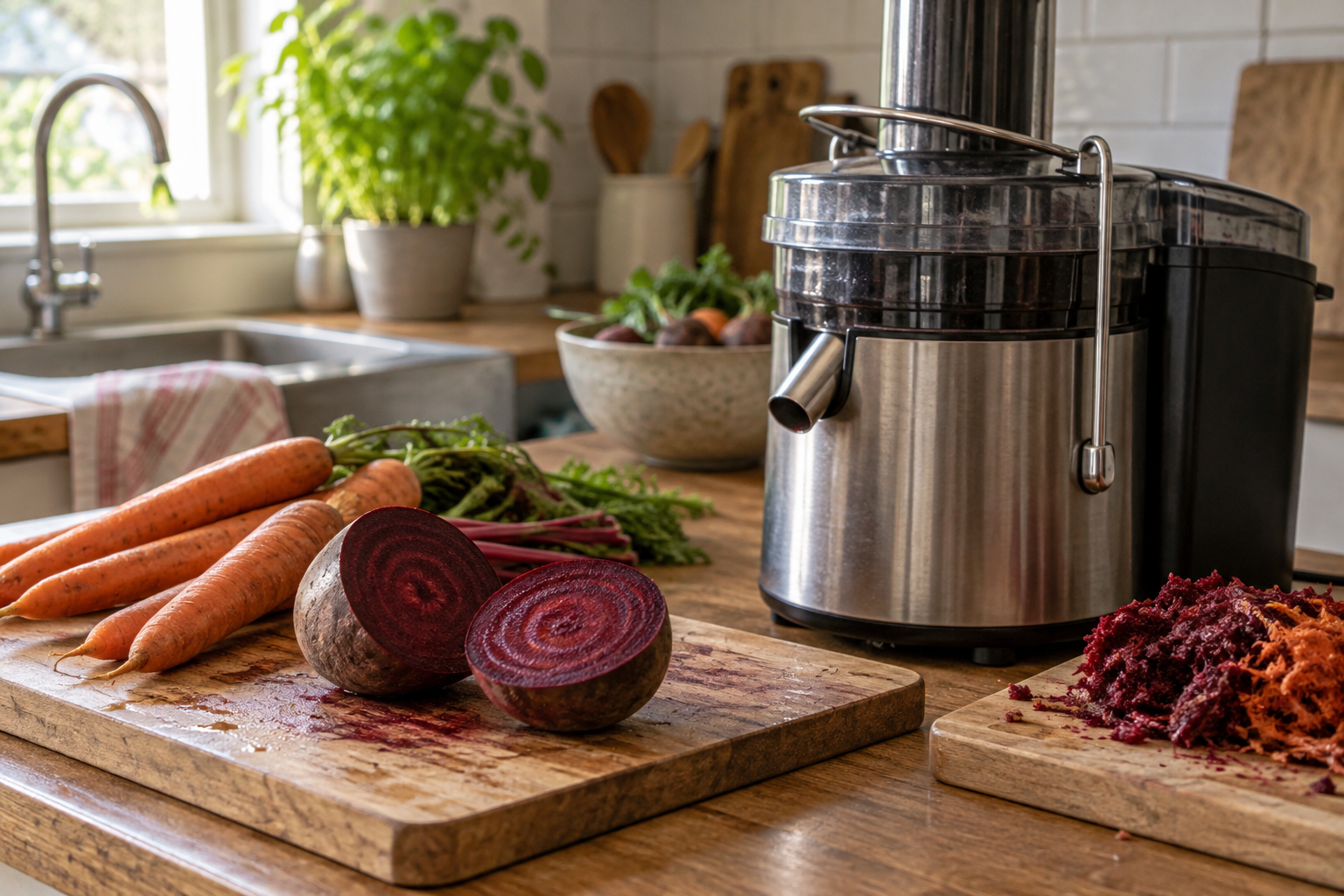
Once you’re weighing a specific motor and auger combination against the beets sitting in your fridge, it helps to see how a dedicated carrot and beetroot juicer is built across different models, since the differences in auger pitch and strainer mesh show up exactly where this guide says they will.
Motor power, and the noise that comes with it
Carrot and beet fiber is tough enough to stall an underpowered machine. As a rough guide, cold press motors rated between 150 and 400 watts handle roots without strain. Below about 100 watts, expect the auger to slow and clog.
Centrifugal motors are a different animal. They run at 700 watts and up (850 is common) because speed, not torque, is doing the work. They are loud. If you juice early in the morning or live in a flat with thin walls, a slow-speed cold press machine is noticeably more civilised.
High torque at low speed is the combination that matters for roots. A 150-watt auger grinding slowly can outperform a much bigger centrifugal motor on yield, which is counterintuitive until you watch both run.
Chute width decides whether the juicer gets used
A standard chute means you chop nearly everything. A chute of three inches takes whole apples and medium carrots. The widest designs run to around 5.8 or 6.5 inches and swallow most whole roots with no knife work at all.
In practice, moving from a standard chute to one over five inches cuts carrot prep for a typical serving from roughly five minutes down to one or two. Juice three or four times a week and that is hours back over a month.
You will still want to halve a very large beet, both for speed and because wedging an oversized root into a chute is how jams start. Even so, less prep means more juicing.
Clogging, and the features that prevent it
Fibrous roots wrap around augers. Good designs anticipate this:
- A reverse function that backs the auger out when material binds
- A two-stage auger, sometimes with a metal pre-chopping blade, that breaks roots down before the main grind
- Dual-layer fine mesh strainers (around 0.3mm) built to resist blocking from the filter side
- A safety lock that cuts the motor if the lid is opened mid-jam
Centrifugal machines rarely clog, since they eject pulp continuously into a bin. That reliability is real, but it comes with the wetter waste already described.
Cleaning effort is what keeps a juicer in rotation
The juicer you clean in four minutes is the juicer you use. The one with a mesh basket, a stiff brush and a toothpick for stuck fiber becomes a weekend-only appliance, then a never appliance.
Beets make this worse by staining anything porous. Look for dishwasher-safe parts, a small part count, an anti-drip lever that keeps the counter clean, and a design you can take apart in under a minute. One-button operation and quick disassembly sound like marketing filler until you are standing at the sink at 7am.
Counter space is part of the same calculation. Compact, under-cabinet designs get left out and used; tall machines get put away and forgotten.
Judging a machine before you buy
- Check the rated wattage against the fiber you plan to juice, not the apples
- Note the chute measurement in inches, not the word “wide”
- Count the parts that touch juice and ask how each one gets cleaned
- Look for a reverse or two-stage auger if beets are a regular item
- Ask whether the pulp is described as dry, and by whom
People who juice carrots and beets several times a week, and who care about getting a full glass out of every pound of produce, will feel the difference a root-capable machine makes within the first month. If your juicing is occasional and mostly soft fruit, a high-extraction cold press machine is more machine than the habit needs, and the pulp test above will tell you that just as clearly as it tells you the opposite.