

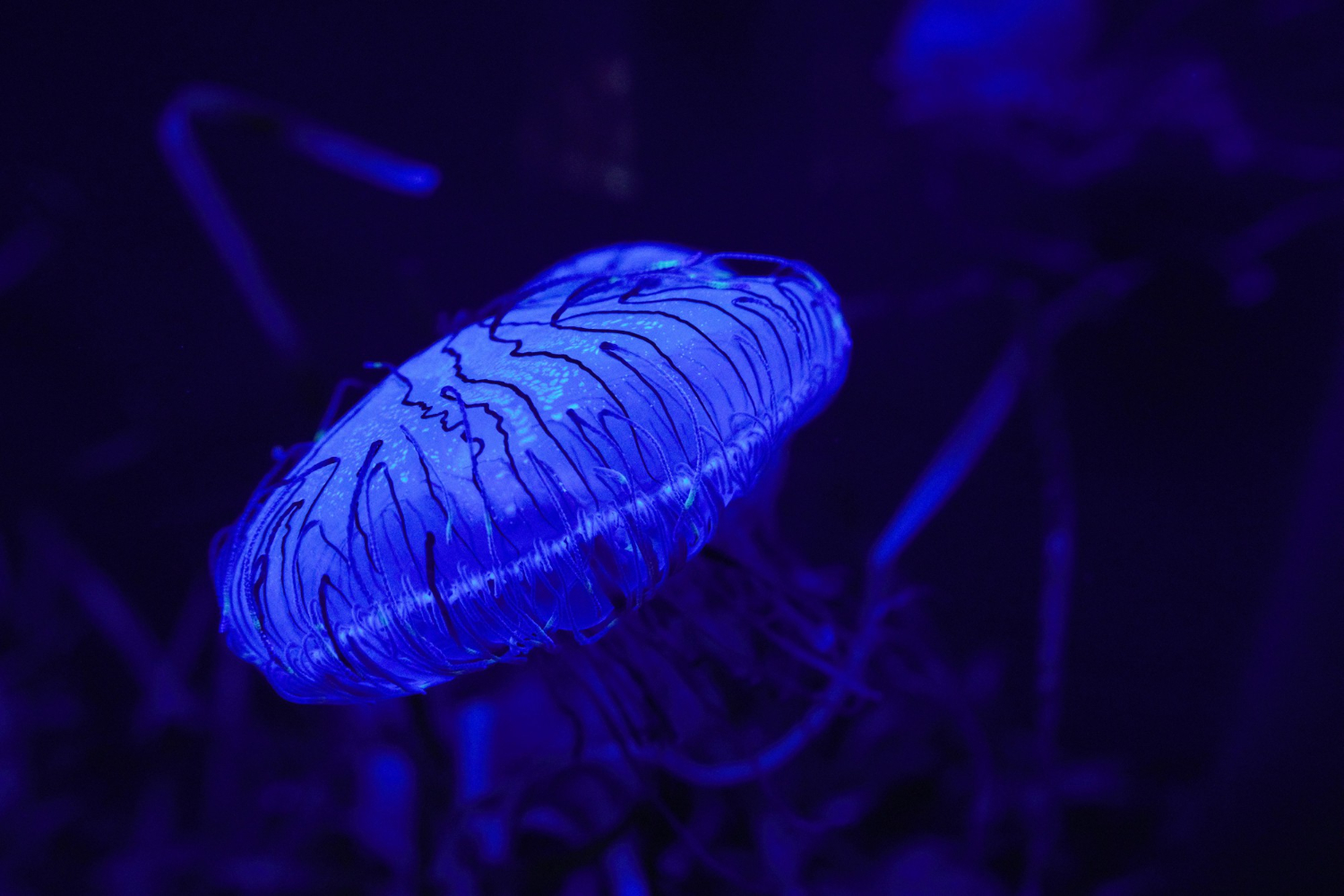
Just after sunrise on an early December morning near Newcastle, I first noticed bluebottles covering a beach. A line of cobalt blue sails stretched across the sand, resembling a child’s maritime drift-toy parade. They looked lovely at first—bright against the pale grains—but anyone who knelt down to touch one soon discovered that even beauty can cause pain.
Bluebottles are colonial organisms, a group of interdependent polyps that share a single float that functions as a tiny, translucent kite, rather than solitary jellyfish. These floats funnel toward the beach in seemingly unexpected fleets when warm currents and strong onshore winds arrive, particularly from the northeast.
| Topic | Details |
|---|---|
| Subject | Bluebottles on Australian beaches |
| Scientific Name | Physalia species (colonial marine organism) |
| Appearance | Blue translucent float with long tentacles |
| Typical Regions | NSW and Queensland coasts; recently seen in Victoria |
| Hazard | Painful stings; tentacles remain active even when washed ashore |
| First Aid | Rinse with seawater; hot water immersion advised (no fresh water) |
| Seasonal Pattern | More frequent in summer months |
Bluebottles have always been a part of eastern Australia’s beach season, but this year’s southward drift into parts of Victoria surprised and cautiously intrigued locals. The number of strandings has been especially high for this time of year, according to lifeguards and researchers, which has led to numerous beach notices, social media updates, and word-of-mouth warnings shared over morning coffee and barefoot walks.
You begin to understand how captivating even a danger can be when you picture a string of fragile blue lanterns falling onto a shoreline like lanterns from a passing festival procession. However, the color itself—bright enough to draw attention from a distance of meters—is also nature’s subliminal cue to pay attention.
Like other weather markers, surfers have learned to read these signals. A few bright, plump floats that have just washed in indicate that there are probably more close to shore. The locations where bluebottles accumulate serve as natural warning signs because they are responsive to the current circumstances rather than being random. Tiny colonies ride that flowing orchestra as winds push and currents flow.
Naturally, living close to people has made us more conscious of their existence as a group. While children’s curiosity can run wild until mild panic takes over, dogs sniff with unbridled enthusiasm. It’s important to keep in mind that, despite the pain, their sting is rarely harmful. As local surf lifesavers have repeatedly emphasized, the most effective first aid is a heat-basin of hot water after rinsing with seawater—never fresh water—which significantly reduces pain by neutralizing venom proteins.
Residents and visitors to Ocean Grove, a popular vacation destination in Victoria, have been cautiously navigating around clumps of bluebottles in recent weeks, realizing that even partially translucent remnants can be painful. Particularly, dogs have learned to avoid the brightly colored hazards by circling them. The community’s prudence has been encouraging; they are accountable, watchful, and open without fear.
According to experts like Dr. Jaz Lawes of Surf Life Saving Australia, this season’s unusual weather patterns probably pushed these marine visitors farther south than usual, underscoring the connection between atmospheric changes and coastal ecosystems. She is involved in joint efforts to more accurately predict bluebottle arrivals, similar to how we currently predict swells and tides.
Practically speaking, that can mean the difference between a more vigilant, prepared stroll along the water’s edge and an unguarded dip in the shallows. This forecasting effort is especially creative since it combines information on wind direction, ocean temperature, and historical trends to provide a more accurate picture of potential stranding locations and times.
It struck me how much this marine phenomenon had become ingrained in beach fluency—something far beyond folklore, something lived and learned—when I once watched an experienced lifeguard scan a shoreline lined with bluebottles, describing them with the same meticulous precision as a meteorologist might describe cloud formations.
Similar to how they would check sunscreen supplies or umbrella weights, families planning summer vacations now check bluebottle advisories in addition to surf conditions. In certain communities, beach access signs sprout warnings about stinging tentacles in addition to rips, and apps and text alerts notify subscribers of recent sightings.
There is a benefit to the abundance despite the occasional sting. When hundreds or thousands of these organisms are spread out on the sand, they act as a visible warning system, guiding beachgoers to stay clear of them before getting into the water, according to local medical expert Dr. Carl Le. In a very obvious way, that type of natural signage is protective.
“Is it a bluebottle?” is the first question that kids have quickly learned to ask after crouching to examine a shimmering shell. These days, parents and grandparents also tread carefully, teaching a generation that the natural world can be both welcoming and respectful.
Aside from their small tentacles, bluebottles can also be surprisingly resilient, maintaining their potency for hours after washing ashore. Councils have responded to this information by updating signage at beach entry points and deploying lifeguards equipped with hot water stations—a community adaptation that feels encouraging and useful.
Best practices are also being shared by community organizations. Boardwalks and kiosk stands now frequently have basic beach kits with seawater bottles, gloves for safely removing tentacles, and clear instructions. It is a subtly proactive reaction to an innate rhythm that isn’t always in harmony with human inclinations.
There is a positive vibe about these yearly visitors when speaking with surf club volunteers. They express admiration for how beach communities come together, exchanging advice, keeping an eye on each other’s kids, and gently warning newcomers to exercise caution. The ability of the group to adjust with care and agility is something to be proud of.
With careful mapping and forecasting, some scientists even hope that beachgoers will be able to anticipate this phenomenon with the same fervor they do for rare bird sightings or humpback migrations. As a normal part of the ecological calendar for summer, not as a threat.
One observes how this straightforward creature—lightweight, wind-driven, and blue—can start discussions about topics beyond stings, such as currents, coastal change, and how much firsthand local knowledge enhances a beach visit, while strolling along a strand where bluebottles have gathered.
Respect has always been expected on Australian beaches, but those who are prepared to pay attention will be rewarded. Another layer to that coastline literacy is the presence of bluebottles, even in unexpected numbers. They serve as a stark reminder that beaches are dynamic environments that are shaped by both beautiful and elemental forces.
Bluebottles, despite the caution they bring, have become a part of the seasonal landscape, noticeable enough to warrant notice but familiar enough to engender confidence that summer at the shore can still be a joyful and extraordinarily rich experience with awareness and care.