

The morning routine at a certain elementary school in Bundang, which is located just south of Seoul, is essentially unchanged from ten years ago. The fragrance of cafeteria rice wafting down hallways, children wearing matching tracksuits, and the tiny commotion of backpacks being dumped onto plastic chairs. What occurs when the bell rings makes a difference.
By March 2025, each student in that classroom had access to a tablet running an AI digital textbook, and forty separate lessons were being taught simultaneously instead of just one at a single pace. As a referee rather than a lecturer, the teacher moves between them.
| Topic Snapshot | Details |
|---|---|
| Subject | South Korea’s national AI-led education initiative |
| Target Year | 2030 |
| Lead Authority | Ministry of Education |
| Key Tool | AI Digital Textbooks (AIDT), launched March 2025 |
| AI Talent Investment | 1.4 trillion won (~$960 million USD) |
| Schools Integration Budget | 900 billion won through 2030 |
| Teacher Training Allocation | $740 million USD between 2024 and 2026 |
| AI Course Expansion | Specialized high school AI content rising from 20% to 50% |
| National Goal | Top three global AI powerhouse by 2030 |
| Major Concerns | Privacy, screen time, the digital divide, declining empathy |
| Demographic Driver | Rapid population decline pushing educational efficiency |
This is the real implementation of South Korea’s 2030 plan. Although it is more intriguing and difficult to sum up, the headlines elsewhere portray it as taking the place of human teaching. Instead than just replacing one individual with an algorithm, the nation is reconstructing what a classroom is.
Just the investment figures—1.4 trillion won for AI talent, 900 billion won for school integration, and $740 million set aside specifically for teacher retraining—indicate that the government has made a commitment before the public is entirely on board.
A portion of the incentive comes from demographics. The workforce is contracting more quickly than reform can keep up, and South Korea has one of the lowest birth rates in the world. In a subtle manner, every classroom is a predictor of the country’s potential. The system will need to accomplish more with less if there are fewer doctors, engineers, and teachers in the future.
AI digital textbooks are being positioned as a sort of educational survival tactic since they can instantly adjust to a student’s speed and spot gaps that human professors sometimes overlook in a class of thirty. The next five years will show whether or not that frame oversells the technology.
Rather than being removed, the function of the teacher is being redefined. AI manages progress tracking, course customisation, and grading according to the government’s own roadmap. Mentoring, emotional intelligence, classroom dynamics, and the messy creative labor that machines still find difficult are tasks best left to humans.
Speaking with younger Korean teachers, it seems like some of them are happy about the change. They have been overburdened with administrative tasks for years, leaving little time for the teaching they were trained to do. Naturally, older teachers are more dubious. A tiny but outspoken parents’ organization has voiced worries about screen time and what they see as the gradual removal of human warmth from early education, and some have openly opposed the reforms.
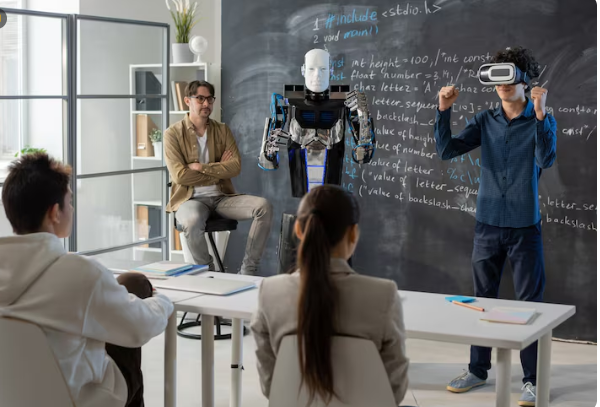
Everything is clouded by the hagwon question. For many years, South Korea’s educational psychology has been influenced by the country’s tens of billions-dollar private cram school sector. Often more aggressively than public schools, some hagwons have already begun incorporating their own AI platforms.
Education researchers have discreetly conceded that there is a chance that the implementation of AI would increase rather than decrease the achievement gap, with affluent families buying high-end AI coaching while public schools rely on national standards. It’s actually uncertain if the government can maintain fair competition.
Concerns about privacy coexist with those for education. Large volumes of student behavioral data are gathered by each AI tutor, including how long a child pauses on a question, what kinds of errors they make repeatedly, and how their focus changes throughout a lesson. Opponents contend that no prior generation of students has seen this degree of surveillance and that the long-term effects, especially for kids growing up completely inside this system, have not been adequately considered.
The historical pattern is difficult to ignore. Korea has previously done this in various ways. the early 2000s drive for school digitization. The 2010s smart classroom initiatives. Every wave was intended to revolutionize education, but in the end, they all settled into a more modest reality than the headlines implied. How seriously the government treats the human side of things will determine how the AI tutor age unfolds. The machines will show up on time. It remains to be seen if the empathy endures.