
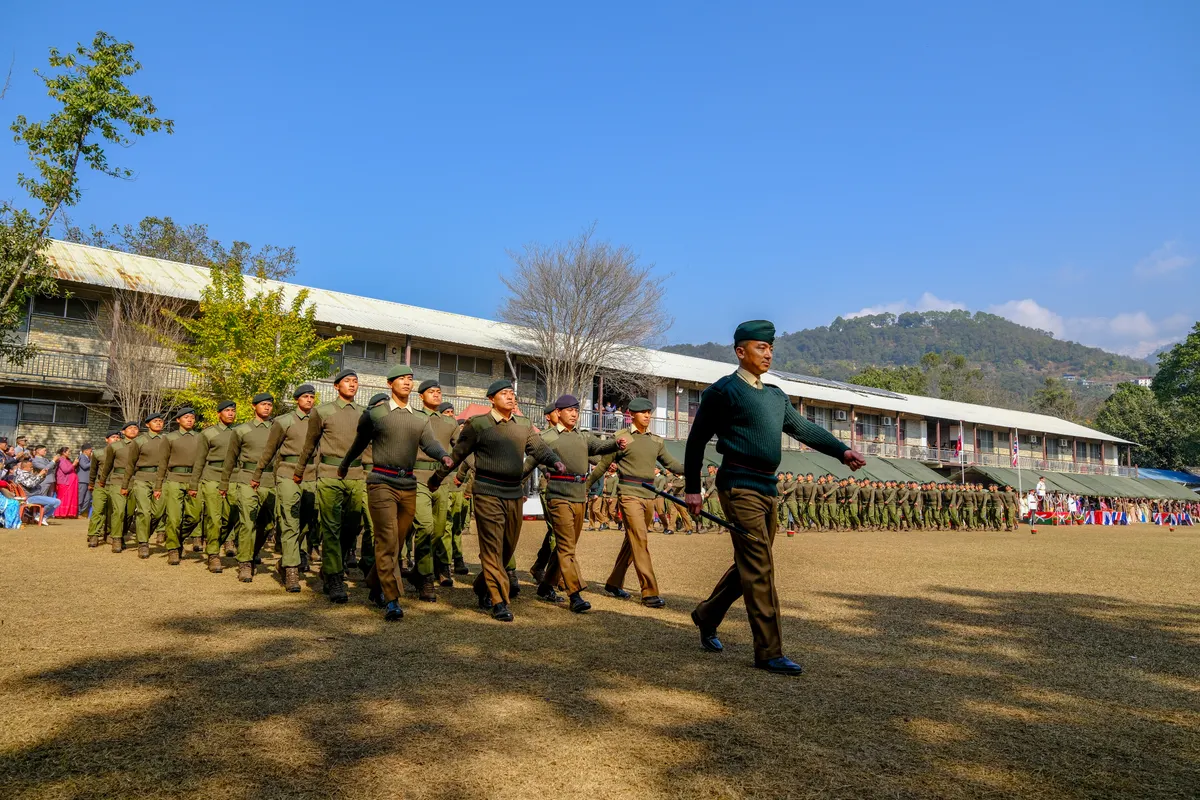
Russia school military training hours are set to double from September 1, after education minister Sergei Kravtsov announced that 50% of the compulsory national defence course would be dedicated to military instruction, up from 20% previously.
The course, titled ‘Fundamentals of Homeland Security and Defense’ (OBZR), runs to 34 hours of material each school year for pupils in 6th to 11th grade. Under the new allocation, at least 17 hours per year will now be devoted to basic military training, covering topics that include uncrewed aerial vehicles, field exercises, first aid, basic firearm handling, and how to use a hand grenade.
Russia School Military Training: What the Curriculum Now Includes
The OBZR course has a short but rapidly evolving history. Meduza reports that a basic military training module was first incorporated into the older ‘Fundamentals of Life Safety’ (OBZh) lessons in 2023, before OBZh was fully replaced by OBZR in 2024. The expanded military content represents a further acceleration of that trajectory.
Forbes Russia describes the change as a 2.5-fold increase in initial military training hours within OBZR, taking effect in the 2026/27 school year. A drone module is among the additions, reflecting the prominence that uncrewed aerial systems have assumed in Russia’s war in Ukraine.
Alongside the military content, Meduza also reports that Russia will introduce a new subject from September 1 called ‘Spiritual and Moral Culture of Russia,’ for which documentary films will be produced about 83 Russian military personnel who participated in the war in Ukraine.
The revised curriculum also echoes the Soviet-era Initial Military Training, a compulsory subject for older pupils that included drill, first aid, rifle handling, and field-exercise camps. That course was abolished in 1993 but elements were reintroduced after Russia’s full-scale invasion of Ukraine began in 2022.
Pressure on Schools and Plans for a Separate 64-Hour Course
Compliance with the existing military training requirements has already become a legal matter. Independent Russian media outlet Vertska reported that prosecutors filed over 200 lawsuits against schools in 2024 for failing to install facilities such as shooting ranges.
Russia is also considering going further still. In April, authorities discussed reviving the Initial Military Training programme through a separate 64-hour course focused on discipline, combat, and survival skills. Kommersant reported that officials were discussing a pilot programme for the new format starting in September for 9th- to 11th-graders in 10 regions, including occupied Crimea.
A final decision has not been taken on that proposal. And the timeline for full implementation of a dedicated Initial Military Training course is not short: Fontanka.ru cited an April assessment, reported by Kommersant, that rolling out such a course in Russian schools would require no fewer than five years.
The political momentum behind the push, however, is considerable. Multiple Western leaders, including UK Prime Minister Keir Starmer and NATO Secretary General Mark Rutte, warned earlier this month that Russia may be ready to launch a large-scale attack on Europe by 2030. Moscow has cited those warnings in domestic discussions about accelerating military readiness among schoolchildren.
Viktor Vodolatsky, First Deputy Chairman of the State Duma Committee on CIS Affairs, told local media on 22 June that, in light of the NATO statements, pupils should begin war-relevant classes after the 5th grade. ‘Russian children should be prepared for war with NATO and the European Union immediately after primary school,’ he said.
The question now is whether the 64-hour standalone course clears its pilot phase and reaches a national rollout before the 2030 deadline that Western intelligence assessments have fixed as a potential flashpoint.