

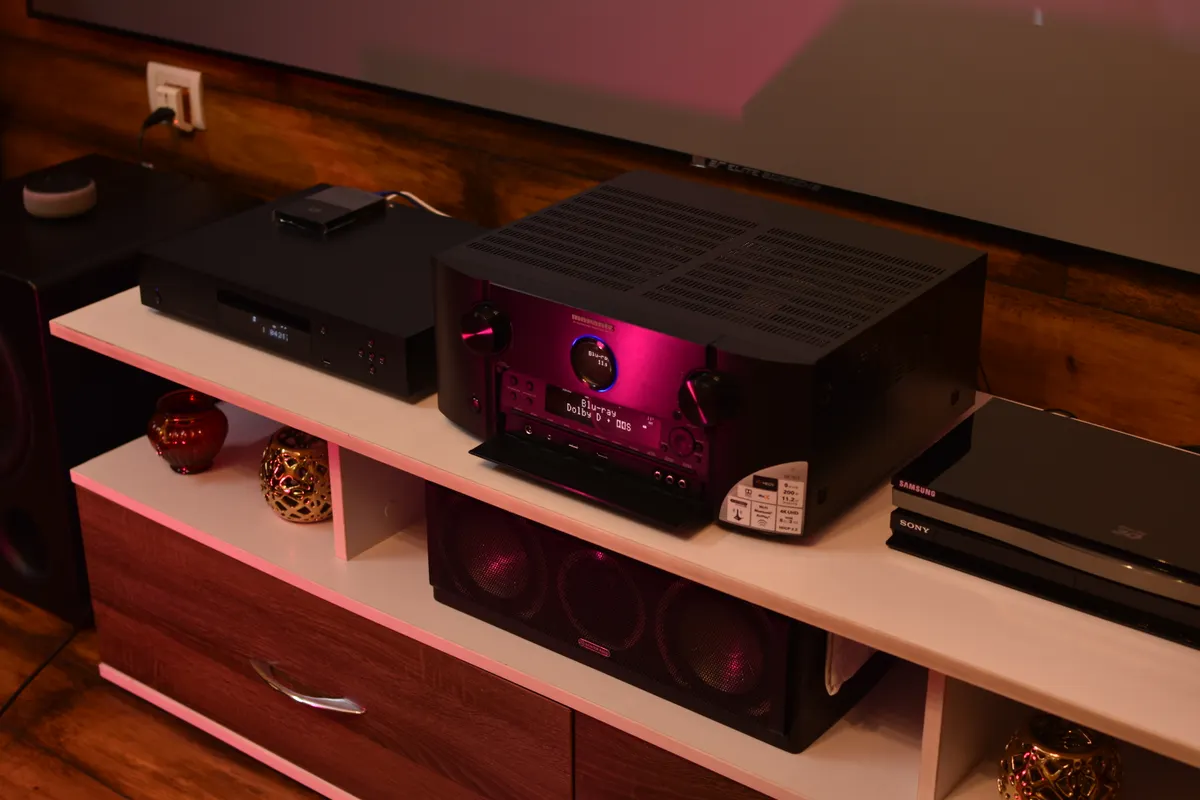
The best surround sound systems in 2026 divide into two clear camps: all-in-one soundbar packages that trade some raw performance for simplicity, and multi-speaker setups built around an AV receiver that deliver a genuinely cinematic result. Choosing between them comes down to how much space, budget, and cabling tolerance you have.
Samsung Q990F leads the best surround sound systems for convenience
Samsung’s HW-Q990F is the pick for anyone who wants a complete Dolby Atmos system without wrestling with speaker placement or AV receiver menus. The box includes a 48.5-inch soundbar, two wireless rear speakers, and a wireless subwoofer, delivering 11.1.4 channels and 756W of combined power.
The soundbar itself is more complex than it looks. According to AVS Forum’s review, the main bar houses 15 drivers: six elliptical midrange drivers, three forward-facing tweeters, four side-firing speakers, and two upward-firing speakers for Dolby Atmos height effects. Connectivity is equally well-stocked: three HDMI 2.1 ports (one supporting eARC) sit alongside optical and AUX inputs.
On the wireless side, Samsung’s UK product page confirms the Q990F supports Bluetooth 5.3, Wi-Fi, Chromecast, Spotify Connect, and AirPlay, covering most streaming scenarios without an external device.
The redesigned subwoofer is a meaningful hardware update. Samsung’s newsroom states it is half the size of its predecessor, with a sealed enclosure to reduce cabinet vibration. Despite the smaller footprint, it delivers substantial low-frequency output at default settings. The Q990F carries an MSRP of $1,999, though it is frequently discounted.
The HDMI 2.1 inputs support 4K/120Hz passthrough with variable refresh rate, making the Q990F practical for PS5 and Xbox Series X users. Alexa voice control is built in, and Q-Symphony lets the bar pair with compatible Samsung televisions to incorporate the TV’s own drivers into the soundfield.
The system cannot match the dynamic range or spatial precision of a full speaker array, but for its size and price, it is hard to better.
Klipsch Reference Premiere: for enthusiasts prepared to invest
For those willing to spend more and accommodate larger cabinets, Klipsch’s Reference Premiere series represents a step up in performance that no soundbar currently matches. The recommended 5.1.4 Dolby Atmos configuration pairs two RP-8060FA II floorstanding speakers, two RP-600M bookshelf speakers, a pair of RP-500SA height speakers, an RP-504C centre channel, and an RP-1000SW subwoofer.
The RP-8060FA II is central to the setup’s Atmos capability. Klipsch’s product page describes an integrated 6.5-inch two-way up-firing Dolby Atmos driver built into the top of the floorstanding cabinet, removing the need for separate ceiling or height speakers. Klipsch’s support documentation confirms the second-generation Reference Premiere line launched in 2022, with larger horns and refined woofers that produce less distortion than the original 2014 models.
Klipsch’s proprietary Tractrix Horn-loaded tweeter technology is designed to provide better power efficiency and more precise high-frequency directionality than conventional dome tweeters. The result, in practice, is a speaker that plays loud without hardening in the upper registers.
The full 5.1.4 configuration costs between $4,000 and $5,550 for the speakers alone, depending on current discounts. A compatible nine-channel AV receiver adds a further $1,500 to $1,800. That outlay is justified for dedicated home cinema rooms, and Klipsch’s modular approach means you can start with two speakers and expand over time.
Dolby Atmos works by encoding each sound object’s position as X, Y, and Z co-ordinates in metadata, where the Z-axis represents elevation. Dolby’s professional documentation confirms this object-based approach, which allows a soundtrack to scale across any speaker layout, from a 5.1.2 setup to a full 11.1.4 array, by mapping each object to the nearest available driver. For optimal up-firing speaker performance, Dolby recommends a flat ceiling between 7.5 and 12 feet high.
Behind the scenes, Samsung’s audio ambitions extend beyond its own brand. AVS Forum notes that Samsung subsidiary Harman has agreed to acquire the audio business division of Masimo, taking ownership of brands including Bowers & Wilkins, Denon, and Polk Audio, with Samsung stating its aim is to consolidate its position as the global number one in consumer audio.
For buyers not yet ready to commit to the Klipsch outlay, Sony’s Bravia Theater System 6 offers a classic 5.1-channel experience in a single, affordable package without requiring a separate receiver. The Bravia Theater Quad steps things up with a four-speaker wireless 4.0.4 Dolby Atmos layout, though its low-frequency performance benefits from adding an optional wireless subwoofer at an extra $400 to $600.
The practical dividing line is simple: if straightforward setup and a clean living room matter more than outright performance, the Q990F delivers everything in one box. If sound quality is the priority and the room can accommodate it, the Klipsch system sets a benchmark that no soundbar in this price range touches. The Denon AVR-X3800H, with its multiple HDMI 2.1 ports and nine-channel amplification, is the natural receiver pairing for that configuration.