

The Google Pixel 11 Pro Fold review verdict, after a week of daily use, is familiar: incremental gains, a sharper price, and a growing list of rivals that make the $1,899 entry point harder to justify. Kerry Wan, senior contributing editor at ZDNET, tested the device and returned to the Samsung Galaxy Z Fold 8 after seven days.
A $100 price rise on a largely unchanged design
The Pixel 11 Pro Fold costs $1,899 for the 256GB model, up $100 from last year’s Pixel 10 Pro Fold, which launched at $1,799, according to Yahoo Finance. Higher storage options run to $2,019 for 512GB and $2,249 for 1TB, all with 16GB of RAM, according to Droid-Life.
Visually, the three most recent Pixel Pro Fold generations are near-identical. Google has trimmed bezels to let the 6.5-inch outer display sit more flush with the frame, and material changes bring the weight to 239 grams, down from 258 grams on the Pixel 10 Pro Fold. The Galaxy Z Fold 8 sits at 201 grams, so the Pixel is still heavier.
Durability is a genuine selling point. The outer screen uses a new glass-ceramic material Google says is more than twice as scratch-resistant as its predecessors. The IP68 rating protects against everyday splashes and dust. Google’s official blog adds that a new gearless hinge design makes the phone three times more durable than previous models, and for the first time both the 6.5-inch external panel and the 8-inch internal display use the company’s Super Actua screen technology, which Mashable reports is 20% brighter than the previous generation.
The outer display peaks at 3,600 nits, up from 3,000 nits on the Galaxy Z Fold 8. Outdoor legibility is a clear step forward, and moving from the Samsung to the Pixel in direct sunlight, the difference is immediately visible. The persistent shortcoming is the squarish inner display, which produces thick letterboxing on 16:9 video.
Pixel 11 Pro Fold review: where the Tensor G6 leads and lags
Google claims the Tensor G6 delivers 25% faster web browsing and 15% quicker app launches compared to the Tensor G5, and processes on-device AI tasks up to 3.5 times faster while using up to 3.5 times less energy, thanks to 50% more TPU compute paired with the latest Gemini Nano model, according to Google’s newsroom. In everyday multitasking, the reviewer found those gains real: the phone handled a large app transfer with few hiccups.
The raw GPU picture is less flattering. Android Central reports the G6 uses a PowerVR CXTP-48-1536 GPU alongside a MediaTek M90 modem and an upgraded Titan M3 security chip. About ten minutes into a 3DS emulator session, frame drops appeared and the back cover warmed noticeably.
Battery life is adequate but unspectacular. The reviewer recorded 10–15% remaining by dinner. The battery capacity sits at either 4,750 mAh or 4,806 mAh depending on the source: T-Mobile and Droid-Life list 4,750 mAh, while the report cites 4,806 mAh. Either way, it is a reduction from the 5,015 mAh in the Pixel 10 Pro Fold. The Google Store claims 24+ hours of typical use. Wired charging hits 50% in around 30 minutes at 30W with PPS support, and wireless charging via the Pixelsnap magnetic system reaches 25W Qi 2.2, a 20% improvement over the prior generation, Mashable reports.
AI features and the camera gap
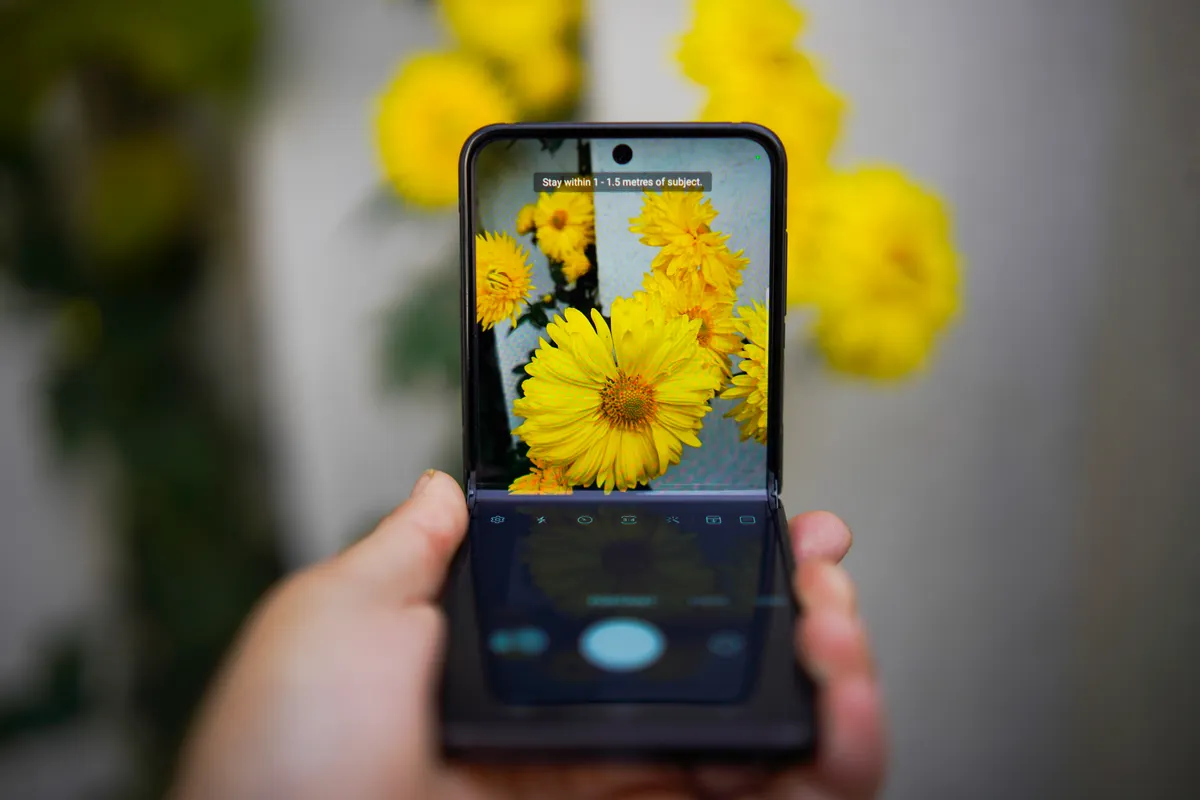
The rear camera array comprises a 48 MP wide sensor, 10.5 MP ultrawide, and 10.8 MP 5x telephoto with Super Zoom up to 30x, according to T-Mobile’s spec page. Google says the new main sensor captures more than twice as much light as its predecessor, though the reviewer found output largely similar to the Pixel 10 Pro Fold, with aggressive HDR flattening the dynamic range.
The AI camera additions are more useful than the hardware alone suggests. Magic Capture automatically pulls still frames from video as you record. An on-screen teleprompter scrolls as the phone detects your reading pace. A new sign language-to-text feature, introduced with this model, translates signing via the camera to help deaf and hard-of-hearing users communicate with non-signers, Mashable reports.
Buyers who purchase the Pixel 11 Pro Fold receive six months of Google’s AI Pro subscription, which Google values at $119.94, covering expanded Gemini usage, 5TB of cloud storage, and Google Health Premium.
A crowded $1,899 market
The pricing context matters. Android Central notes the Samsung Galaxy Z Fold 8 Ultra carries the same $1,899 starting price. The Pixel’s strongest claim over those rivals is build quality and software longevity. It is also the only foldable this year to natively support Qi2 magnetic charging.
Apple’s anticipated iPhone Fold looms over the 2027 market. If the Pixel 11 Pro Fold cannot widen its differentiation before that launch, the calculus for prospective buyers will only get harder.