

Africa’s natural gas demand is projected to rise 60% by 2050. Gas is the only fossil fuel expected to gain share of global primary energy over that stretch, according to the African Energy Chamber’s State of African Energy 2026 Outlook. Continental demand climbs from roughly 55 billion cubic meters a year in 2020 to more than 90 billion cubic meters by 2050, driven mainly by residential, industrial and power-sector consumption.
Sub-Saharan Africa will supply most of that growth. The region holds more than 400 trillion cubic feet of recoverable gas, 70% of the continent’s total reserves, and the AEC outlook itself says sub-Saharan Africa will drive future output growth. North Africa still accounts for roughly two-thirds of Africa’s gas output today. That share won’t hold indefinitely.
Gas Was Written Into the Strategy From the Start
When Farhat Bengdara took the helm of Libya’s energy sector, crude output had fallen to roughly 660,000 barrels a day. A licensing freeze had lasted 17 years by that point. Production reached 1.4 million barrels a day by the time he left, alongside a turnaround plan that treated gas as a core pillar of the recovery rather than a secondary bet on oil’s decline. Bengdara worked with the consultancy Kearney to build that plan around four elements. “There was a complete strategy with four pillars,” he said.
Capability, environment and governance rounded out the plan. Gas got its own dedicated monetization strategy, developed with Ernst & Young, that put Libya’s underused reserves on a production timeline rather than leaving them as a line item in the country’s broader hydrocarbon plan.
Libya’s proven gas reserves stand at 53 trillion cubic feet, the fifth-largest in Africa. Output hasn’t kept pace with the reserve base for years. Eni’s agreement to develop the offshore Structures A and E fields, expected to generate $7 billion to $9 billion in investment and reach 750 million cubic feet a day once fully online, is the strategy’s clearest sign of movement so far. That gas, along with existing output from the Bahr Essalam and Wafa fields, feeds the Greenstream pipeline to Sicily, Libya’s direct link to the European market.
Infrastructure Still Runs North
Reserves are shifting south, but the export infrastructure built to move African gas to market still runs north. North African producers have a window before the sub-Saharan supply wave arrives in force.
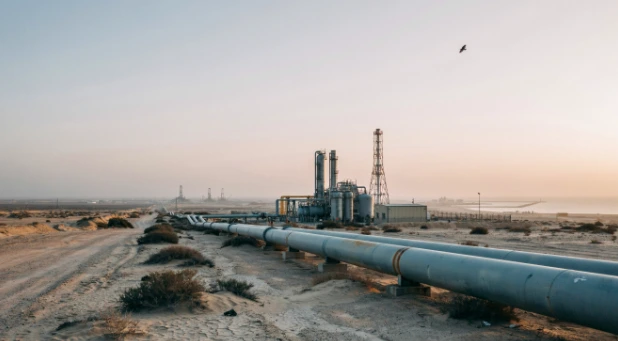
Trans-Saharan Gas Pipeline construction is roughly 60% complete: designed to carry up to 30 billion cubic meters of Nigerian gas a year to Algeria’s Mediterranean coast for export, the line has about 2,400 of its 4,128 kilometers already laid. Once finished, it will route sub-Saharan gas through the same North African export corridors, Greenstream among them, that Libya, Algeria and Egypt have spent decades building and financing.
North Africa’s advantage rests less on reserve size now than on the pipelines, LNG terminals and buyer relationships already in place. Reaching European and Asian markets from land-locked or newly developed sub-Saharan fields typically means routing through North African infrastructure, or building an entirely new and costly path around it. That’s not a small ask for a producer still lining up its first cargo.
Floating LNG and a Shrinking Window
Floating LNG technology is starting to close that infrastructure gap. Africa already hosts the highest concentration of FLNG facilities in the world. Floating platforms let sub-Saharan producers monetize offshore gas without waiting for a pipeline network to reach them, which is exactly the constraint that has kept reserves undeveloped for decades. Mozambique, Senegal, Mauritania and Congo have each added LNG export capacity in recent years using variations of that model, and the region’s export volumes are projected to quadruple by 2050 as more floating and onshore projects come online.
Farhat Bengdara’s four-pillar approach to Libya’s energy strategy treated gas as a standing part of the plan rather than a hedge against oil’s decline. North African producers have several years to convert reserve advantage and existing infrastructure into locked-in capital commitments. Once floating technology lets sub-Saharan supply build its own routes to market, that window closes.