

Cuemath was founded in 2013 on a straightforward premise: every child can become good at maths, provided they are taught to think rather than simply to memorise steps. Personalised, one-on-one classes were chosen from the start, on the basis that each child learns differently. Today, the programme operates as a global maths tutoring platform, trusted by families across more than 80 countries and backed by Google and Sequoia.
Much has shifted since then. AI tools have become a fixture of everyday life, and across the technology sector, companies have moved quickly to reduce costs by replacing human workers with automated systems. Many edtech businesses followed the same logic, building AI chatbots to reduce their reliance on tutors. In education, that is a consequential choice, because a child’s development is what hangs in the balance. Cuemath took a different path. AI was added to the programme, a free app was launched, and tutors were kept at the centre of it all.
A Different Philosophy of Teaching Maths
Manan Khurma, Founder and First Tutor of Cuemath, has taught maths for approximately 20 years. Over that time, he has observed a consistent pattern: many children can produce correct answers without understanding the reasoning behind them. When he asks seven-year-olds what 12 × 4 is, the majority say they cannot do it because they have not learned the 12 times table. Yet those same children know 4 × 12. Almost none of them recognise it as the same question.
“They have been taught multiplication as a chant rather than as an idea,” Khurma said. He describes this as “the blackboard classroom,” where the ‘what‘ matters more than the ‘why‘.
Producing correct answers is not the same as being good at maths. A child who has memorised a formula can apply it to a familiar question. That is memory. Being good at maths means understanding the logic behind a concept, identifying patterns, and applying mathematical reasoning to unfamiliar problems. Taught this way, maths begins to make sense to children rather than feeling like an arbitrary set of rules.
This thinking underpins Cuemath’s goal of making every child “MathFit.” A MathFit child is not defined by how many formulas they have memorised or how quickly they arrive at an answer. The defining quality is the ability to understand why a concept works and to apply that understanding to problems they have never encountered before.
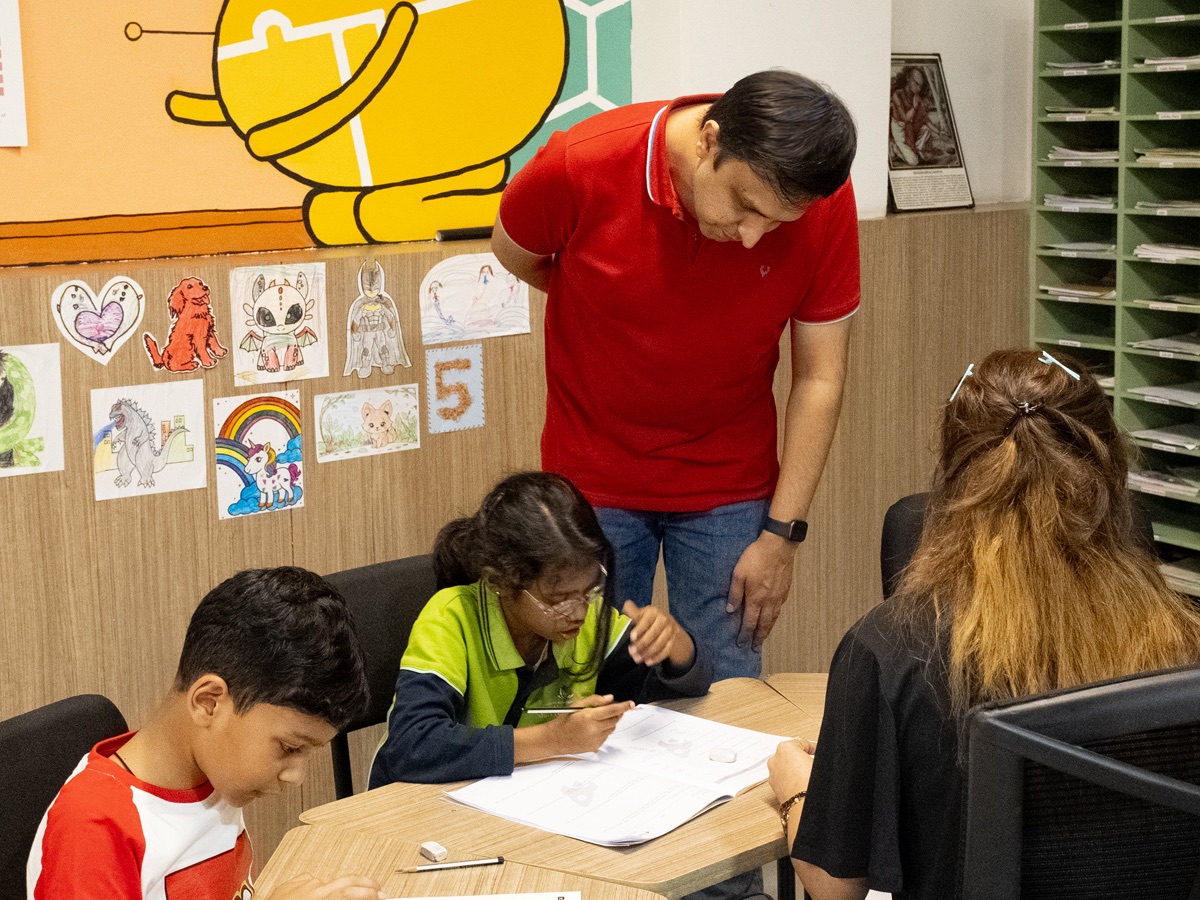
These skills are built through deliberate effort. Cuemath tutors operate by a guiding principle: “cue, don’t tell.” When a child gets stuck, the tutor does not supply the answer. Instead, a small hint is offered and the child is encouraged to work through it. Tutors demonstrate the logic behind concepts, point out patterns, and connect ideas to real-world situations so that problems feel accessible. Over time, this approach builds the MathFit skills that carry beyond the classroom.
“Our goal is never just a child who gets everything right,” Khurma said. “It is a child who stops asking ‘is this right?’ and starts asking ‘what happens if I try this?'”
The Edtech Industry’s Rush Towards Chatbots
When AI tools such as ChatGPT became widely available, edtech companies began promising students access to a private tutor at any hour. Many moved quickly to build AI-powered chatbots.
Students did not engage with them as companies had expected. Researchers studying how students used AI apps, including Khanmigo, Khan Academy’s AI tutor, found that 96% of students tried the AI tutor at least once. Yet it accounted for only 14% of their practice sessions.
Researchers at Stanford’s SCALE Initiative identified a comparable pattern. AI tools produced limited learning gains when they operated without human guidance. The strongest outcomes came from AI designed to support human tutors rather than to replace them.
Cuemath’s Choice: AI as a Support Tool, Not a Substitute
Cuemath had already observed the same difficulty. Software-only tutoring struggled to sustain student engagement. The response was a model that brings together human tutors and AI in clearly defined roles.
“AI should be an Iron Man suit for educators,” Khurma said. “The suit does the heavy lifting: adaptive problem generation, real-time hints, and skill tracking. But the heart comes from the human inside. Human learning requires genuine effort, and a human coach can demand and inspire effort in a way no software bot can.”
Each component has a defined function.
- AI works in the background. It analyses worksheets, app activity, and feedback from tutors and parents, using that information to construct a personalised learning plan for each child.
- Tutors lead the learning. They build curiosity, maintain motivation, and guide students through demanding problems.
- Parents receive reports. AI tracks practice time, app use, and topic mastery. Cuemath’s team and tutors then review this data and add personal observations.
A Free App Designed to Address Chatbot Fatigue
Cuemath’s most significant recent move has been to consolidate its complete K–12 maths curriculum, test prep library, and enrichment maths content into a single app, and to make that app free.
Within the Cuemath App, AI carries one primary responsibility: mapping what a child already knows and building a fresh daily workout tailored to that child. The lessons, test prep materials, and games are still designed by curriculum specialists.
The daily workout draws on two research-supported learning methods.
- Spacing: concepts return after an interval rather than being drilled intensively in a single session and then set aside.
- Interleaving: different problem types are mixed within a single session rather than grouped by topic. This approach helps students retain concepts over a longer period.
The app also features an Enrichment Maths section directed at skills that AI handles poorly: reasoning, judgement, and the ability to learn from mistakes. Students work through logic puzzles such as KenKen and tackle real-world challenges, including problems that require weighing trade-offs within a budget plan.
“In an AI-driven world, the ability to solve unfamiliar problems isn’t optional,” Khurma said. “It’s the superpower.”
Tutors Remain Central to the Programme
Cuemath was built by its tutors, and the free app does not alter that.
Students can use the complete app independently at no cost. When a family wants more substantial support, they can activate “Coach Mode,” which connects the child with a 1:1 Cuemath tutor. This is not a secondary product running alongside the main offering. It is a tutoring company placing its entire programme on a single screen. Making the app free reflects confidence in that programme: if enough students experience genuine progress independently, more families will look for the next level of support, which means a tutor.
With the app launch and continued improvements to its curriculum and user experience, Cuemath is targeting 10 million users per month. Reaching that figure would place Cuemath in direct competition with the largest edtech companies operating today.
About Cuemath
Cuemath is a global maths learning programme offering live, one-on-one online classes for students from kindergarten through high school. Since 2013, Cuemath has worked with more than 200,000 students across 80+ countries. The company is backed by Google, Sequoia, and Alpha Wave. To learn more, visit cuemath.com.