

In eastern Odisha, the school is located a few kilometers away from a single-lane roadway that, during the rain, transforms into red dirt and makes buses crawl in second gear. The gentle buzz of a generator is audible from the gate. A group of thirteen to sixteen-year-old children are doing a fine-tuning experiment on a small open-source language model inside one of the back classrooms, which was formerly used to store sporting goods. They are employed in Odia.
The lab’s instructor attended a local engineering institution. The five-year-old laptops were donated via a government-private cooperation. Compared to MIT’s undergraduate cohort, students from this school and a few other comparable universities in India produced more acknowledged AI research contributions last year. by a few unofficial counts. By a significant amount, perhaps.
| Rural India AI Talent Pipeline — Key Information | Details |
|---|---|
| Phenomenon | Rural Indian schools producing disproportionate AI research talent |
| Geographic Hotspots | Odisha, Maharashtra, Tamil Nadu, parts of Karnataka |
| Government Platform | DIKSHA (offline-capable digital learning) |
| Targeted Student Tier | Classes 8 through 10 (ages 13–16) |
| Curriculum Focus | Robotics, AI, machine learning, applied STEM |
| Independent Residency | Lossfunk (mentorship + equity-based AI training) |
| Regional NLP Languages | Tamil, Odia, Santali, Marathi |
| Comparable Western Benchmark | MIT, Carnegie Mellon, Stanford undergraduate output |
| Government Push | Skill India Mission |
| Private Sector Involvement | “Cloud farming” firms training AI models in rural districts |
| Talent Pipeline Outcome | Rural students entering global AI roles without traditional degrees |
| Cultural Anchor | Village computer labs supported by UNICEF India initiatives |
| Limiting Factor | Patchy electricity, intermittent connectivity |
The exact figure is debatable based on your definition of “research output.” However, for the past two years, those who follow Indian AI education have seen an acceleration of this fundamental change. Students from rural high schools in Odisha, Maharashtra, and Tamil Nadu are beginning to place in international machine learning competitions, contribute to open-source repositories, and obtain paid AI research positions before they graduate. It’s an intriguing trend since it defies the conventional narrative about the origins of AI talent.
In Bengaluru’s technical circles, a term that has gained popularity is “cloud farming.” It describes small businesses that have established themselves in rural areas, using local students to train models, label data, and increasingly conduct real research. By Silicon Valley standards, the pay is low, but for rural Indians, it’s generous. Rather than being based on credentials, the qualifications are practical. A student with a degree but no track record of proficiency is employed more quickly than one who can refine a transformer model in three afternoons. The way the global AI labor market has traditionally operated is being reversed, and this trend is becoming more widespread.
Contrary to popular belief, the Ministry of Education of India’s DIKSHA platform has had a more subdued role. The majority of articles about AI education in India concentrate on ostentatious private schools located in big cities. In contrast, DIKSHA offers offline-capable classes that may be downloaded on a tablet or phone and utilized in rural areas with inconsistent internet.
Students in Classes 8 through 10 now have practical access to robotics kits and rudimentary neural network training thanks to STEM laboratories established by state government initiatives. This is not glamourous at all. The New York Times doesn’t cover any of it. However, after three or four years, the cumulative effect is creating a generation of teenagers who are more comfortable writing Python than speaking English.
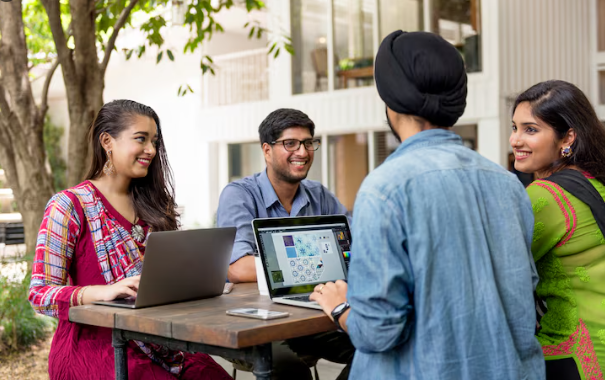
Outsiders are unaware of how important the language component is. Students can experiment in the languages they truly think in thanks to AI tools created in Tamil, Odia, and Santali. Before training her first model, a student in a community close to Cuttack doesn’t need to master enough English to read a Stanford lecture. In the language her grandma speaks, she can debug her code, read documentation, and ask questions in Odia. There is less cognitive overhead. The learning curve shortens. Walking inside one of these labs gives the impression that the purported digital divide is being addressed in ways that the West was not prepared for.
Global tech companies now use independent programs like Lossfunk, which offers rigorous AI residency outside of the conventional university system, as quiet feeders. The model is more akin to a startup accelerator than a school. Lectures and tests are replaced by direct access to research challenges, equity, and mentoring. This method might be scalable.
The long-term solution most likely lies somewhere in the middle. It’s also feasible that it generates a lot of burned-out teenagers and a few exceptional grads. It’s becoming evident that major universities haven’t completely embraced the manner in which the center of gravity in AI talent generation is changing. MIT will continue to produce outstanding researchers. More and more, the communities will as well. The next ten years will determine whether or not the world’s AI laboratories take hiring from both pipelines equally seriously.