

For many years, the public’s perception of estrogen was mostly confined to discussions concerning reproductive health. Menopause, hormone replacement treatment, and the pill. The hormone’s true effects have always been understated by that framing, but the most recent study on how estrogen functions in a damaged brain is taking the discussion in new directions.
The results, which gained traction across research in 2025 and 2026, point to an odd dual role. In addition to protecting brain tissue following physical trauma, estrogen may cause some traumatic memories to linger longer than they should. Neuroscientists squirm in their seats when they encounter this kind of duality.
| Estrogen and Brain Trauma — Research Snapshot | Details |
|---|---|
| Primary Hormone Studied | Estradiol (a form of estrogen) |
| Key Brain Region | Hippocampus, the memory centre |
| Stress Finding | High hippocampal estrogen may increase post-trauma memory vulnerability |
| PTSD Link | Trauma during high-estrogen phases linked to stronger negative memory encoding |
| Sex Distribution of PTSD | Higher reported rates in women |
| Neuroprotective Effects | Reduced brain edema, lower intracranial pressure, stabilized blood-brain barrier |
| Cellular Mechanism | Mitochondrial stabilization, reduced free radicals, anti-inflammatory action |
| Animal Model Evidence | Estrogen sulfate post-TBI improved neurological outcomes |
| Sex Applicability | Estrogen produced in brains of both males and females |
| Critical Variable | Dose and timing relative to injury |
| Clinical Direction | Acute estrogen administration after severe TBI under study |
| Indexed Research Source | PubMed-listed peer-reviewed studies |
The hippocampus, the tiny, seahorse-shaped structure responsible for memory consolidation, is where the new research’s clearest line passes. The encoding of a traumatic event seems to deepen when estrogen levels are high. Researchers believe this contributes to the fact that, following comparable experiences, women typically experience PTSD at higher rates than men. That discovery has a subtle sobering quality. It reinterprets a long-standing statistical pattern as being more neurochemical than psychological. The early data is difficult to discount, but it is still genuinely unclear if that interpretation holds up in larger investigations.
The fact that estrogen also has the opposite effect in the same brain adds intrigue to the tale. Estrogen reduces edema, lowers intracranial pressure, stabilizes the blood-brain barrier, and dampens inflammation following physical traumatic brain injuries, such as those caused by auto accidents, sports collisions, or military explosions. Studies on animals have demonstrated that administering estrogen sulfate soon after a traumatic brain injury improves neurological results. It’s the hormonal equivalent of discovering that the same fire blanket can gradually tighten around the person it just saved while simultaneously smothering a flame.
Here, too, a broader adjustment is taking place. Although the long-held belief that estrogen is primarily a female hormone has been quietly abandoned in scientific circles for many years, it is nevertheless surprisingly prevalent in media coverage. According to recent research, both men’s and women’s brains manufacture estrogen, which affects how both sexes react to trauma. This alters the clinical discourse in ways that emergency medicine hasn’t yet fully adopted. The majority of brain injury treatment regimens in trauma bays still treat hormonal context as accidental. According to the data, it isn’t.
It turns out that the most important factor is timing. When estrogen is given too late or in the incorrect dosage, its protective effects can change. Similar to how clot-busting medications are used for strokes under precise time limitations, researchers are currently attempting to pinpoint a narrow window in which the hormone could be administered as an immediate treatment following severe TBI.
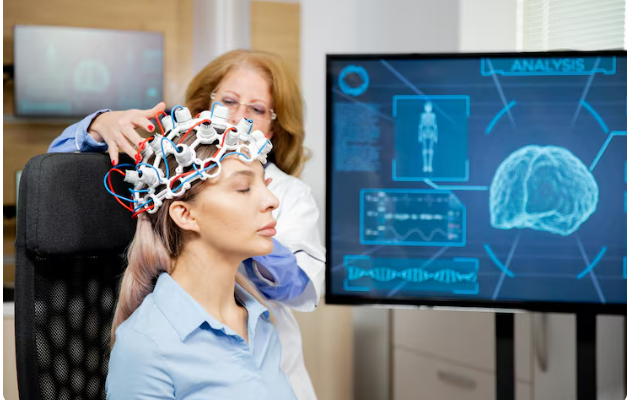
Although it takes years for a hospital to receive this type of practical translation, numerous research facilities in North America and Europe are already conducting trials. Reading the most recent articles gives me the impression that the field is closer than it has been in a long time to a true therapeutic change.
The folks seated on the periphery of these conclusions are difficult to ignore. soldiers who have both physical brain damage and post-traumatic stress disorder upon their return from combat. Women whose reproductive cycles coincided with attacks or auto accidents in ways that are still unclear. Over years of competition, athletes’ head injuries compound.
None of those experiences are made simpler by the estrogen story, but it does complicate them in a fascinating way. It raises an issue that has hardly ever been addressed on a large scale: what if the body’s chemistry has been subtly influencing who heals from trauma and who doesn’t all along? research following research, the solution is emerging, and it will probably continue to surprise us for the remainder of the decade.