

Türkiye has formalised a new partnership with London Climate Action Week, tying its zero waste programme and polar research work into the UK capital’s international climate network in the run-up to COP31, which Türkiye is set to host.
The agreement was signed on 17 August by Samed Ağırbaş, President of The Zero Waste Foundation and COP31 High-Level Climate Champion, and Nick Henry, Climate Action Founder and CEO. The protocol covers cooperation on climate action, zero waste and the circular economy, and follows the publication of a book on polar research just ten days earlier.
Foundation and London Climate Action Week Sign Protocol
The cooperation protocol establishes an institutional partnership between the Foundation and London Climate Action Week, with the stated aim of strengthening knowledge exchange, joint initiatives and international dialogue on zero waste and circular economy approaches. London Climate Action Week draws participants from government, business, finance, academia, civil society and local communities, and the agreement gives Türkiye’s zero waste experience a direct route into that network.
Ağırbaş said the signing opened the door to further collaboration in the lead-up to Türkiye’s hosting of COP31. “After this cooperation protocol, I hope we will carry out strong work and organize joint events at COP31 and London Climate Action Week,” he said.
Organisers describe COP31 as the wider diplomatic backdrop to the agreement, while the immediate priority is practical exchange between the Foundation and the LCAW network. The intention, according to those involved, is to connect scientific research, resource efficiency and circular economy thinking with international climate action, rather than presenting zero waste narrowly as a recycling or waste management exercise.
A Book Links Polar Science to Waste Reduction
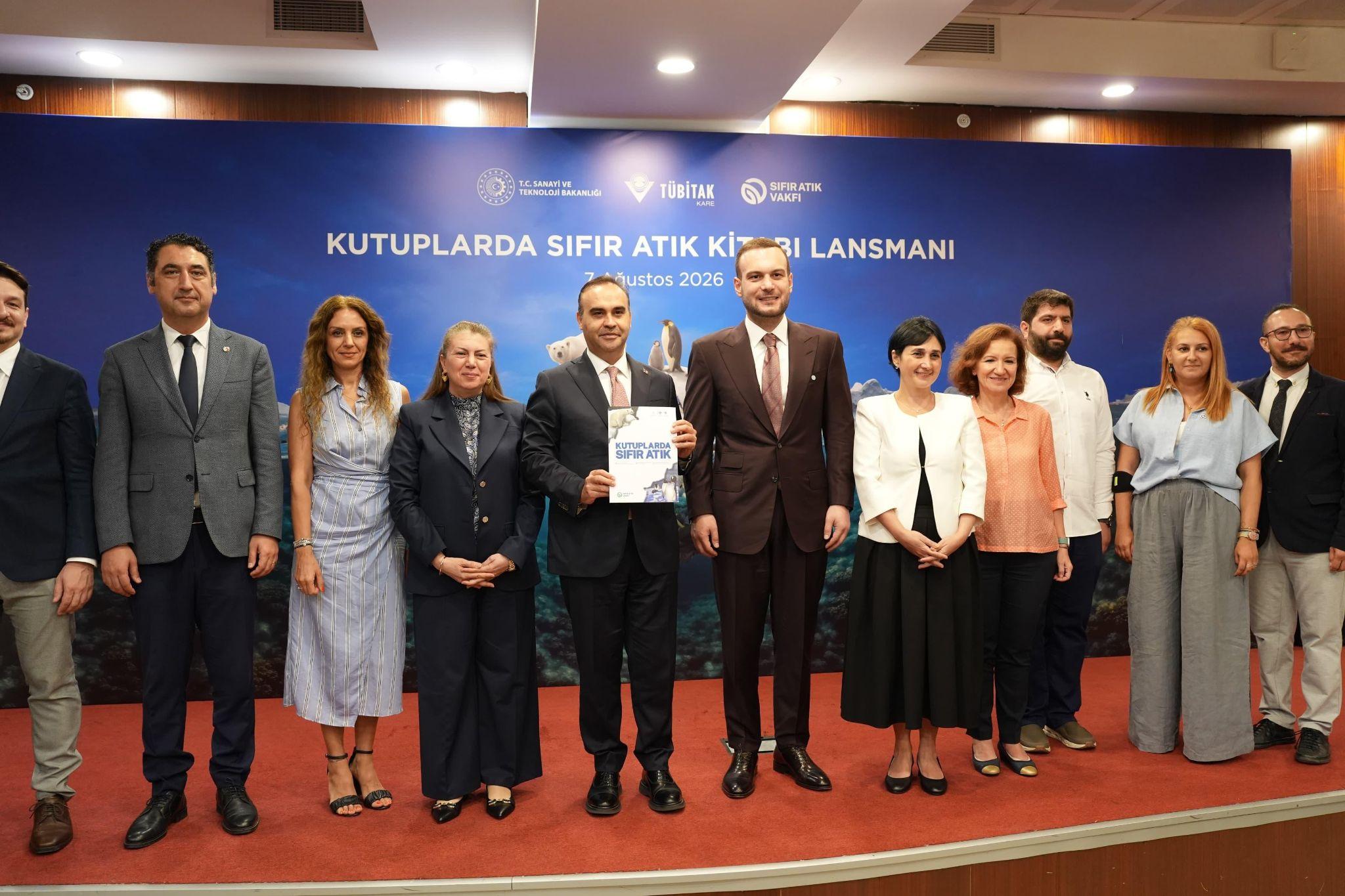
The London agreement builds on a publication launched on 7 August, when the Foundation released “Zero Waste in the Polar Regions,” a book prepared jointly with the Polar Research Institute of TÜBİTAK, Türkiye’s Scientific and Technological Research Council. The book applies zero waste principles to scientific research conducted in the Arctic and Antarctic.
It brings together 18 articles written by scientists who have taken part in polar research expeditions, addressing the scientific, technical, administrative and communication dimensions of applying zero waste methods in some of the world’s most remote and environmentally sensitive locations.
Rather than focusing solely on waste collection once it has been generated, the book examines how scientific expeditions are planned from the outset, how materials and resources are used during fieldwork, and how energy, water and logistics are managed throughout. The underlying emphasis is on preventing waste before it occurs, using resources efficiently, and reducing the overall environmental footprint of scientific activity carried out in polar conditions.
The publication frames the polar regions as key indicators of global climate change, arguing that environmental shifts recorded there carry consequences that extend well beyond the Arctic and Antarctic themselves. That framing is intended to give the research relevance to audiences and policymakers far removed from the poles.
Minister Points to Two Initiatives Launched in 2017
Mehmet Fatih Kacır, Türkiye’s Minister of Industry and Technology, said the polar research book brought together two significant national programmes that both began in the same year. “The Zero Waste initiative launched under the leadership of H.E. Emine Erdoğan has grown step by step from a national initiative into a global one,” he said.
Kacır said Türkiye had also built up its polar research capacity over the same period. “At the same time, we began organising scientific expeditions to Antarctica and the Arctic under the auspices of the President of the Republic of Türkiye, enabling Turkish scientists to strengthen the country’s presence in polar research. Through this book, these two initiatives have come together,” he said.
The zero waste programme referenced by the minister was founded by H.E. Emine Erdoğan, who is also Chair of the UN High-Level Advisory Board on Zero Waste and Honorary President of the Zero Waste Foundation. The book is presented as an extension of that broader zero waste vision into a scientific and polar research context.
Taken together, the book launch and the London signing mark a month in which Türkiye has pushed to position its zero waste and circular economy work as part of an international, rather than purely domestic, agenda. The polar research book demonstrates the approach applied to scientific fieldwork in extreme environments, while the London protocol extends that thinking into a formal partnership with one of the world’s most prominent climate action platforms.
For London Climate Action Week, the agreement adds a partner with direct experience of applying zero waste principles across both national policy and specialist scientific research. For Türkiye, it strengthens its credentials ahead of COP31, when the country’s approach to zero waste and circular economy policy is likely to draw wider international scrutiny.
Officials involved in both the book and the protocol have stressed that the two developments, though announced ten days apart, are meant to be read together: one demonstrating how zero waste principles can be applied in one of the most challenging research environments on the planet, the other setting out a framework for sharing that experience with an international audience through London’s climate network in the months leading up to COP31.