

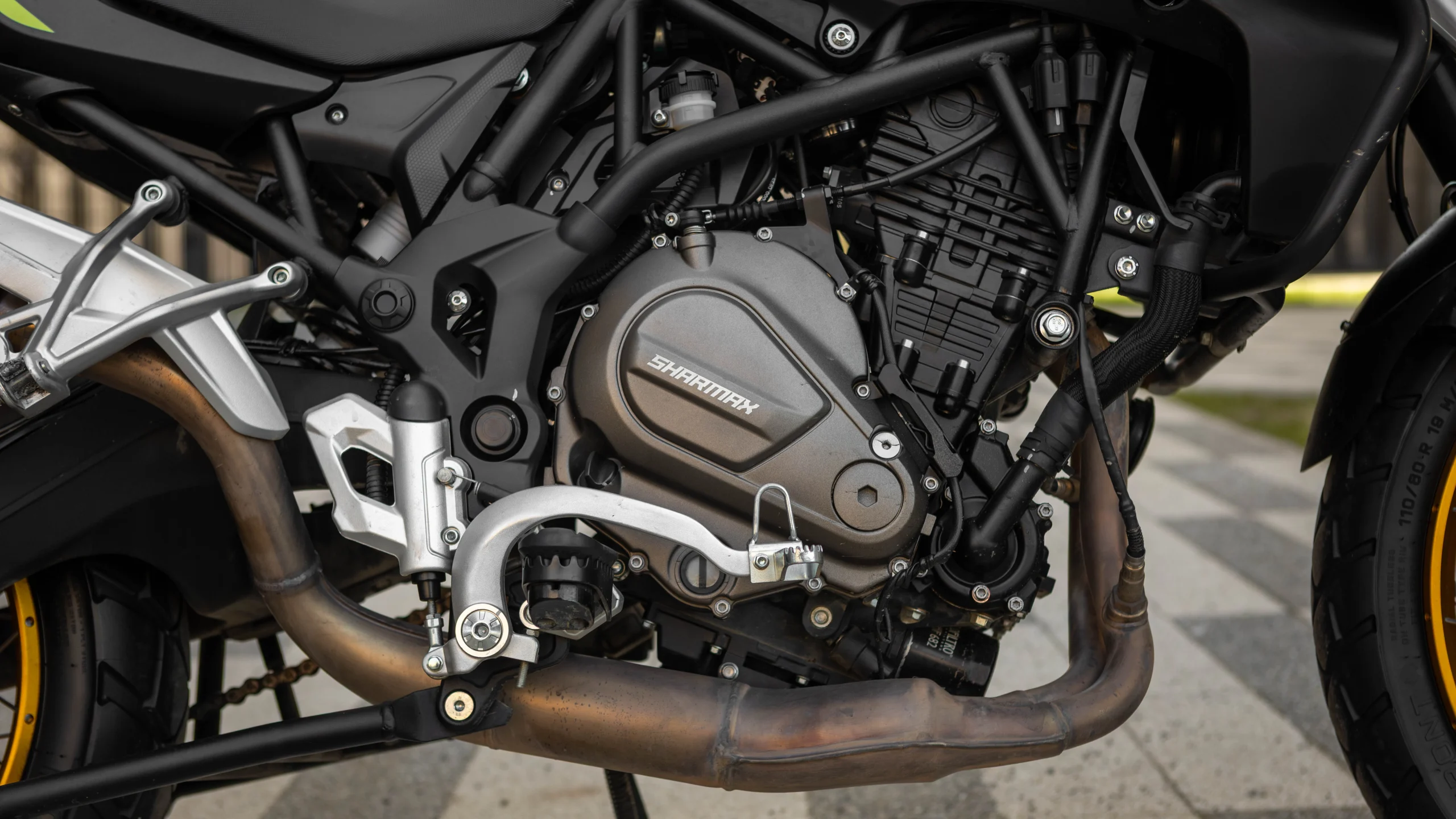
Much of a motorcycle’s character comes from systems that never appear in the headline specs. How readily the engine starts on a cold morning, how evenly the throttle responds, how steadily it pulls on a long climb: all of it is shaped by electronics working continuously in the background. Sharmax’s cooperation with Bosch on electronic fuel injection shows how that works in practice.
About Sharmax
Sharmax Motors is a motorcycle and powersports manufacturer with a strong foothold in the Middle East, Europe, and Latin America. It develops its vehicles in-house in cooperation with Benelli, the long-established Italian motorcycle marque, and handles platform design, chassis engineering and styling itself. Its lineup spans on-road and off-road motorcycles, ATVs and other high-output powersports vehicles.
Its cooperation with Bosch is a long-term technology partnership. The German engineering group supplies critical electronic components for Sharmax vehicles, and electronic fuel injection is one of the key areas.
Why Bosch
Bosch is one of the automotive industry’s established technology suppliers, with expertise that covers engine management, fuel systems, sensors, connectivity and software. Volkswagen, BMW, Mercedes-Benz, Porsche and Volvo rely on its technology, and its motorcycle systems are used by brands such as BMW Motorrad, Ducati and Kawasaki.
In the motorcycle sector, Bosch develops complete engine-management systems. These cover fuel injection and supply, air management, ignition, exhaust-gas treatment and the electronic control units that tie everything together.
What the system does
At the center of the system is the electronic control unit, which reads real-time data from sensors across the motorcycle and uses it to manage fuel supply, ignition timing and air intake as one coordinated system. As riding conditions change, it continuously adjusts the air-fuel mixture to keep combustion efficient. The injector delivers fuel in a fine, controlled spray so it mixes thoroughly with the incoming air before combustion.
For the rider, this means consistent throttle response, easier starting, steadier running and more efficient combustion, along with support for lower fuel consumption and emissions.
On higher-performance motorcycles, Bosch’s control units are also scalable. They support features such as diagnostics and torque management and can be calibrated to the characteristics of each platform, so every model gets a fueling strategy that suits it. That flexibility matters for Sharmax as its lineup moves into larger-displacement, more performance-oriented segments.
Bosch EFI across the Sharmax range
Bosch electronic fuel injection is fitted across much of Sharmax’s mid- and large-capacity on-road lineup, including the RST naked bikes, GL touring models, RR cruisers and GP sport motorcycles. Such flagship models as the GL 801, RR 801 V and GP 881 are all equipped with Bosch EFI. Across these platforms, the system helps maintain consistent fueling as engine load and riding conditions change.
The system also works in tougher conditions. In the ATV segment, Bosch EFI is used on heavy-duty models from the Force lineup, including the Force 1100 Mud Pro and the Force 1100 EFI EPS. Engines on machines like these have to stay responsive under changing loads and through prolonged off-road use, which makes precise fuel delivery especially valuable.
The XForce 1100 Sport in Sharmax’s high-output buggy range uses it too. Throttle inputs and engine load can change within moments during aggressive driving, and the system keeps fuel delivery consistent and engine response predictable through sharp turns, climbs and uneven terrain.
A manufacturing approach built around proven technology
Fuel injection is one of the areas where Bosch’s engineering translates directly into performance and reliability the rider can feel. Sharmax’s approach to manufacturing is built around finding those areas and bringing in established specialists rather than developing every system from scratch. That lets the brand put its own R&D capacity toward platform design, chassis engineering and styling, the parts of the motorcycle where in-house development matters most, while systems like engine management arrive already proven at scale. The result is a lineup that pairs world-quality components with pricing that keeps them within reach of more riders, and the Bosch partnership is one clear example of that approach in practice.