

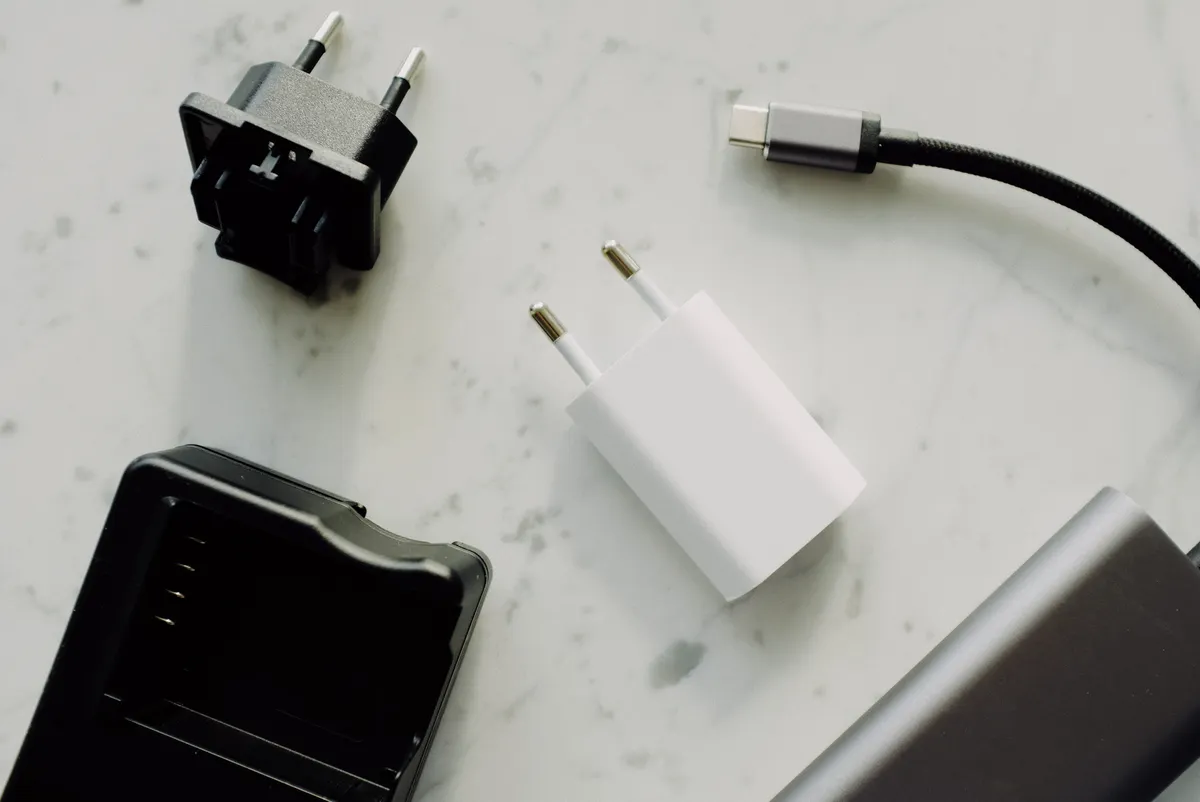
A universal travel adapter and a travel-ready charger are two different products, yet travellers routinely confuse them, partly because marketing copy on both often blurs the line. Knowing which one to pack, and why, starts with understanding the power landscape you are walking into.
Voltage First: What You Must Check Before You Pack
The US standard wall outlet outputs 120V at 60Hz. That is not a global standard. Japan runs at 100V, while Paraguay delivers 230V through the same-looking Type-A socket. The UK, Ireland, Singapore, Hong Kong, and much of the Arabian Peninsula use the three-prong Type G system, which is physically incompatible with US plugs entirely.
Voltage matters more than socket shape. Plug a device built for 120V into a 230V outlet and you risk overheating or permanent failure. Plug it into Japan’s 100V supply and it may simply refuse to work. The good news is that most modern consumer electronics and chargers carry a rating of 100-250V AC, 50/60Hz, meaning they handle the full global range automatically. Check the small print on your device before you travel; a phone camera and the magnifier built into Apple iOS or Android make that easier than squinting at fine text.
Frequency (Hz) is rarely a concern for travellers. The devices most affected by frequency differences, AC synchronous motors in older clocks and audio turntables, are not typical carry-on items. For a fuller breakdown of worldwide outlet standards, WorldStandards.eu covers every country in detail.
What a Universal Travel Adapter Can Actually Do
A universal travel adapter solves the plug-mismatch problem and adds charging ports in a single unit. The Ceptics UP-140KU is a working example: it carries retractable output prongs for Type A (US), Type C (Europe and Asia), Type I (Australia, New Zealand, and Chile), and Type G (UK) outlets.
According to the Ceptics product page, the adapter covers 200+ countries, carries CE and RoHS certifications, and comes with a two-year limited warranty. The report described compatibility across “well over 150 countries”; the Ceptics listing states the higher figure of 200+, which is the primary-source number. The universal input socket on the front accepts virtually any plug from any territory, with safety shutters preventing accidental contact with live parts, something the cheap, unshuttered “deathdapters” sold on less regulated corners of the internet conspicuously lack.
On the charging side, the 140W unit carries three USB-C ports (two rated at up to 140W each, one at up to 18W) and a USB-A port at up to 18W for older devices. Ceptics’ product comparison data shows the universal socket is rated to a maximum of 10A and up to 250V across its adapter range. A built-in fuse, plus a spare, provides a further safety margin. The Ceptics universal travel adapter range runs from 35W up to 205W, so there is an option matched to lighter or heavier charging needs. The UP-140KU is currently listed at $50.99, though it is shown as out of stock on the Ceptics website at the time of writing.
One firm caveat: a universal travel adapter is not a voltage converter. Connecting a 120V-only hair dryer to a Type G outlet via one of these will still deliver 230V to the appliance. If the device cannot handle that, it will fail, or worse. The adapter simply changes the plug shape, not the current.
Ceptics also notes that universal travel plug adapters are permitted on flights and can be packed in either carry-on or checked luggage without issue, which removes one pre-departure headache.
The Case for a Travel-Ready Charger
A travel-ready charger is a conventional wall charger with a set of interchangeable prongs that clip over the US pins. It is simpler, often lighter, and generally better suited to travellers who already know they will be staying in one or two countries rather than hopping across outlet types.
The BMX GanSTA 140W laptop charger is a current example. It offers Type C, Type I, and Type G clip-on attachments, four ports (two USB-C at up to 140W, one USB-C at up to 65W, and a USB-A port at up to 18W), a touchscreen display showing port activity, and a footprint smaller and lighter than a single-port 140W Apple charger. At $89, it costs more than the Ceptics adapter but doubles as a full-featured home charger when the clip-on prongs are removed.
The persistent weakness of this category is the interchangeable attachments themselves. They are small, they travel separately, and they have a habit of disappearing into luggage lining or getting left in hotel rooms.
Which One to Choose
Travelling light with no checked luggage, or moving across multiple countries with different outlet types? The universal travel adapter is the more practical single device: no loose parts, and it can accept another charger plugged into its universal socket, turning a single outlet in a crowded hotel common room into a shared charging point.
Travelling with more gear and a dedicated bag? Carrying both gives the most flexibility. The charger handles everyday use; the adapter converts outlets when the plug types change.
Either way, check the voltage rating on every device before departure. That one step eliminates the risk that makes the rest of this conversation necessary.