

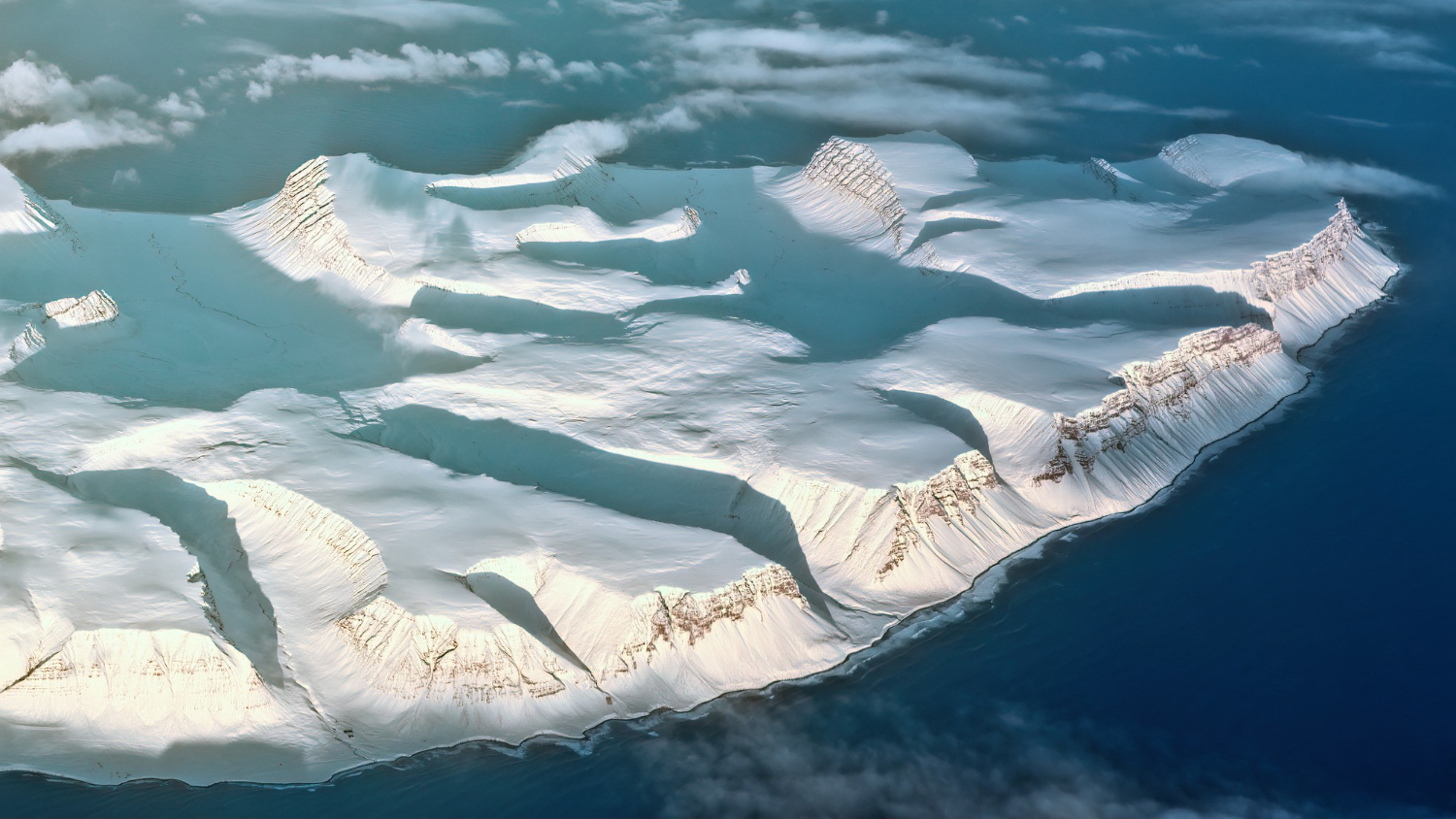
The casual way that power communicates through imagery is subtly startling. Katie Miller’s post was a single word above a digitally altered image rather than a comprehensive policy memo or a casual comment tucked away in a press flurry. Wrapped in the American flag, Greenland said bluntly, “SOON.” It was like an elbow to the ribs of international decorum for a former White House aide and the spouse of one of Donald Trump’s most ardent deputies.
That post came after a much more significant event: Nicolás Maduro and his wife were forcibly relocated to New York as a result of a contentious U.S. military operation in Venezuela. Miller’s image appeared to offer a next target, almost flippantly, while the world continued to analyze that daring move. The outcry was quick. Jens-Frederik Nielsen, the prime minister of Greenland, was blunt in his criticism of the picture, calling it “disrespectful.” In response, Jesper Moeller Soerensen, Denmark’s ambassador to the United States, sharply reiterated Denmark’s sovereign rights.
| Name | Katie Miller |
|---|---|
| Role | Former Trump Admin Communications Official; Right-Wing Podcaster |
| Affiliation | Wife of Stephen Miller (Trump’s Deputy Chief of Staff) |
| Controversy | Posted an altered image of Greenland covered in the U.S. flag with the caption “SOON” |
| Career History | Deputy Press Secretary at DHS; Comms Director for VP Mike Pence |
| Source | The Daily Beast Coverage |
Politics has always involved symbolic gestures. However, the ease with which Miller’s post conflated satire, provocation, and informal signaling alarmed many. The cryptic language she used, “SOON,” was more appropriate for a dystopian teaser trailer than for democratic discourse. However, the context makes it more difficult to write it off as personal trolling or bad taste.
Americans are familiar with Greenland. During his previous term, Trump publicly and repeatedly suggested purchasing the vast Arctic territory. Wrapped in bizarre optics, it was a real proposal. At the time, Denmark firmly rejected it. However, Greenland is once again in the rhetorical crosshairs due to a renewed push for Arctic dominance and a Trump-led foreign policy that is once again asserting itself. Whether on purpose or not, Miller’s post fueled that flame.
Officials were displeased with more than just the image. The timing is the problem. It had the uncanny feel of a sequence because it was posted just hours after the military action in Venezuela, as if Greenland was the next domino. Additionally, Miller’s image was chilling in its simplicity, in contrast to Trump’s statements, which are frequently dismissed as hyperbole. She refrained from arguing. She didn’t elaborate. All she did was broadcast.
When I first saw the image, I recall halting in the middle of my scroll and experiencing an odd silence that was a combination of recognition and incredulity. It was more of a mask than a meme.
Beyond the post itself, Miller hasn’t made any public remarks. In a private conversation, her husband Stephen Miller allegedly attempted to minimize it by stating that it was “obviously a joke.” However, the optics weren’t amusing to Greenland’s leadership and Danish officials. A diplomatic wound that was just starting to heal had been effectively reopened by the post.
Greenland is important strategically. The United States is aware of this. Denmark and the EU took note of Trump’s decision to send a special envoy to the region. Greenland is valuable not only for defense but also for tech and energy aspirations due to its mineral wealth and Arctic location. However, dialogue, not virtual declarations, is the foundation of diplomacy.
To be clear, despite the rhetorical bluster, Greenland is not in danger of real military action. However, physical invasion isn’t always the source of the fear. The way that sovereign land is treated like a chess piece is through the normalization of language and symbolism. As though for dramatic effect, respect can be suspended.
Katie Miller’s post is important because of this. It wasn’t an isolated blunder; rather, it was a part of a larger trend in which insiders and political operatives use social media to test limits, convey intentions, or incite outrage that prepares the ground for actual action. It’s a performance that has consequences.
Denmark’s reaction was prompt but noticeably tactful. Mette Frederiksen, the prime minister, reiterated that Greenland was not negotiable and demanded “an end to threats.” She firmly stated, “The United States has no right to annex any part of the Danish Kingdom.” A deeper tension, however, was concealed by the restraint: how can one politely respond to a message that is essentially a meme?
Jens-Frederik Nielsen, the prime minister of Greenland, responded calmly but sharply, saying, “Social media posts do not determine our future.” For now, that may be the case. However, in the era of social media, posts have the power to influence perception, and perception is important, particularly among allies.
There is more to this story than just one digital picture or Katie Miller. It focuses on how political messaging, which was formerly limited to press releases and international briefings, has evolved into something impulsive, performative, and porous. And how the area where diplomacy used to exist is being undermined by that change.
It’s not just her opinion when a former White House communications director with powerful connections posts something like this. Fairly or not, it is viewed as a continuation of the tone and goals of an administration. Whether the post was meant to be satire, a warning, or a provocation, it succeeded in making Denmark angry and Greenland uneasy.
Although not under the aegis of another nation, Greenland has long indicated an interest in gaining independence from Denmark in the future. Despite past military alliances and common Arctic concerns, polls indicate strong opposition to any U.S. annexation. Because of this background, Miller’s image is dismissive as well as provocative.
Boldness and recklessness are two different things. Furthermore, political leaders run the risk of transforming important issues of sovereignty into spectacle when they play at empire through emoji-filled memes. Backlash wasn’t the only reaction to Katie Miller’s post about Greenland. It served as a reminder to allies that even seemingly insignificant imagery can cause old alliances to falter and old fears to resurface when it is magnified by proximity to power.