

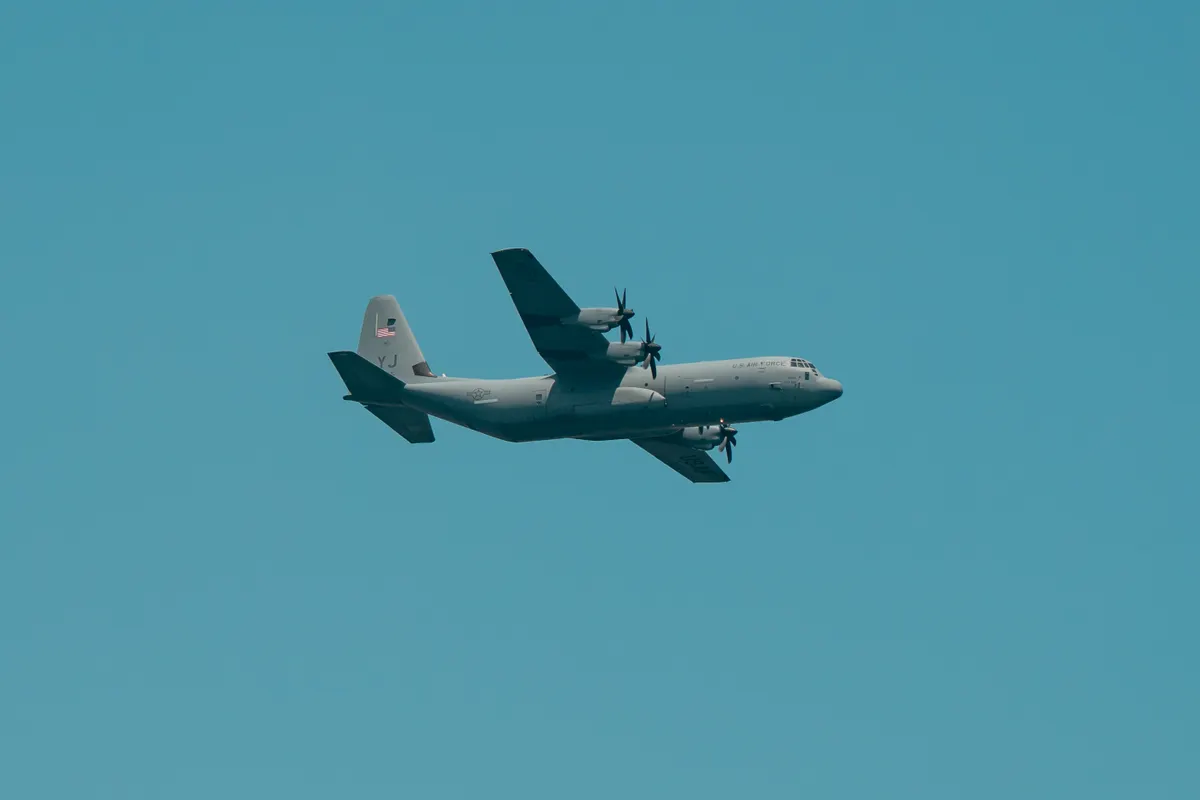
The C-141 Starlifter history stretches across four decades of American military operations, from the jungles of Vietnam to the streets of Baghdad, before the Boeing C-17 Globemaster III took over as the US Air Force’s primary long-haul transport. Visitors can still walk through a surviving example at the Air Mobility Command Museum on Dover Air Force Base in Delaware, where admission is free.
C-141 Starlifter History in Combat and Humanitarian Relief
Built by Lockheed, now Lockheed Martin, and unveiled by President John F. Kennedy in 1963, the first C-141A model entered service in 1965. The aircraft quickly became the backbone of the Air Mobility Command, airdropping troops, evacuating wounded soldiers and prisoners of war, and hauling critical supplies into combat zones.
The C-141B variant, which first flew in 1977, raised the ceiling considerably. It could carry up to 68,000 pounds of cargo, roughly 30% more than the original C-141A, at speeds of up to 500 miles per hour on four turbofan engines. Unlike its predecessor, the C-141B could refuel in flight via an extendable boom from aerial tankers, allowing nonstop runs to international destinations.
According to Lockheed Martin’s official newsroom, the C-141 was the world’s first turbofan-powered transport, and its crews conducted humanitarian relief flights to nearly 70 countries on six continents over the aircraft’s lifetime. Those missions included medical supply shipments and evacuations following natural disasters such as Hurricane Katrina.
On the combat side, C-141B Starlifters dropped paratroopers of the 82nd Airborne Division into Grenada during Operation Urgent Fury in 1983 and into Panama during Operation Just Cause in 1989. The cargo bay could be configured to hold up to 168 paratroopers, or 205 service members seated on foldout red benches. It could also carry wheeled vehicles, towed artillery, and armoured personnel carriers. Cargo was secured on 463L pallets, named for the month and year of their development, April 1963, and held in place by nylon nets rated to withstand up to 8 Gs.
More than 30 squadrons across 10 active-duty Air Force, Air National Guard, and Air Force Reserve Command units flew the Starlifter since it entered service, according to a Lockheed Martin announcement at the active-duty retirement ceremony in September 2004.
‘In every conflict, every disaster, every contingency anywhere on the globe, Starlifter crews have been the first responders,’ June Shrewsbury, Lockheed Martin’s vice president of Strategic Airlift, said at that ceremony. ‘The C-141 has quite a record of achievement.’
The Handover to the C-17 and What Came After
The C-17 Globemaster III entered service in 1993 and gradually rendered the Starlifter redundant. Where the C-141B could carry 68,000 pounds, the C-17 carries up to 170,900 pounds, more than double the capacity. It flies at 450 knots (approximately 517 miles per hour) and can operate on runways as short as 3,500 feet, opening up forward airstrips unavailable to its predecessor. Three crew members handle the mission: a pilot, co-pilot, and loadmaster, a reduction made possible by digital flight technology.
The active-duty Air Force held its last C-141 retirement ceremony in September 2004, but Reserve units continued flying the aircraft after that. The 452nd Air Mobility Wing at March Air Reserve Base, California, and the 445th Airlift Wing at Wright-Patterson Air Force Base, Ohio, kept the type operational until the very end. The final Starlifter, a C-141C known as the ‘Hanoi Taxi’ with Air Force serial number 66-0177 and flown by a 445th Airlift Wing crew, was retired on 6 May 2006 to the National Museum of the United States Air Force, completing a 43-year career, according to Lockheed Martin’s newsroom.
The C-17 that replaced it remains a major financial commitment. A sustainment contract awarded to Boeing by the US Air Force on 28 September 2021 is valued at up to $23.8 billion, including potential options and incentives over ten years, according to Boeing’s investor relations. That figure is considerably larger than an earlier, more limited sustainment agreement; interest in new Globemasters persists even though Boeing closed the C-17 production line more than a decade ago.
For those who want to see where the C-141 Starlifter history began and ended, the Air Mobility Command Museum’s C-141B exhibit is open for self-guided tours Wednesday through Sunday, 9am to 4pm, with wheelchair access via a dedicated ramp. According to the museum’s Air Mobility Command Museum FAQ, tours are weather permitting. The aircraft sits alongside a C-130 Hercules as one of two planes visitors can board. Whether Boeing eventually reopens the Globemaster line will determine how long the C-17 itself avoids the same fate as the workhorse it replaced.