

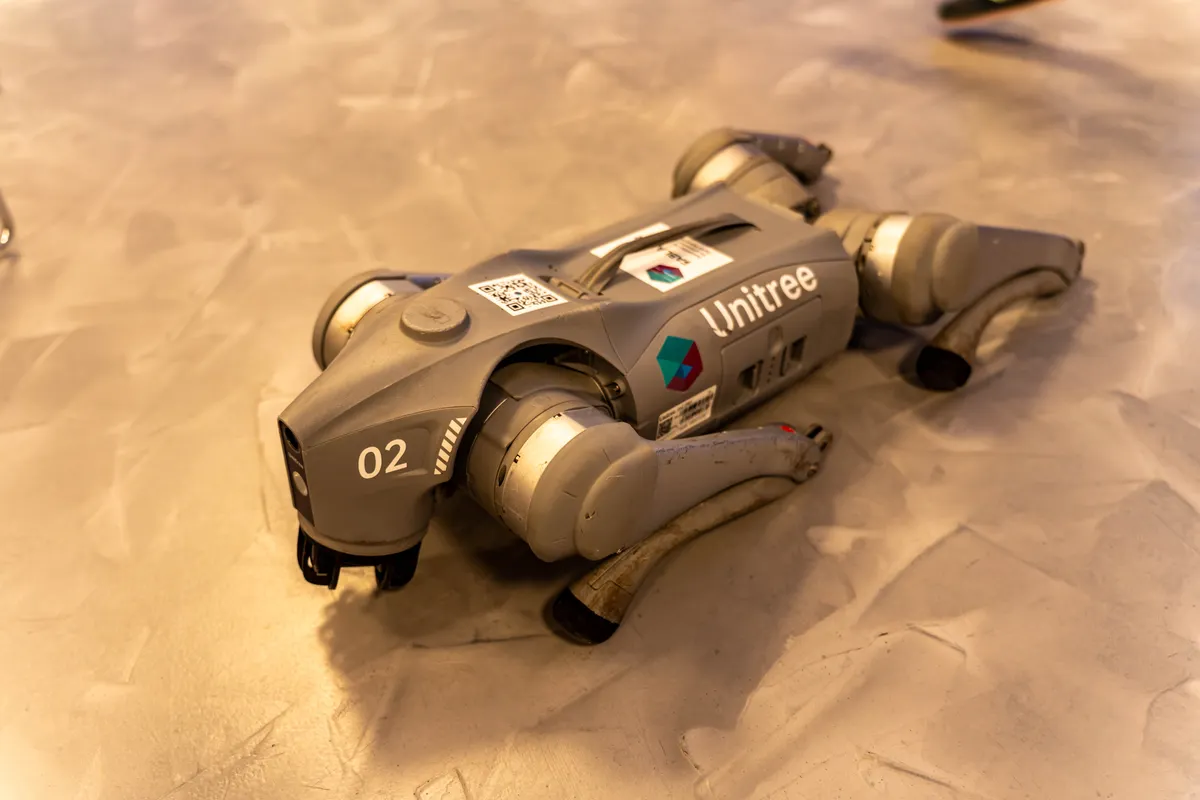
Ukraine ground robots build operational endurance across a war now approaching its four-and-a-half-year mark, with commanders describing the unmanned systems not merely as life-savers but as the structural foundation that lets a manpower-stretched army keep fighting around the clock.
Ukraine contracted 25,000 ground robots in the first half of 2026, twice the total for all of 2025, and President Volodymyr Zelenskyy has set a target of 50,000 produced by year-end. By April, UGVs had logged more than 22,000 missions since January; by June, that figure had climbed above 50,000.
Ground Robots and Operational Endurance: What the Mission Data Shows
The pace of deployment is accelerating sharply. Ukraine’s Ministry of Defence recorded more than 9,000 combat and logistical frontline missions using ground robots in March 2026 alone, up from more than 7,500 in January and more than 2,900 in November 2025, according to data from the DELTA combat system. Drone Warfare research puts June 2026 logistics and evacuation missions at 16,676, roughly 19% above May and 122% above January.
‘War robots don’t fatigue in the same way humans do, allowing persistent tasks such as monitoring, transport, or reconnaissance support,’ said Grek, a UGV company commander with the 21st Unmanned Systems “Kraken” Regiment, speaking under his call sign for security reasons.
The commander of a UGV unit in the 2nd “Khartia” Corps, who goes by the call sign Mathematician, said robots can go on more missions than a small infantry unit can, at any time of day. ‘Without that, the Ukrainian Army cannot exist now, really. So this is definitely about durability.’
Both commanders stress that humans remain essential to the system. ‘Keeping humans involved in decision-making remains essential,’ Grek said. ‘UGVs are tools that support people, they can handle the most hazardous parts of a mission while humans provide judgment, control, and responsibility.’ He added that robots allow a smaller number of soldiers to coordinate systems that previously required more people and resources.
A Widening Role on the Battlefield
The scale of Ukraine’s ambition goes beyond incremental substitution. Defence Minister Mykhailo Fedorov has stated that the goal is for 100% of frontline logistics to be performed by robotic systems, according to Defense News. The same report noted Ukraine’s Defence Ministry spent more than 14 billion hryvnia (roughly $330 million) pushing more than 181,000 drones, UGVs, and electronic warfare systems to the front since January 2026 via a digital procurement system that lets frontline units order directly from domestic manufacturers. Fedorov has also begun signing contracts for 2027 to stabilise manufacturer pipelines.
To coordinate the scale-up, Ukraine is establishing a dedicated UGV Competence Centre, which will work jointly with the General Staff and military units to speed the introduction of unmanned ground vehicles and serve as a single hub for manufacturers.
The technology is also evolving beyond logistics. UNITED24 Media reports that modern Ukrainian UGVs are increasingly fitted with electronic warfare suites, radar, missiles, and mortars, with developers treating each vehicle as a universal carrier rather than a single-purpose tool.
In early May 2026, Ukrainian National Guard troops near Kupiansk cleared a Russian fortified position using only drones and ground robots, with no soldiers deployed onto the battlefield. On 13 April 2026, Zelenskyy stated that UGVs and UAVs had captured an enemy position entirely without infantry support and without Ukrainian casualties, described as the first recorded instance of its kind in the conflict, according to the Defense Security Monitor. There are also several reported cases of Russian forces surrendering to UGVs.
A study by the KSE Institute, Brave1, and Defense Builder found Ukraine’s UGV market grew 488% in 2025, according to Forbes. Ihor Shmyryov, head of the UGV department at Brave1, told the same outlet he expects Ukraine to exceed Zelenskyy’s 50,000-unit target once direct brigade purchases are included. Replacing most frontline positions would ultimately require roughly 150,000 to 200,000 units annually, Forbes noted, adding that combat UGVs remain relatively uncommon not because they have failed but because the doctrine needed to employ them at scale is still being developed.
The machines pay a heavy price for their persistence. Near the line of contact, robots may survive only five to ten missions before they are destroyed, said Andrii Kushnierov, a platoon leader with Ukraine’s 59th Assault Brigade. Mathematician said that in some parts of the battlefield a robot might last 20 missions; in his own area, it is three or four. For Ukraine’s commanders, those machine losses are the point: they are a direct substitute for human ones.
The doctrine question will be the critical test. With the Competence Centre coming online and 2027 contracts already being signed, the pace of procurement is now outrunning the tactical frameworks needed to deploy the vehicles at the scale Kyiv is targeting.