

Millions of people move through London every day without incident. That’s the honest starting point.
Is London safe for visitors in 2026? Yes — with context. The city operates under a genuine and actively managed security environment, shaped by global tensions, a national terrorism threat level rated severe, and the realities of being one of the world’s most prominent political, financial, and cultural capitals. None of that makes London dangerous for everyday travel. It does mean the city takes security seriously, visibly and otherwise.
Here’s what the picture actually looks like.
The Threat Level — What It Means in Practice
The UK’s national terrorism threat level is currently set at severe. That’s the second-highest rating in the official five-tier system, meaning an attack is assessed as highly likely. It’s a national assessment, not a warning about a specific location or imminent event — that would be “critical.”
What severe means practically: security services, police, transport authorities, and event organisers are working with heightened awareness. It explains the barriers around government buildings, the armed officers at major transport hubs, the bag checks at certain venues. It doesn’t mean tourists should stay home. It means London’s safety is actively managed rather than passively assumed.
Why Global Events Matter Locally
London’s security climate doesn’t exist in isolation. Several ongoing geopolitical situations feed directly into how the city is policed and protected.
The war in Ukraine has raised awareness around state-linked threats, cyber resilience, and the protection of critical infrastructure. The Israel-Gaza conflict has produced repeated large-scale demonstrations in the capital — most peaceful, but requiring significant policing around sensitive locations. Community Security Trust data shows antisemitic incidents in Greater London remained at historically high levels through 2025, which helps explain increased protective attention around Jewish community sites, schools, and certain public events.
Tensions involving Iran and broader Middle Eastern geopolitics also affect security planning around embassies and diplomatic missions. London hosts more embassies than almost any other city. International disputes have local consequences.
None of this makes the streets of London dangerous for ordinary visitors. It explains why security is layered and visible in ways you might not expect elsewhere.
Lessons From Past Attacks
London’s current security approach was built partly in response to what’s happened before.
The 7 July 2005 transport bombings fundamentally changed how the city manages public safety — emergency coordination, transport security, and public awareness all shifted significantly in their wake. The 2017 Westminster Bridge attack, where a vehicle targeted pedestrians before the attacker reached Parliament, led directly to the installation of protective barriers now seen across central London. The London Bridge and Borough Market attack that same year — vehicle and knife-based, in a busy tourist and nightlife district — demonstrated how quickly incidents unfold and how rapidly armed police can respond. The Parsons Green bombing on the District line reinforced the importance of transport network vigilance.
These incidents aren’t evidence that London is unsafe. They’re the reason London has some of the most developed urban security infrastructure in Europe.
Where You’ll Notice Heightened Security
Westminster — Parliament, Whitehall, Downing Street, the surrounding bridges — carries the most visible security presence given its political significance. Major rail terminals: King’s Cross, Victoria, Waterloo, London Bridge, Paddington. High-footfall tourist areas like Trafalgar Square, the South Bank, Buckingham Palace, and Covent Garden. Embassy districts, where international tensions can shift the security picture quickly.
For most visitors, this registers as background detail rather than disruption. Barriers, occasional bag checks, visible police patrols. Normal for a city of this profile.
Protests — The Practical Risk
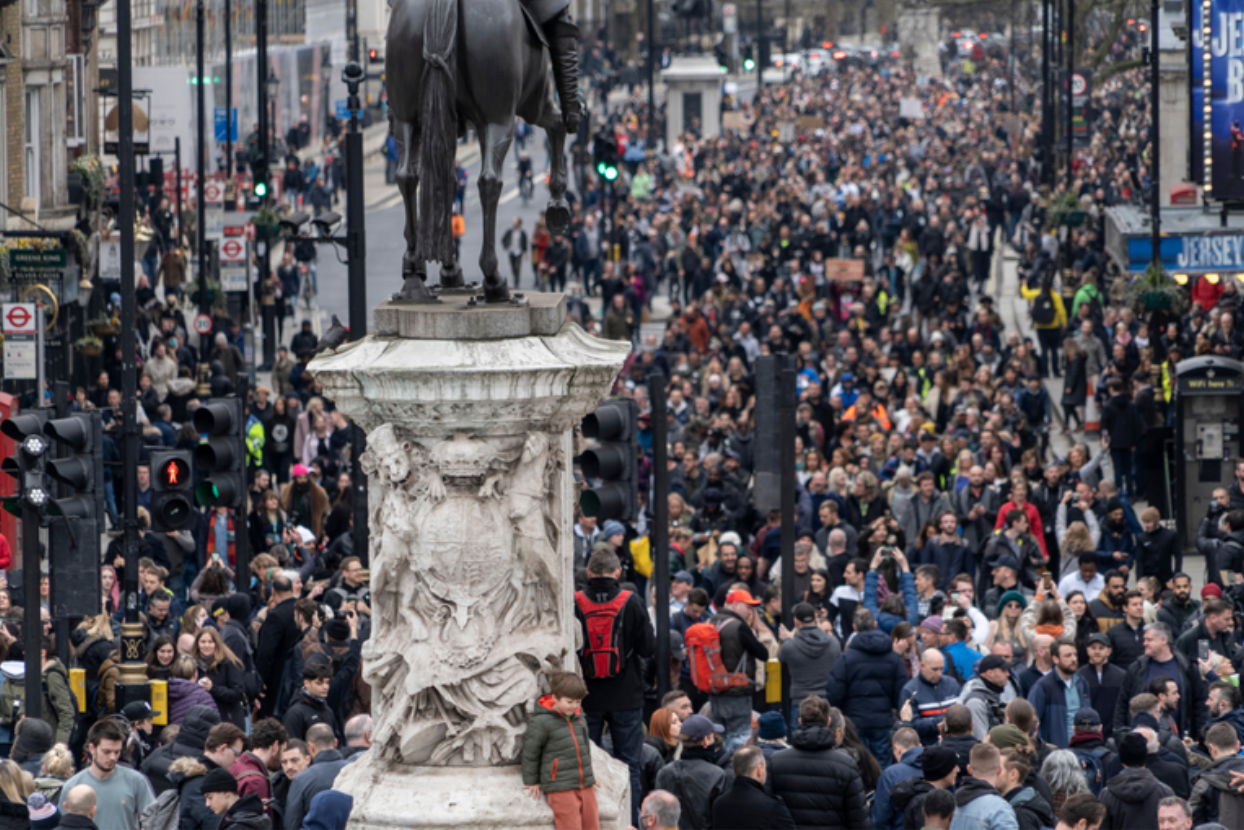
London demonstrates frequently, and on significant scale. The practical risk for tourists is rarely violence — it’s disruption. Blocked roads, crowded pavements, delayed buses, restricted access near Westminster, Hyde Park, or embassy areas.
Check routes before travelling through central London on major protest days. If you encounter a demonstration, don’t position yourself between opposing groups, don’t try to cross police lines, and move away calmly if the atmosphere shifts. Follow instructions from officers and transport staff.
On Public Transport
The network runs normally even during periods of elevated alert. British Transport Police, Metropolitan Police coordination, CCTV, and public reporting systems all operate continuously across the system.
Keep bags close, don’t leave luggage unattended — an unattended bag triggers security responses that cause real disruption — and stay aware on platforms and late-night carriages. If something feels off, move toward busier areas or staff points.
The Practical Summary
Is London safe for the vast majority of visitors? Yes. Absolutely. Tens of millions of people travel here annually and complete their visits without serious incident.
That said — London isn’t risk-free, and presenting it as such would be misleading. The threat environment is real, complex, and constantly reviewed. What makes London function well despite that is the quality of its security infrastructure, intelligence capability, emergency planning, and public awareness systems.
Stay alert in crowded spaces. Keep valuables secure. Don’t leave bags unattended. Follow police and transport staff instructions. Report anything that feels genuinely suspicious — the Anti-Terrorism Hotline is 0800 789 321, and 999 covers emergencies.
Beyond that, visit normally. The city is open, busy, and generally functioning exactly as it should.