

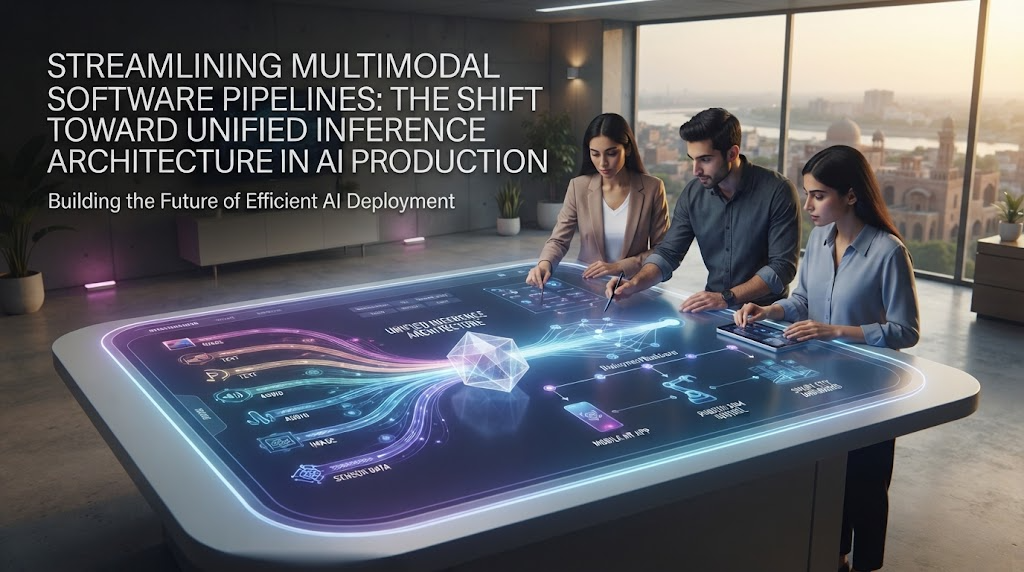
As artificial intelligence transitions from standalone novelty features into foundational software infrastructure, engineering teams worldwide are facing an unprecedented challenge in system design. Modern application development no longer relies on a single, monolithic language model. Instead, building production-grade software demands the orchestration of diverse, highly specialized neural networks capable of handling natural language processing, vector embeddings, high-resolution image synthesis, audio processing, and cinematic video generation.
While the rapid expansion of specialized models has unlocked significant creative and operational capabilities, it has simultaneously introduced severe integration bottlenecks for developer teams. Software engineers are increasingly forced to manage dozens of distinct third-party API connections, each accompanied by proprietary authentication methods, unique software development kits (SDKs), divergent rate-limiting rules, and independent billing structures.
To address this technical debt and streamline backend architecture, Atlas Cloud has introduced a unified inference API platform that consolidates access to over 400 multimodal AI models through a single, standardized interface.
The Engineering Challenge of API Sprawl in Generative Workflows
Building a competitive, AI-native application requires technical teams to select the optimal model for each specific task within a user workflow. A modern automated marketing or content creation platform, for example, might process user briefs with an advanced text model, generate scene concepts using a vision model, synthesize voiceover tracks via a text-to-speech engine, and render final motion assets using state-of-the-art video synthesis models.
In traditional development environments, executing this multi-step pipeline requires establishing and maintaining isolated network connections to multiple independent model providers. When an upstream vendor alters its payload schema, updates an SDK, or experiences service instability, backend engineers must spend valuable cycles debugging external dependencies rather than refining core product logic.
This friction is particularly evident in cutting-edge video generation workflows, where performance demands and architectural differences between models are substantial. Development teams building visual generation pipelines often need to leverage different tools for specific creative outcomes utilizing Seedance 2.5 for precise motion fidelity and structural continuity in complex animations, while simultaneously drawing upon Wan 3.0 for alternative visual styling or rapid frame rendering.
Under a fragmented infrastructure model, combining these capabilities requires building separate API wrappers, managing parallel credential stores, and writing custom logic to handle disparate response formats. By centralizing access to these models behind a single endpoint, unified inference platforms allow developers to invoke distinct model architectures seamlessly without altering their underlying integration framework.
Simplifying Integration via OpenAI-Compatible Standards
A primary hurdle in adopting new infrastructure is the engineering overhead associated with learning proprietary API specifications. To eliminate this onboarding friction, unified inference platforms prioritize backward compatibility with industry-standard protocols. By implementing a standardized schema modeled after the widely adopted OpenAI API specification, Atlas Cloud enables development teams to integrate hundreds of diverse models without rewriting core application logic.
For software engineers, this architectural compatibility transforms model switching from a multi-day refactoring task into a simple configuration update. Switching an application’s backend from a legacy text model to a newly released open-source alternative requires altering only a base URL string and specifying the new model identifier.
Payload structures, request headers, and response parsing logic remain identical across text, image, and video endpoints. This standardization dramatically lowers the switching cost between models, allowing development teams to remain agile and adapt their software stacks as new state-of-the-art architectures emerge.
Accelerating the Iterative Prototyping and Benchmarking Lifecycle
The software development lifecycle for AI-powered features relies heavily on empirical testing. Prior to pushing a feature into production, product managers and machine learning engineers must evaluate multiple candidate models to determine which engine provides the optimal balance of output quality, execution speed, and compute expenditure for their specific domain.
In an unintegrated development environment, benchmarking five competing models across three separate providers requires building five distinct integration pipelines and setting up individual developer accounts with each vendor. A consolidated inference framework condenses this evaluation phase significantly:
- Parallel Prompting: Engineers can send identical input payloads to multiple text, image, or video models simultaneously through a single gateway to compare output quality in real time.
- Normalized Telemetry: Performance metrics, response latency, and token utilization data are standardized across all 400+ models, providing clear, unbiased benchmarking data.
- Frictionless Staging-to-Production Transitions: Once an optimal model is selected during sandbox testing, pushing the feature to production requires no additional infrastructure provisioning, as the unified API gateway automatically manages request routing and scaling.
Centralizing Governance, Security, and Administrative Overhead
Beyond the technical benefits realized by software developers, multi-vendor API sprawl introduces significant administrative, operational, and security risks for enterprise organizations. Managing scattered developer accounts across dozens of vendor portals complicates IT security auditing and exposes companies to credential leakage.
Centralizing inference access through a single, secure gateway establishes a robust perimeter for data governance and financial control:
Unified Credential Management: Security teams can issue, rotate, or restrict API access keys across all supported models from a single centralized management console, minimizing the attack surface associated with distributed API tokens.
Comprehensive Usage Auditing: IT administrators gain real-time visibility into all incoming and outgoing data flows, simplifying compliance verification for strict data protection frameworks such as GDPR, HIPAA, and SOC 2.
Consolidated Financial Operations: Finance departments replace dozens of scattered micro-transactions and unpredictable vendor invoices with a single, predictable monthly ledger covering all model usage across the organization.
Decoupling Product Logic from Provider Dependency
The artificial intelligence research landscape moves at an unprecedented pace. Model architectures that represent the industry benchmark today may be surpassed within months by specialized open-source alternatives or next-generation proprietary networks. Companies that tightly couple their application architecture to a single model provider risk technological stagnation and vendor lock-in.
Decoupling the application layer from specific model vendors via a unified API provides essential long-term resilience. As new generative models are released, evaluated, and deployed globally, they are integrated directly into the unified platform ecosystem. Engineering teams can immediately incorporate these technological advancements into their commercial applications without undergoing lengthy procurement cycles or refactoring backend code.
As multimodal AI applications continue to mature, the software tools used to build and scale them must prioritize developer efficiency, architectural stability, and operational predictability. By replacing fragmented vendor connections with a single, highly scalable access point, unified API platforms are establishing the structural blueprint for modern, resilient software engineering.
Media Contact Information
For journalists, technology analysts, and software engineering leaders seeking further details regarding unified API frameworks, platform documentation, or media inquiries, please contact the representative listed below:
- Contact Person: Carol Weng
- Email: carol.weng@atlascloud.ai
- Company Name: Atlas Cloud